The Sun Puzzle Crossword
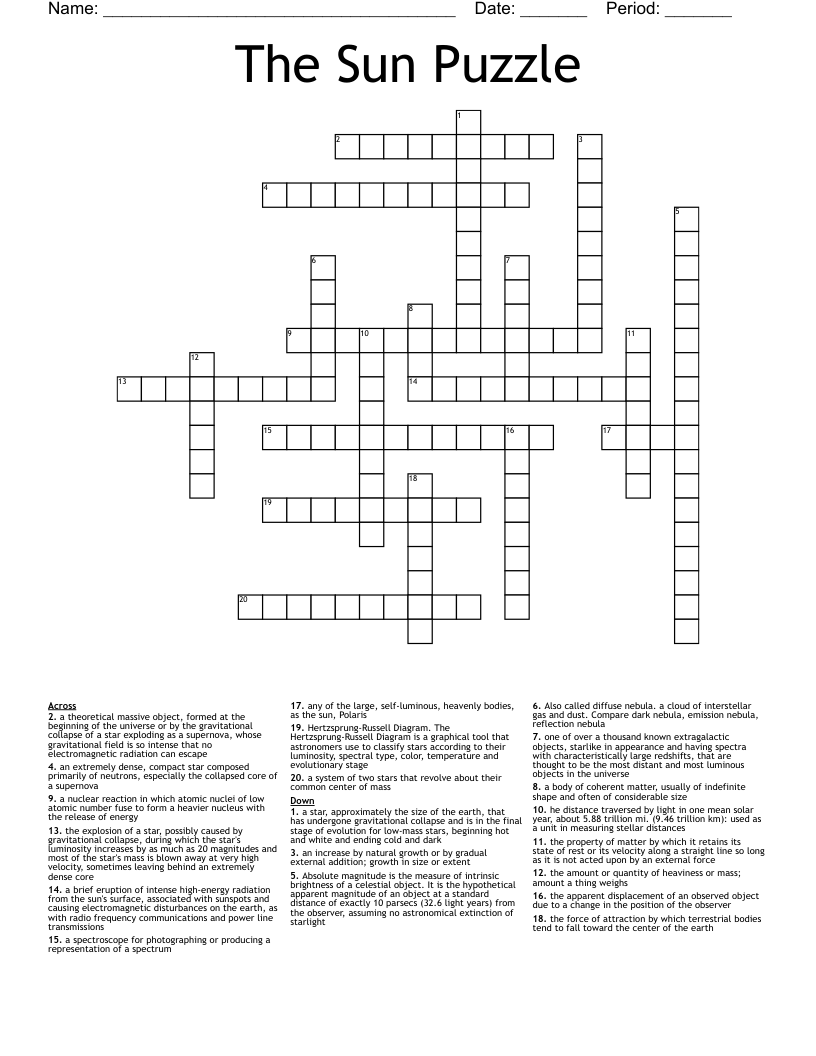
This printable crossword puzzle on the topic of Astronomy & Space has 20 clues. Answers range from 4 to 18 letters long. This crossword is also available to download as a Microsoft Word document or a PDF.
Description
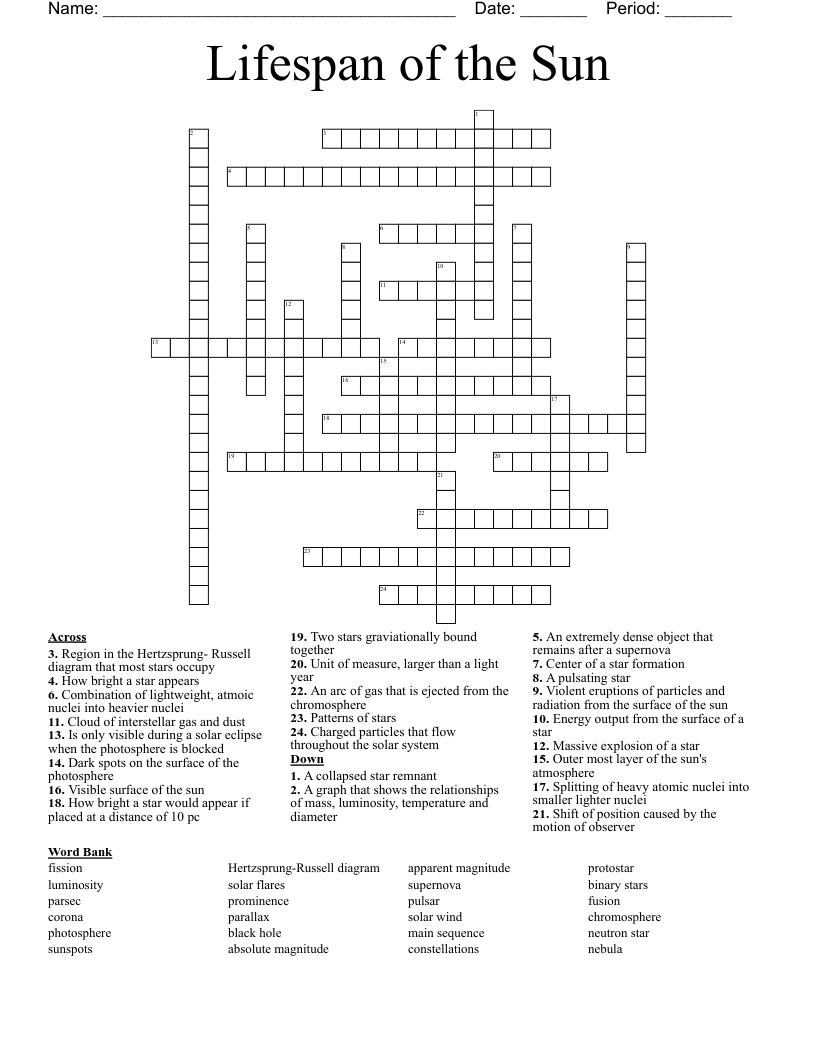
the apparent displacement of an observed object due to a change in the position of the observer
he distance traversed by light in one mean solar year, about 5.88 trillion mi. (9.46 trillion km): used as a unit in measuring stellar distances
a nuclear reaction in which atomic nuclei of low atomic number fuse to form a heavier nucleus with the release of energy
any of the large, self-luminous, heavenly bodies, as the sun, Polaris
a system of two stars that revolve about their common center of mass
one of over a thousand known extragalactic objects, starlike in appearance and having spectra with characteristically large redshifts, that are thought to be the most distant and most luminous objects in the universe
the force of attraction by which terrestrial bodies tend to fall toward the center of the earth
the property of matter by which it retains its state of rest or its velocity along a straight line so long as it is not acted upon by an external force
a brief eruption of intense high-energy radiation from the sun's surface, associated with sunspots and causing electromagnetic disturbances on the earth, as with radio frequency communications and power line transmissions
a spectroscope for photographing or producing a representation of a spectrum
Absolute magnitude is the measure of intrinsic brightness of a celestial object. It is the hypothetical apparent magnitude of an object at a standard distance of exactly 10 parsecs (32.6 light years) from the observer, assuming no astronomical extinction of starlight
Hertzsprung-Russell Diagram. The Hertzsprung-Russell Diagram is a graphical tool that astronomers use to classify stars according to their luminosity, spectral type, color, temperature and evolutionary stage
Also called diffuse nebula. a cloud of interstellar gas and dust. Compare dark nebula, emission nebula, reflection nebula
a star, approximately the size of the earth, that has undergone gravitational collapse and is in the final stage of evolution for low-mass stars, beginning hot and white and ending cold and dark
the explosion of a star, possibly caused by gravitational collapse, during which the star's luminosity increases by as much as 20 magnitudes and most of the star's mass is blown away at very high velocity, sometimes leaving behind an extremely dense core
a theoretical massive object, formed at the beginning of the universe or by the gravitational collapse of a star exploding as a supernova, whose gravitational field is so intense that no electromagnetic radiation can escape
an extremely dense, compact star composed primarily of neutrons, especially the collapsed core of a supernova
an increase by natural growth or by gradual external addition; growth in size or extent
a body of coherent matter, usually of indefinite shape and often of considerable size
the amount or quantity of heaviness or mass; amount a thing weighs