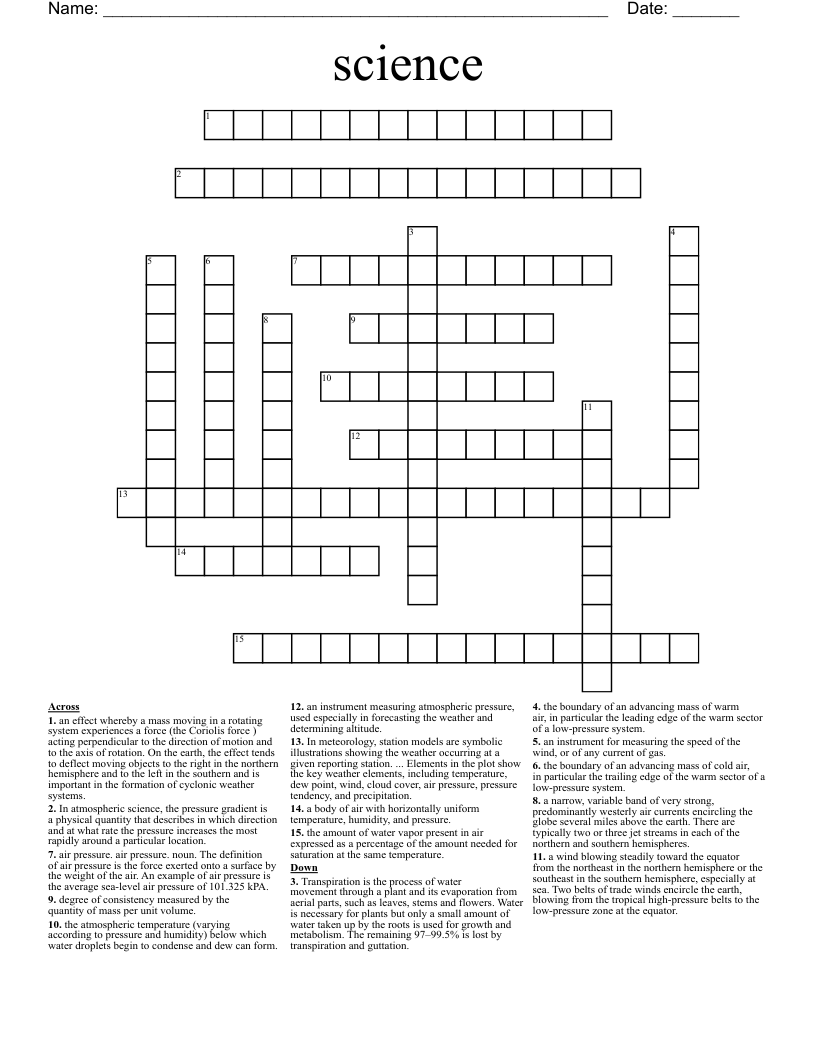
science Crossword
This printable crossword puzzle on the topic of Weather & Climate has 15 clues. Answers range from 7 to 19 letters long. This crossword is also available to download as a Microsoft Word document or a PDF.
Description
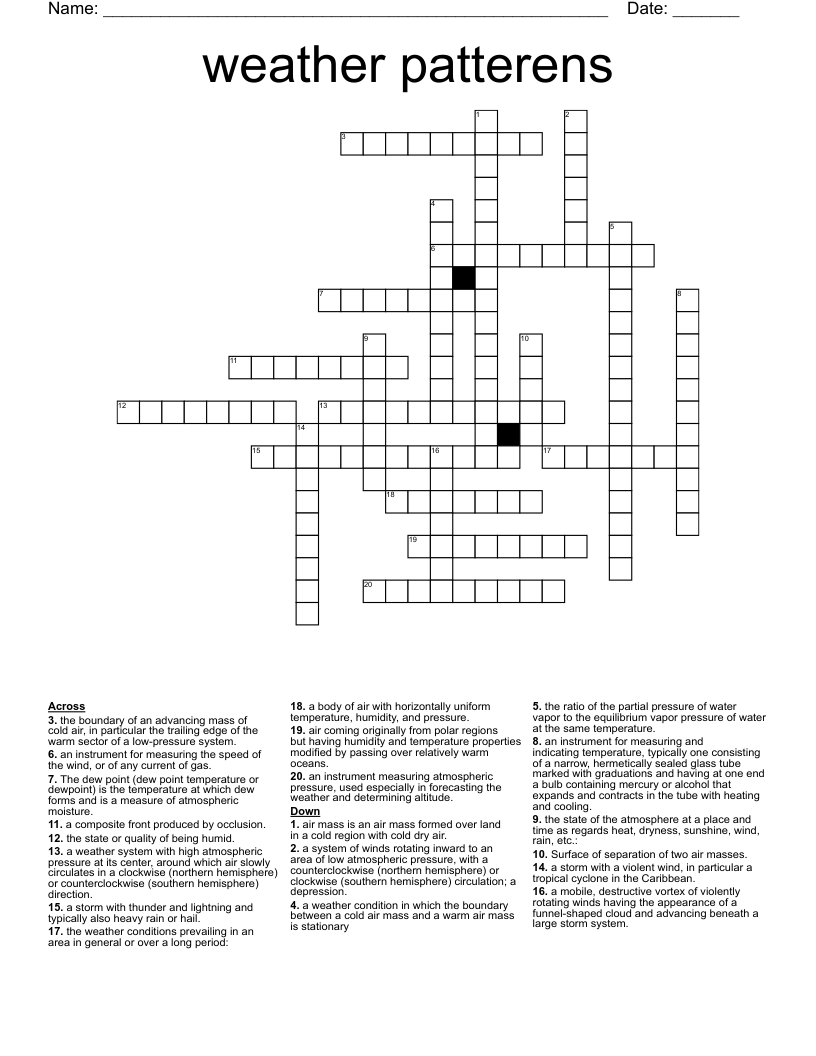
an instrument for measuring the speed of the wind, or of any current of gas.
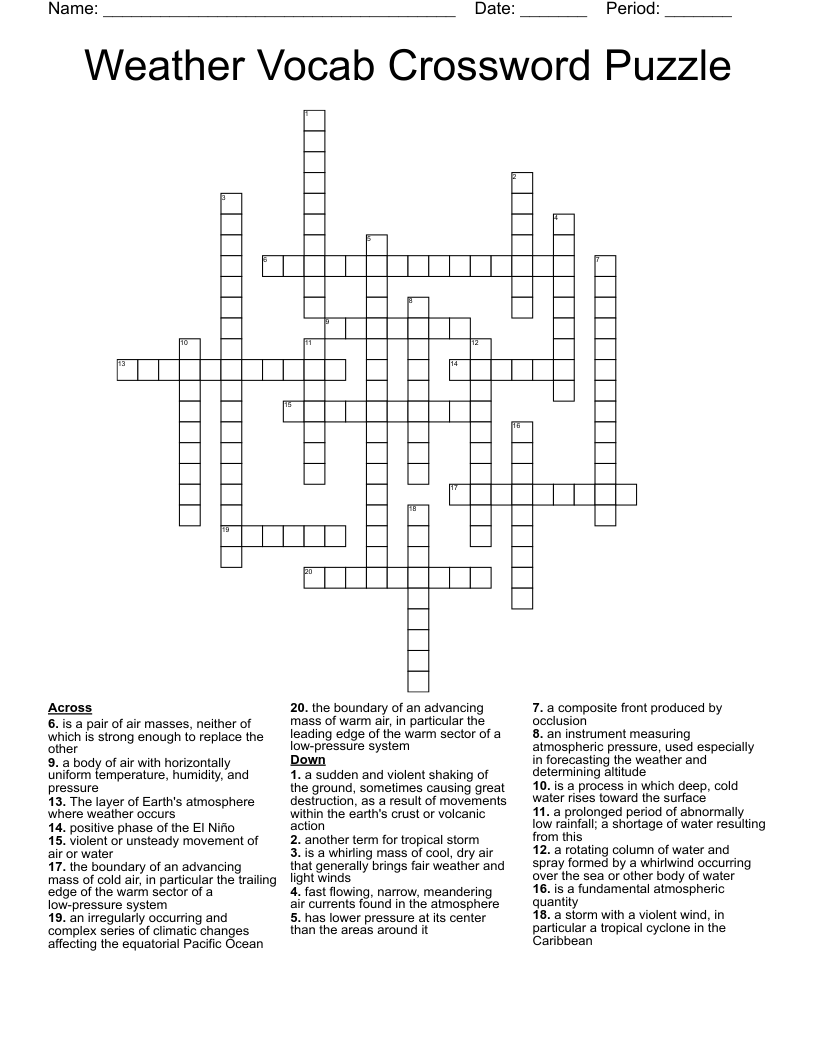
an instrument measuring atmospheric pressure, used especially in forecasting the weather and determining altitude.
In meteorology, station models are symbolic illustrations showing the weather occurring at a given reporting station. ... Elements in the plot show the key weather elements, including temperature, dew point, wind, cloud cover, air pressure, pressure tendency, and precipitation.
In atmospheric science, the pressure gradient is a physical quantity that describes in which direction and at what rate the pressure increases the most rapidly around a particular location.
the atmospheric temperature (varying according to pressure and humidity) below which water droplets begin to condense and dew can form.
the amount of water vapor present in air expressed as a percentage of the amount needed for saturation at the same temperature.
air pressure. air pressure. noun. The definition of air pressure is the force exerted onto a surface by the weight of the air. An example of air pressure is the average sea-level air pressure of 101.325 kPA.
degree of consistency measured by the quantity of mass per unit volume.
an effect whereby a mass moving in a rotating system experiences a force (the Coriolis force ) acting perpendicular to the direction of motion and to the axis of rotation. On the earth, the effect tends to deflect moving objects to the right in the northern hemisphere and to the left in the southern and is important in the formation of cyclonic weather systems.
Transpiration is the process of water movement through a plant and its evaporation from aerial parts, such as leaves, stems and flowers. Water is necessary for plants but only a small amount of water taken up by the roots is used for growth and metabolism. The remaining 97–99.5% is lost by transpiration and guttation.
a narrow, variable band of very strong, predominantly westerly air currents encircling the globe several miles above the earth. There are typically two or three jet streams in each of the northern and southern hemispheres.
a wind blowing steadily toward the equator from the northeast in the northern hemisphere or the southeast in the southern hemisphere, especially at sea. Two belts of trade winds encircle the earth, blowing from the tropical high-pressure belts to the low-pressure zone at the equator.
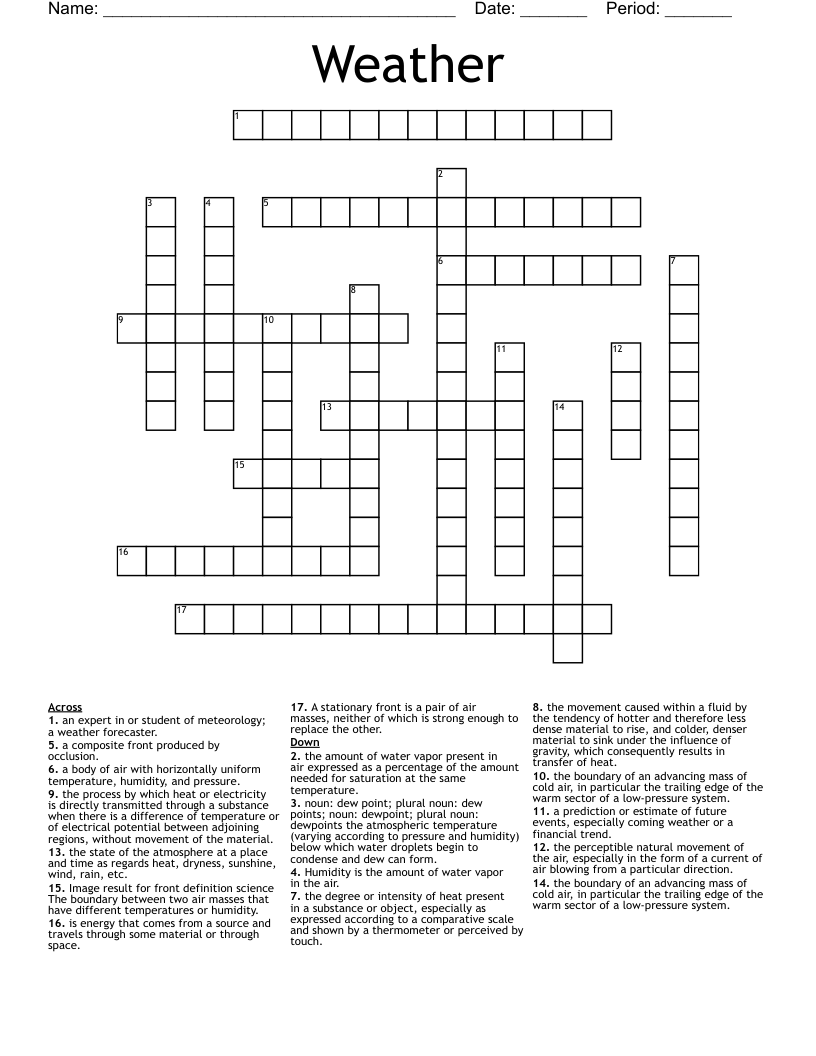
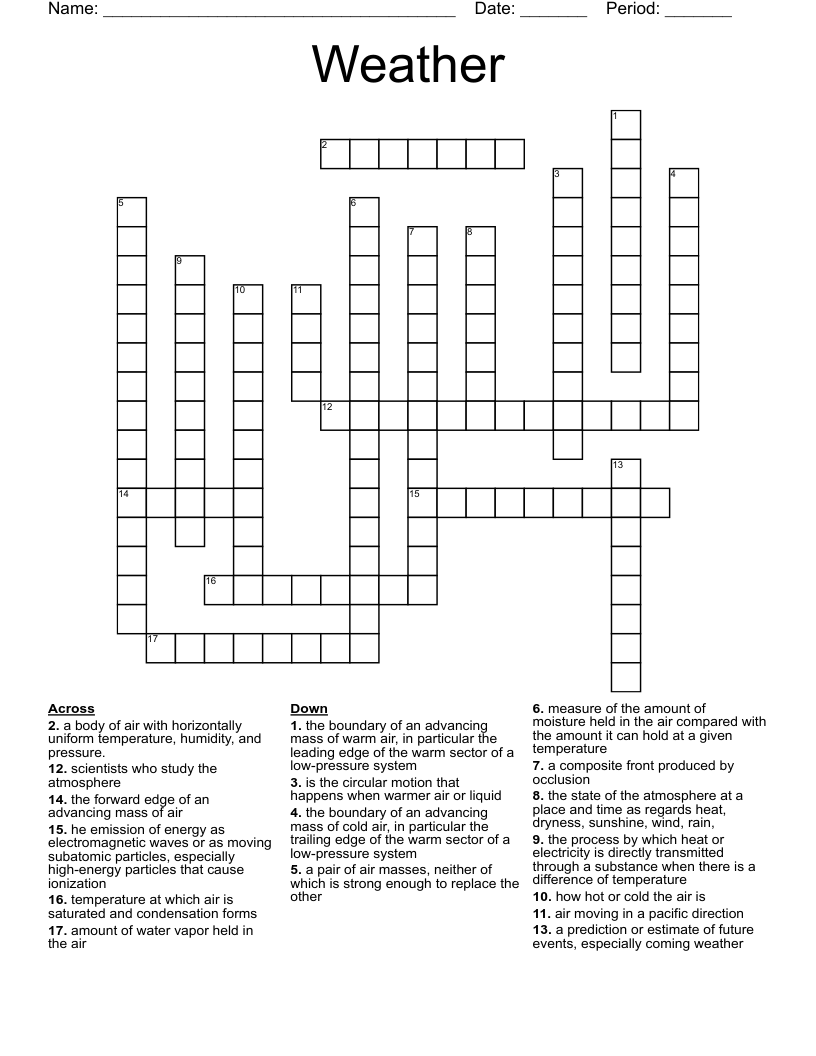
a body of air with horizontally uniform temperature, humidity, and pressure.
the boundary of an advancing mass of cold air, in particular the trailing edge of the warm sector of a low-pressure system.
the boundary of an advancing mass of warm air, in particular the leading edge of the warm sector of a low-pressure system.