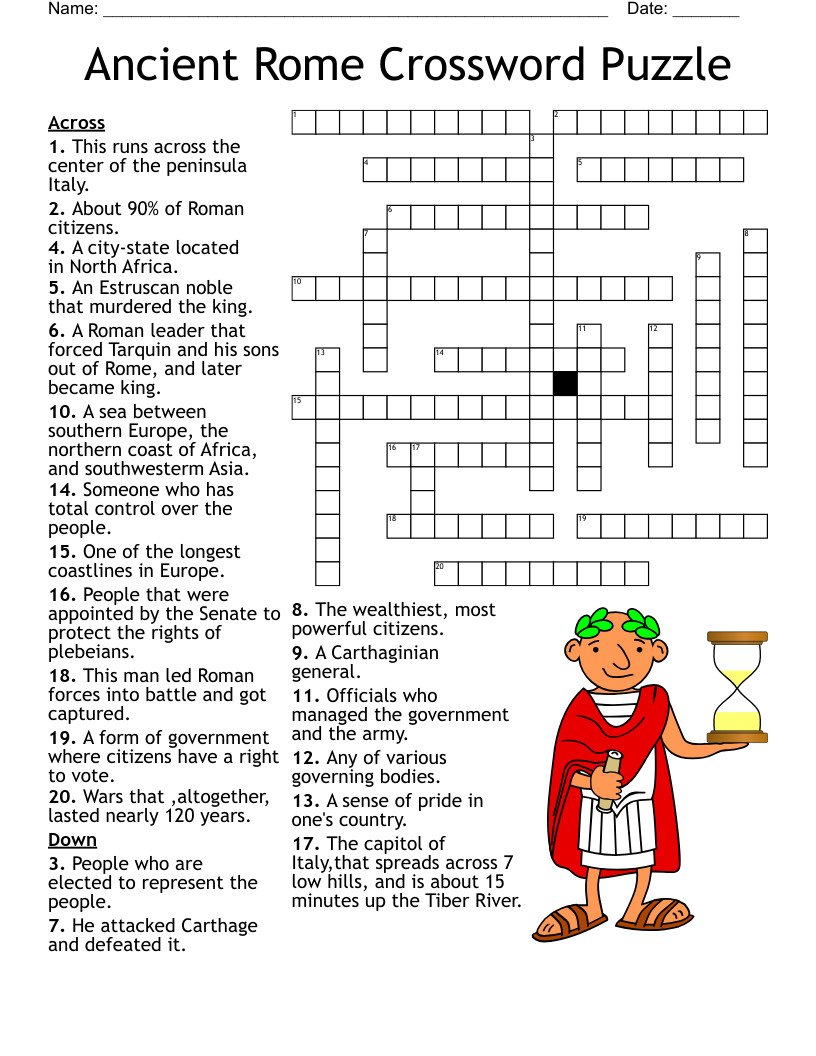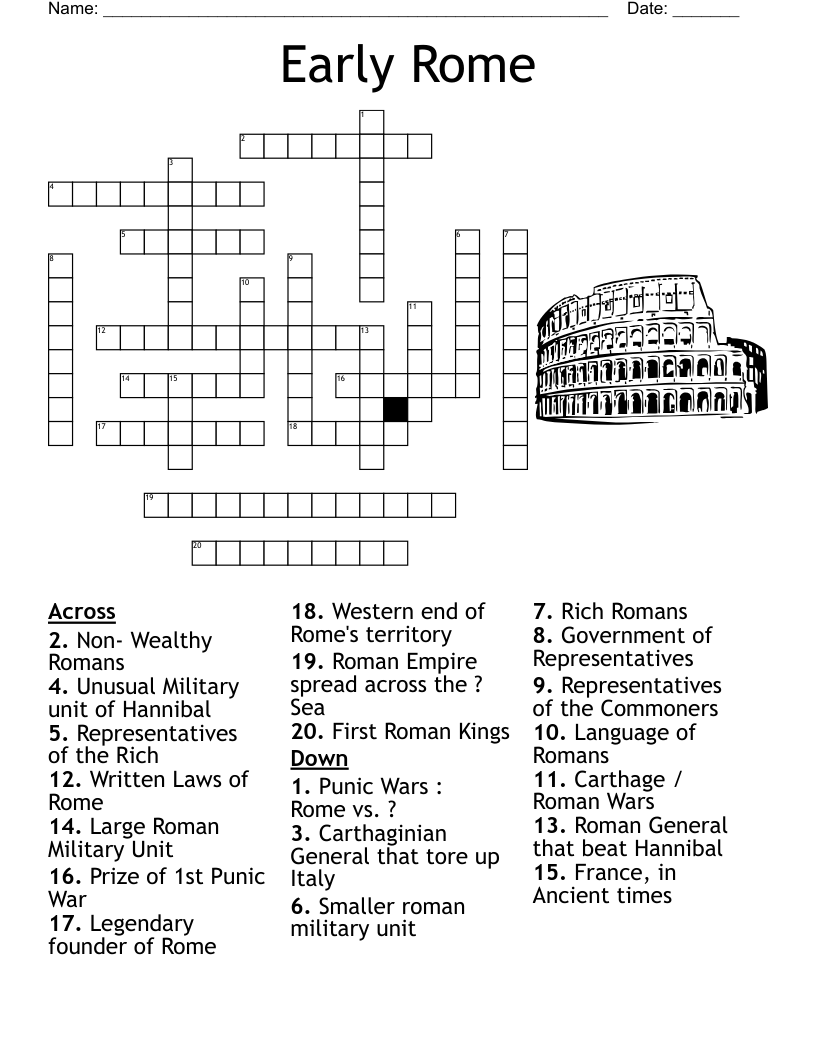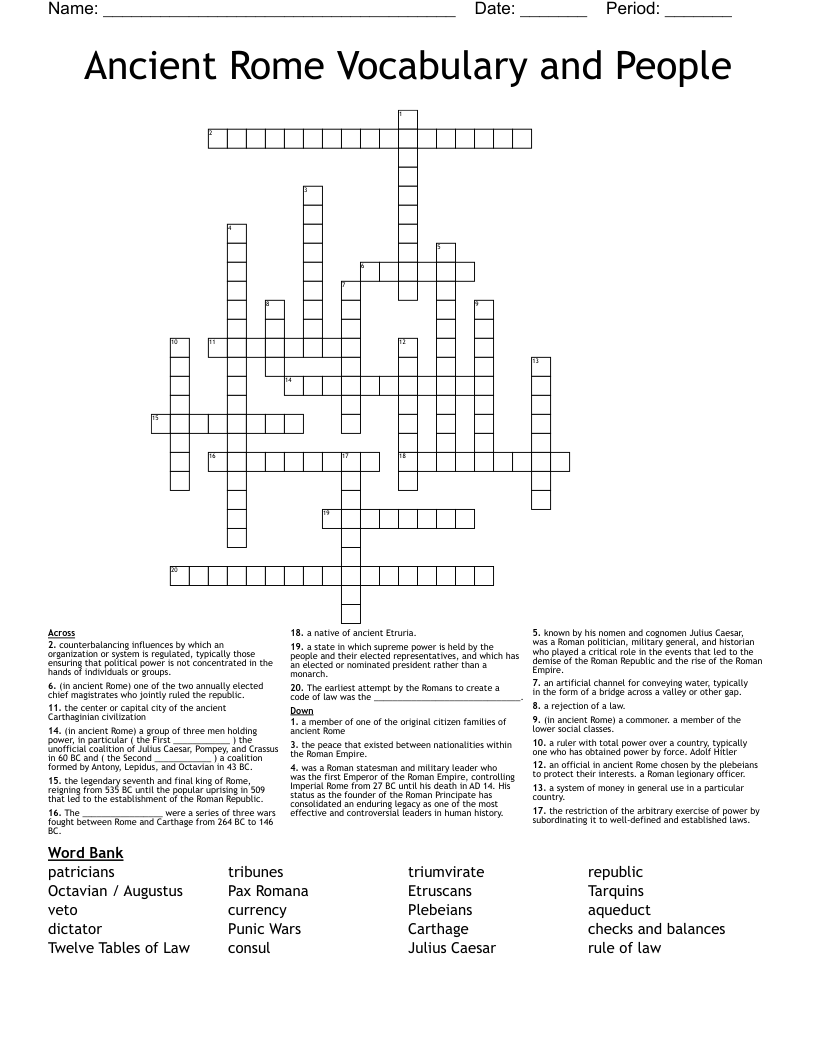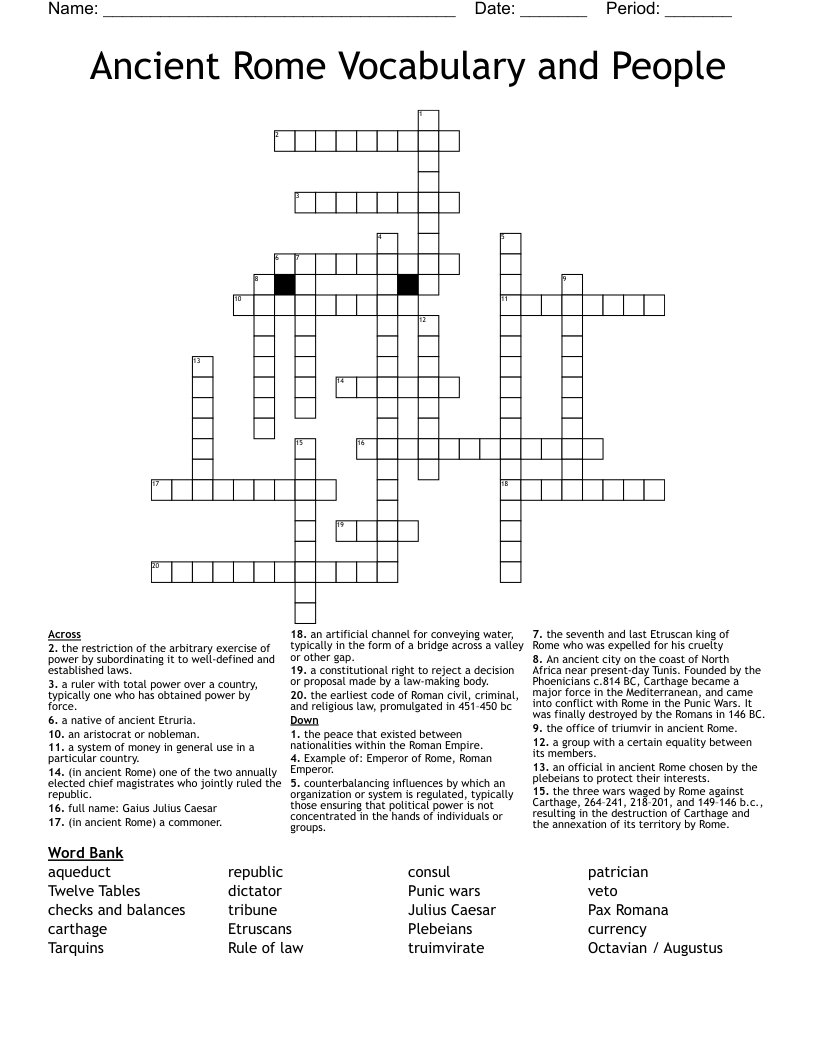
Ancient Rome- Vocabulary and People Crossword
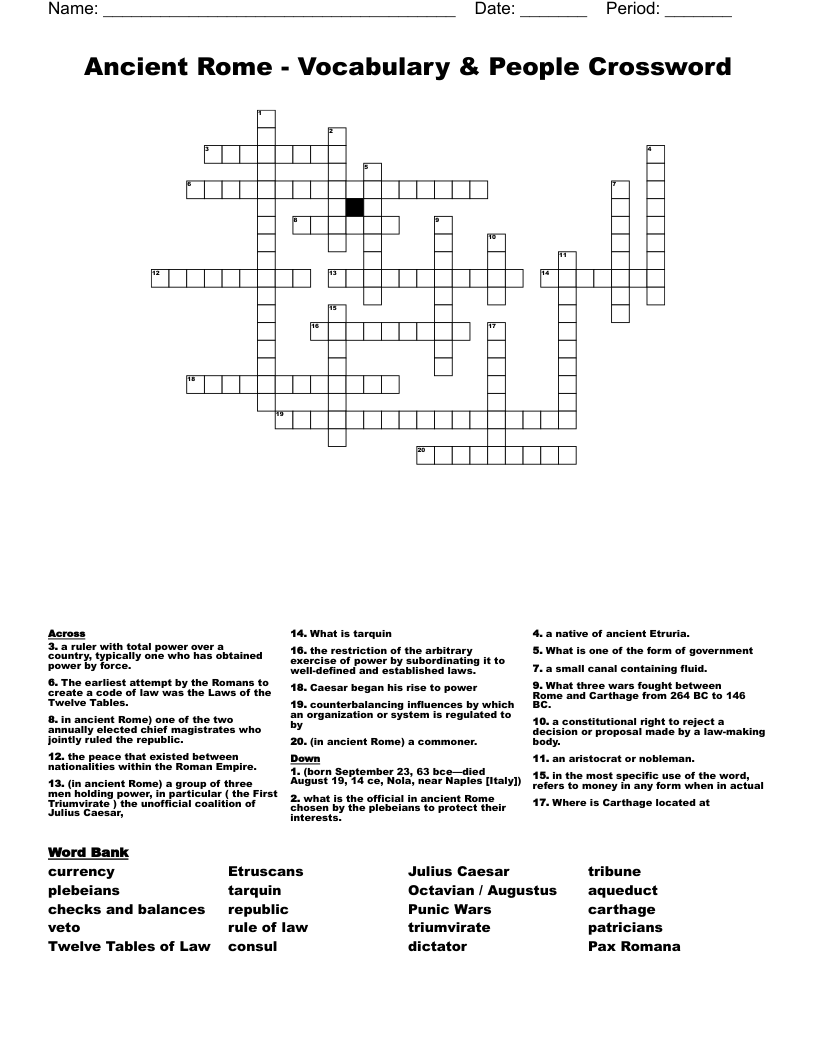
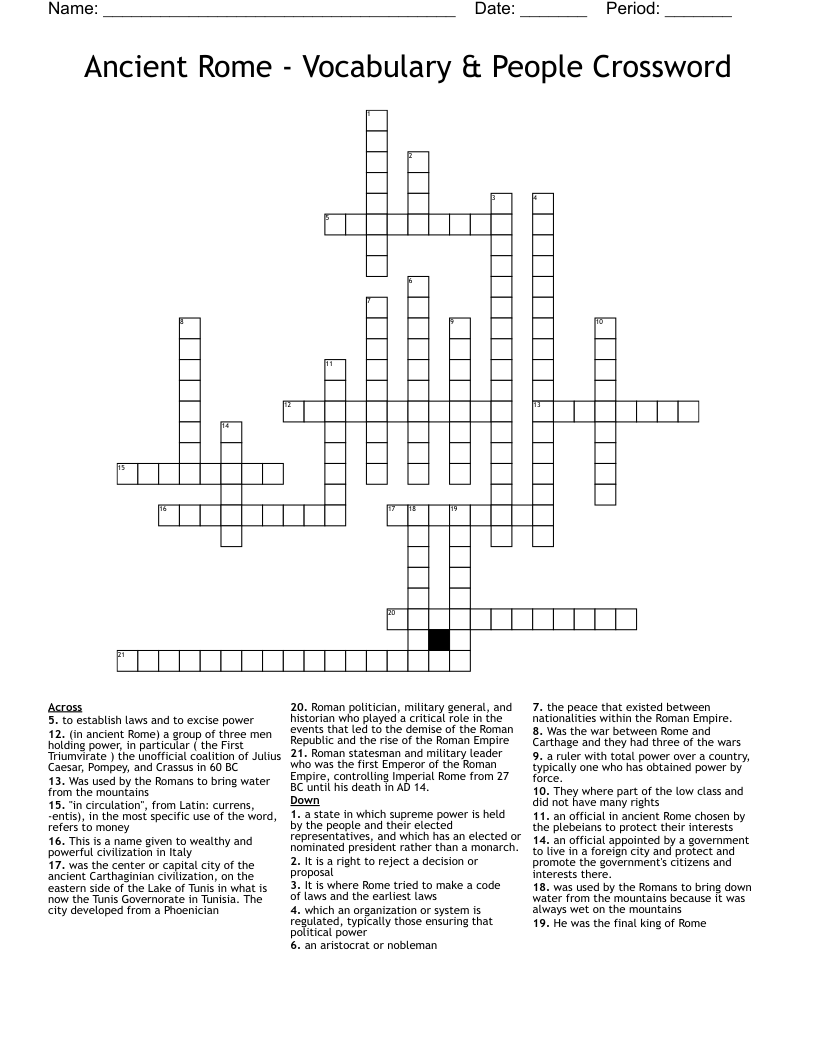
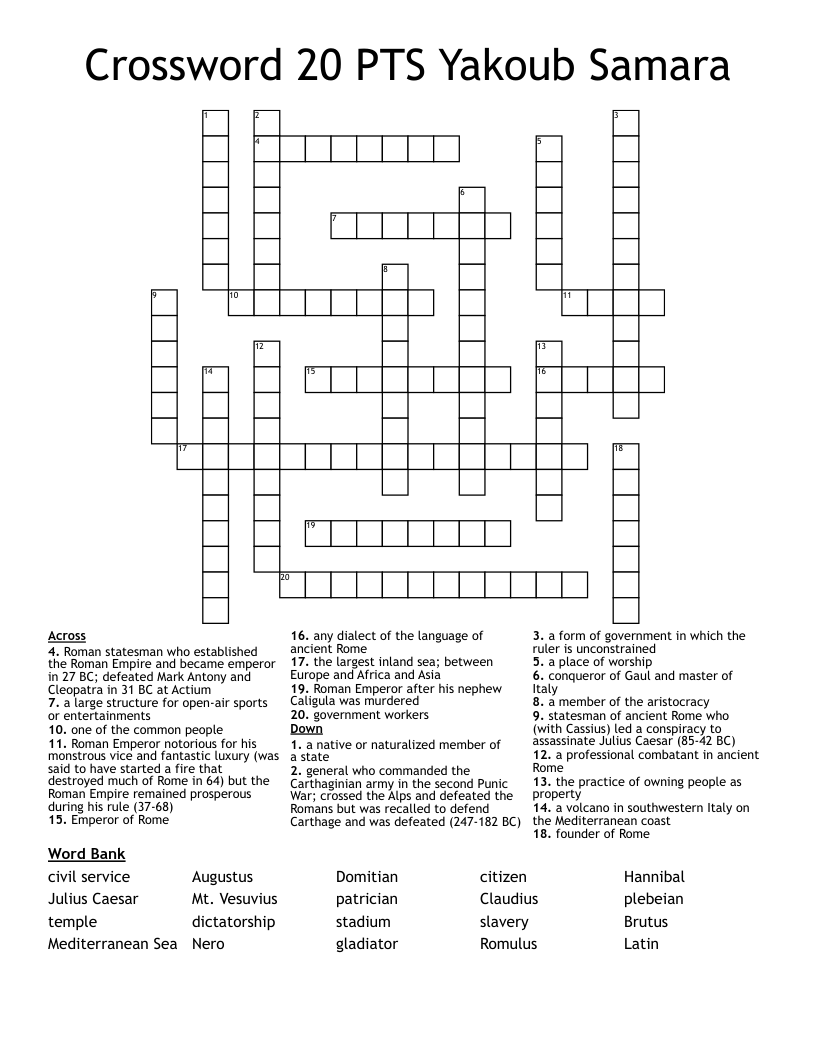
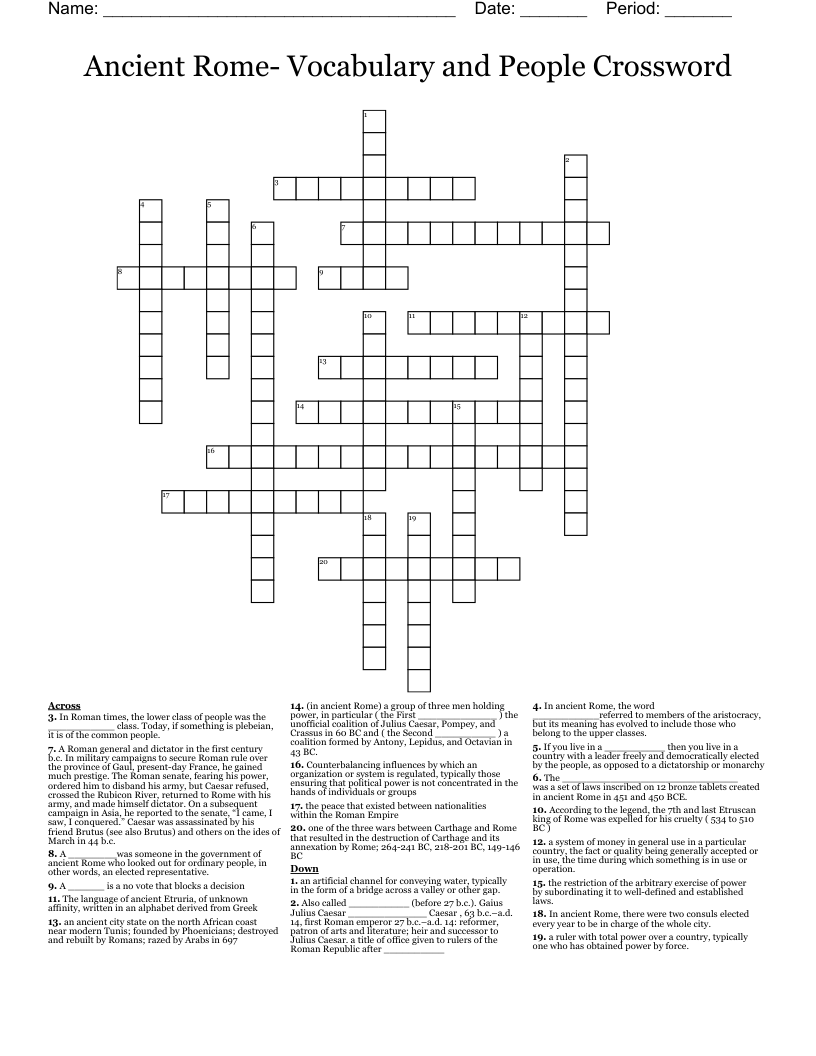
This printable crossword puzzle on the topic of Ancient Civilizations has 20 clues. Answers range from 4 to 17 letters long. This crossword is also available to download as a Microsoft Word document or a PDF.
Description
The language of ancient Etruria, of unknown affinity, written in an alphabet derived from Greek
According to the legend, the 7th and last Etruscan king of Rome was expelled for his cruelty ( 534 to 510 BC )
If you live in a __________ then you live in a country with a leader freely and democratically elected by the people, as opposed to a dictatorship or monarchy
Counterbalancing influences by which an organization or system is regulated, typically those ensuring that political power is not concentrated in the hands of individuals or groups
an ancient city state on the north African coast near modern Tunis; founded by Phoenicians; destroyed and rebuilt by Romans; razed by Arabs in 697
one of the three wars between Carthage and Rome that resulted in the destruction of Carthage and its annexation by Rome; 264-241 BC, 218-201 BC, 149-146 BC
In ancient Rome, the word ___________referred to members of the aristocracy, but its meaning has evolved to include those who belong to the upper classes.
In Roman times, the lower class of people was the ___________ class. Today, if something is plebeian, it is of the common people.
In ancient Rome, there were two consuls elected every year to be in charge of the whole city.
A ________was someone in the government of ancient Rome who looked out for ordinary people, in other words, an elected representative.
A ______ is a no vote that blocks a decision
The _____________________________ was a set of laws inscribed on 12 bronze tablets created in ancient Rome in 451 and 450 BCE.
the restriction of the arbitrary exercise of power by subordinating it to well-defined and established laws.
a ruler with total power over a country, typically one who has obtained power by force.
A Roman general and dictator in the first century b.c. In military campaigns to secure Roman rule over the province of Gaul, present-day France, he gained much prestige. The Roman senate, fearing his power, ordered him to disband his army, but Caesar refused, crossed the Rubicon River, returned to Rome with his army, and made himself dictator. On a subsequent campaign in Asia, he reported to the senate, “I came, I saw, I conquered.” Caesar was assassinated by his friend Brutus (see also Brutus) and others on the ides of March in 44 b.c.
(in ancient Rome) a group of three men holding power, in particular ( the First _____________ ) the unofficial coalition of Julius Caesar, Pompey, and Crassus in 60 BC and ( the Second __________ ) a coalition formed by Antony, Lepidus, and Octavian in 43 BC.
Also called __________ (before 27 b.c.). Gaius Julius Caesar _____________ Caesar , 63 b.c.–a.d. 14, first Roman emperor 27 b.c.–a.d. 14: reformer, patron of arts and literature; heir and successor to Julius Caesar. a title of office given to rulers of the Roman Republic after __________
the peace that existed between nationalities within the Roman Empire
an artificial channel for conveying water, typically in the form of a bridge across a valley or other gap.
a system of money in general use in a particular country, the fact or quality being generally accepted or in use, the time during which something is in use or operation.