Immigration In Education Worksheet
This printable matching worksheet on the topic of US History (General) has 15 questions and answers to match. This matching worksheet is also available to download as a Microsoft Word document or a PDF.
Description
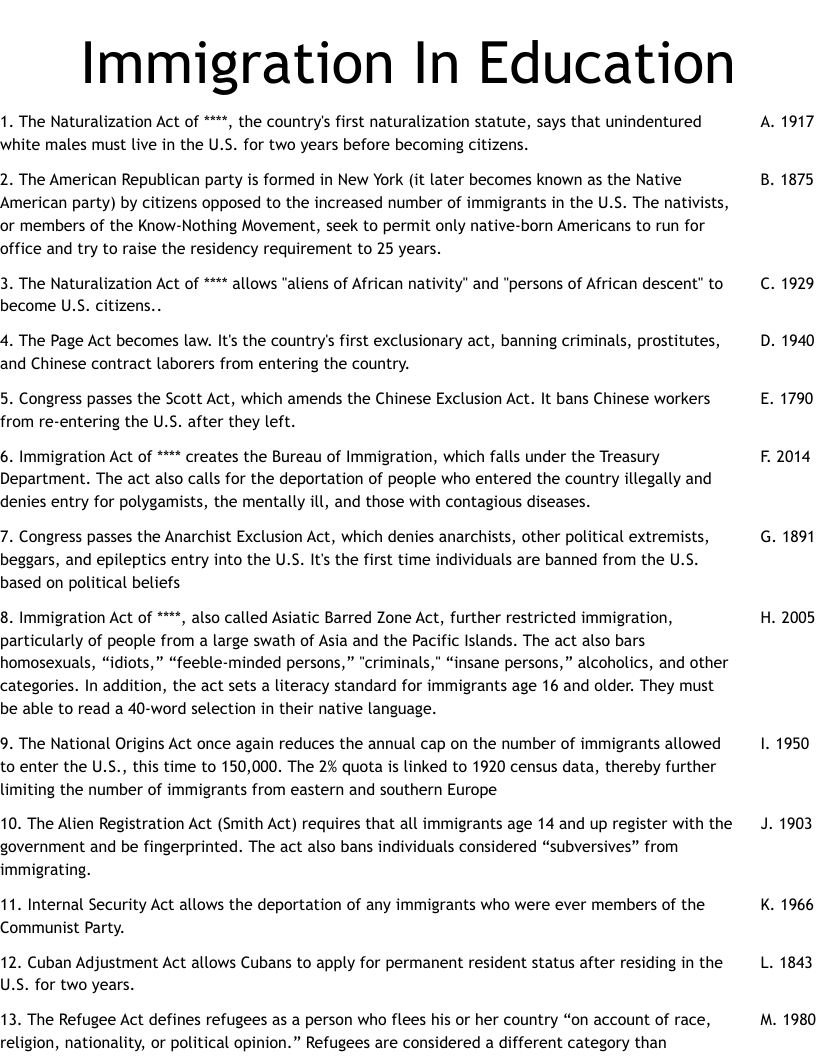
The Naturalization Act of ****, the country's first naturalization statute, says that unindentured white males must live in the U.S. for two years before becoming citizens.
The American Republican party is formed in New York (it later becomes known as the Native American party) by citizens opposed to the increased number of immigrants in the U.S. The nativists, or members of the Know-Nothing Movement, seek to permit only native-born Americans to run for office and try to raise the residency requirement to 25 years.
The Naturalization Act of **** allows "aliens of African nativity" and "persons of African descent" to become U.S. citizens..
The Page Act becomes law. It's the country's first exclusionary act, banning criminals, prostitutes, and Chinese contract laborers from entering the country.
Congress passes the Scott Act, which amends the Chinese Exclusion Act. It bans Chinese workers from re-entering the U.S. after they left.
Immigration Act of **** creates the Bureau of Immigration, which falls under the Treasury Department. The act also calls for the deportation of people who entered the country illegally and denies entry for polygamists, the mentally ill, and those with contagious diseases.
Congress passes the Anarchist Exclusion Act, which denies anarchists, other political extremists, beggars, and epileptics entry into the U.S. It's the first time individuals are banned from the U.S. based on political beliefs
Immigration Act of ****, also called Asiatic Barred Zone Act, further restricted immigration, particularly of people from a large swath of Asia and the Pacific Islands. The act also bars homosexuals, “idiots,” “feeble-minded persons,” "criminals," “insane persons,” alcoholics, and other categories. In addition, the act sets a literacy standard for immigrants age 16 and older. They must be able to read a 40-word selection in their native language.
The National Origins Act once again reduces the annual cap on the number of immigrants allowed to enter the U.S., this time to 150,000. The 2% quota is linked to 1920 census data, thereby further limiting the number of immigrants from eastern and southern Europe
The Alien Registration Act (Smith Act) requires that all immigrants age 14 and up register with the government and be fingerprinted. The act also bans individuals considered “subversives” from immigrating.
Internal Security Act allows the deportation of any immigrants who were ever members of the Communist Party.
Cuban Adjustment Act allows Cubans to apply for permanent resident status after residing in the U.S. for two years.
The Refugee Act defines refugees as a person who flees his or her country “on account of race, religion, nationality, or political opinion.” Refugees are considered a different category than immigrants. The president and Congress are granted the authority to establish an annual ceiling on the number of refugees allowed into the U.S. The act also lowers the annual limit of immigrants to 270,000, from 290,000.
The REAL ID Act of ****requires states to verify a person’s immigration status or citizenship before issuing licenses, expands restrictions on refugees requesting asylum, and limits the habeas corpus rights of immigrants.
On Nov. 20, ****, President Barack Obama announced he was taking executive action to delay the deportation of some 5 million illegal immigrants. Under the new policy people who are parents of U.S. citizens or legal residents will receive deportation deferrals and authorization to work legally if they have been in the U.S. for more than five years and pass background checks. Obama's action also amended the 2012 Deferred Action for Childhood Arrivals program, which allows people under age 31 who were brought to the U.S. as children to apply for two-year deportation deferrals and work permits. Obama's policy change lifted the age ceiling and added a year to the deferral period. Twenty-six states challenged the executive order, and in February 2015 a federal judge issued a preliminary injunction, temporarily blocking the provisions of the executive order while the states pursued a lawsuit to permanently shut down the program.