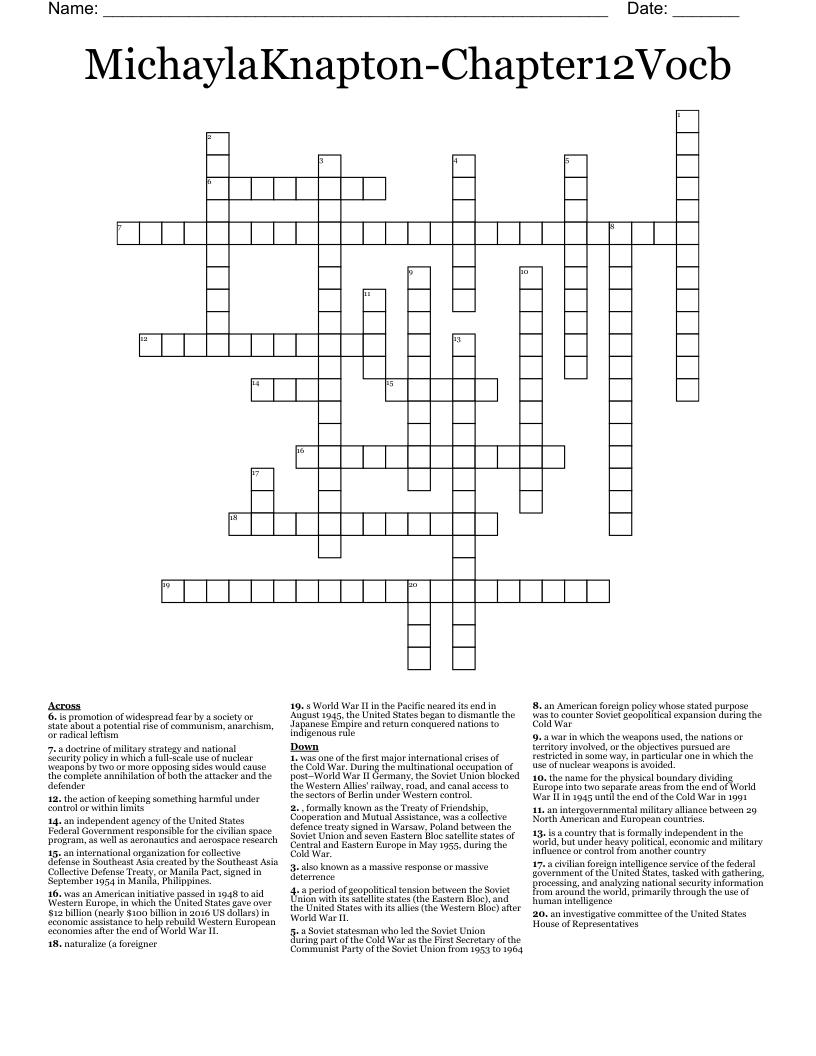
MichaylaKnapton-Chapter12Vocb Crossword
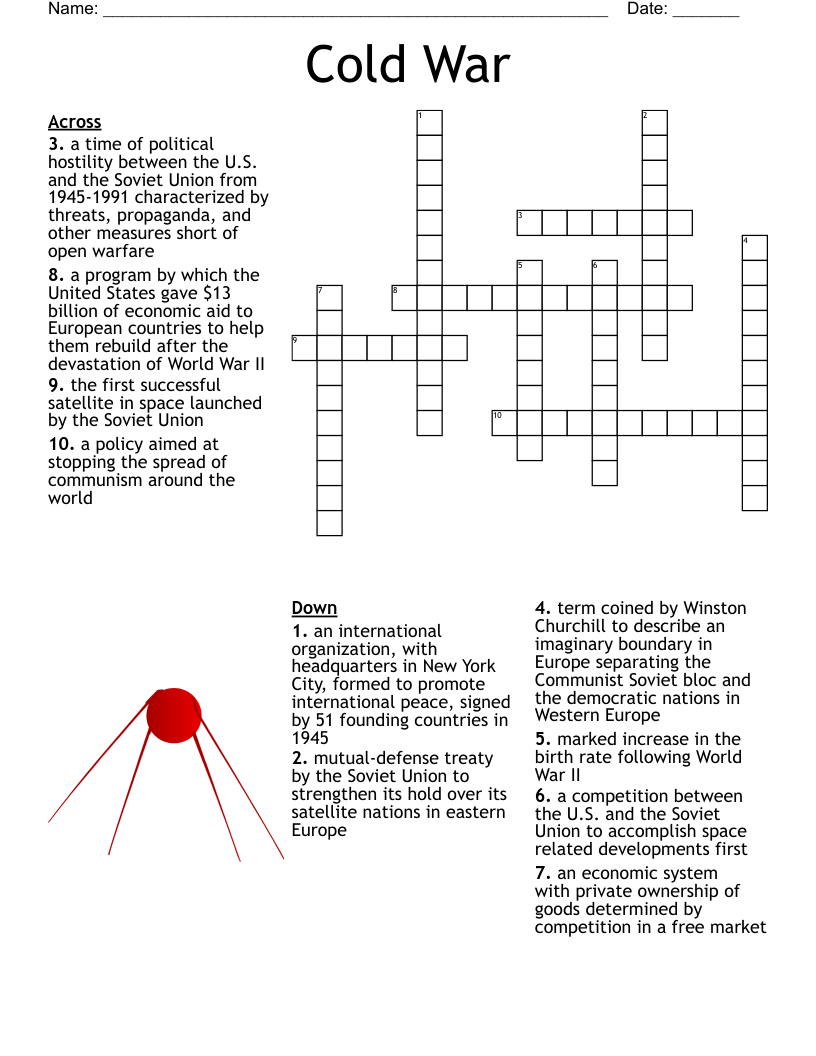
This printable crossword puzzle has 20 clues. Answers range from 3 to 26 letters long. This crossword is also available to download as a Microsoft Word document or a PDF.
Description
is a country that is formally independent in the world, but under heavy political, economic and military influence or control from another country
a period of geopolitical tension between the Soviet Union with its satellite states (the Eastern Bloc), and the United States with its allies (the Western Bloc) after World War II.
the name for the physical boundary dividing Europe into two separate areas from the end of World War II in 1945 until the end of the Cold War in 1991
an American foreign policy whose stated purpose was to counter Soviet geopolitical expansion during the Cold War
the action of keeping something harmful under control or within limits
was an American initiative passed in 1948 to aid Western Europe, in which the United States gave over $12 billion (nearly $100 billion in 2016 US dollars) in economic assistance to help rebuild Western European economies after the end of World War II.
was one of the first major international crises of the Cold War. During the multinational occupation of post–World War II Germany, the Soviet Union blocked the Western Allies' railway, road, and canal access to the sectors of Berlin under Western control.
an intergovernmental military alliance between 29 North American and European countries.
, formally known as the Treaty of Friendship, Cooperation and Mutual Assistance, was a collective defence treaty signed in Warsaw, Poland between the Soviet Union and seven Eastern Bloc satellite states of Central and Eastern Europe in May 1955, during the Cold War.
s World War II in the Pacific neared its end in August 1945, the United States began to dismantle the Japanese Empire and return conquered nations to indigenous rule
a war in which the weapons used, the nations or territory involved, or the objectives pursued are restricted in some way, in particular one in which the use of nuclear weapons is avoided.
an international organization for collective defense in Southeast Asia created by the Southeast Asia Collective Defense Treaty, or Manila Pact, signed in September 1954 in Manila, Philippines.
a doctrine of military strategy and national security policy in which a full-scale use of nuclear weapons by two or more opposing sides would cause the complete annihilation of both the attacker and the defender
also known as a massive response or massive deterrence
a Soviet statesman who led the Soviet Union during part of the Cold War as the First Secretary of the Communist Party of the Soviet Union from 1953 to 1964
naturalize (a foreigner
a civilian foreign intelligence service of the federal government of the United States, tasked with gathering, processing, and analyzing national security information from around the world, primarily through the use of human intelligence
an independent agency of the United States Federal Government responsible for the civilian space program, as well as aeronautics and aerospace research
is promotion of widespread fear by a society or state about a potential rise of communism, anarchism, or radical leftism
an investigative committee of the United States House of Representatives