American Revolution Crossword
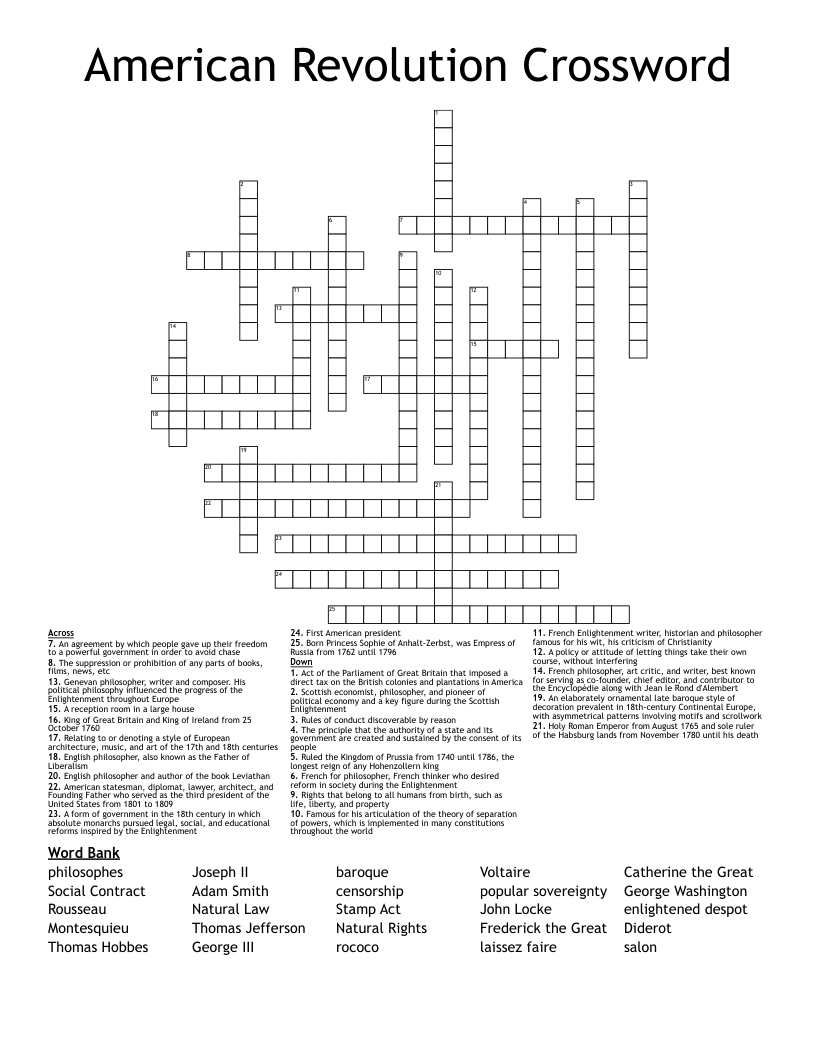
This printable crossword puzzle has 25 clues. Answers range from 5 to 18 letters long. This crossword is also available to download as a Microsoft Word document or a PDF.
Description
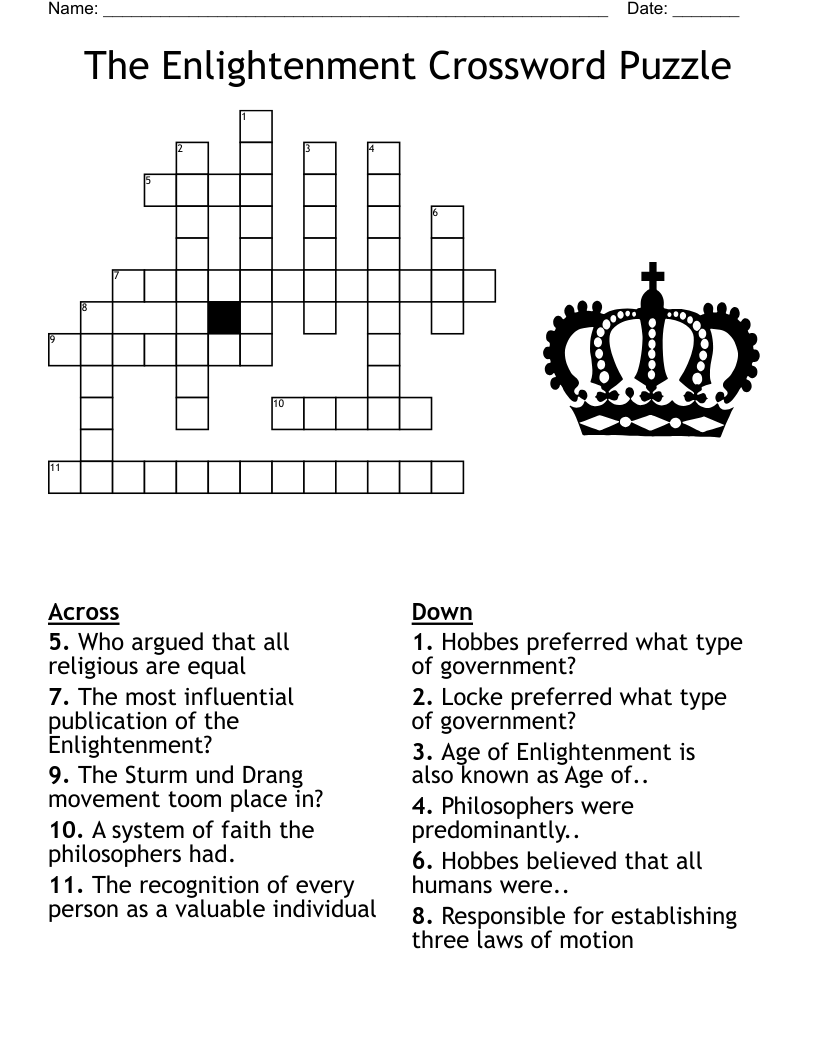
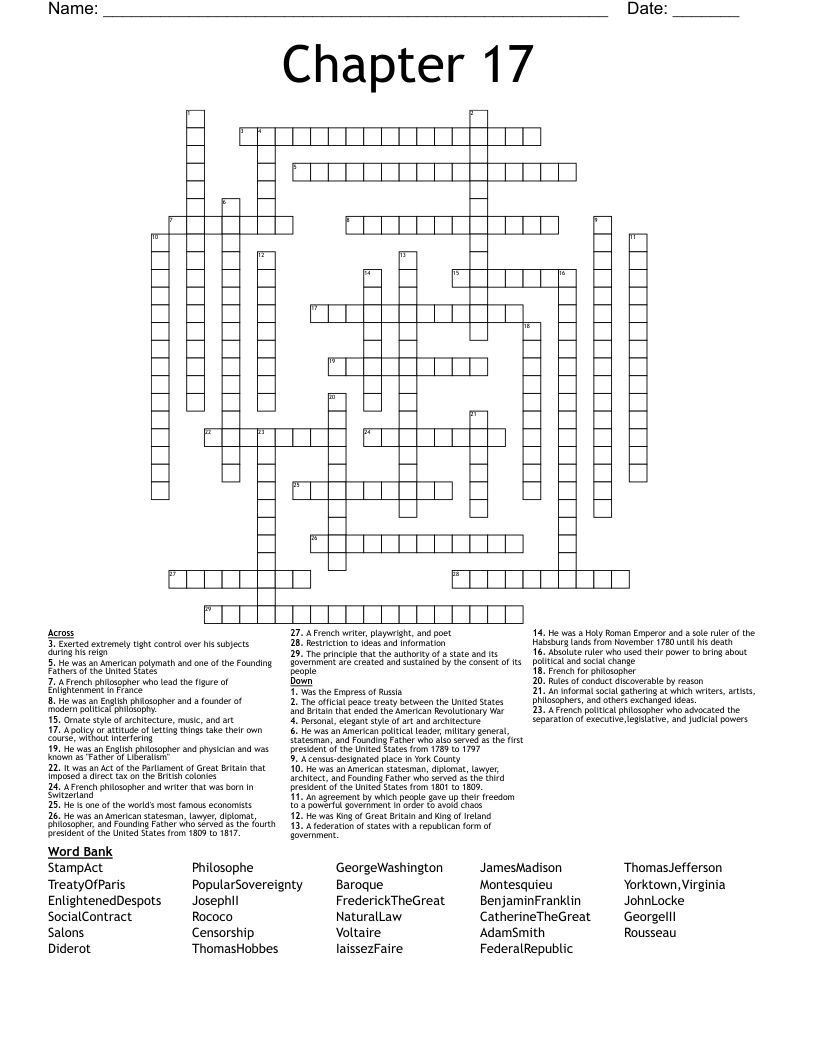
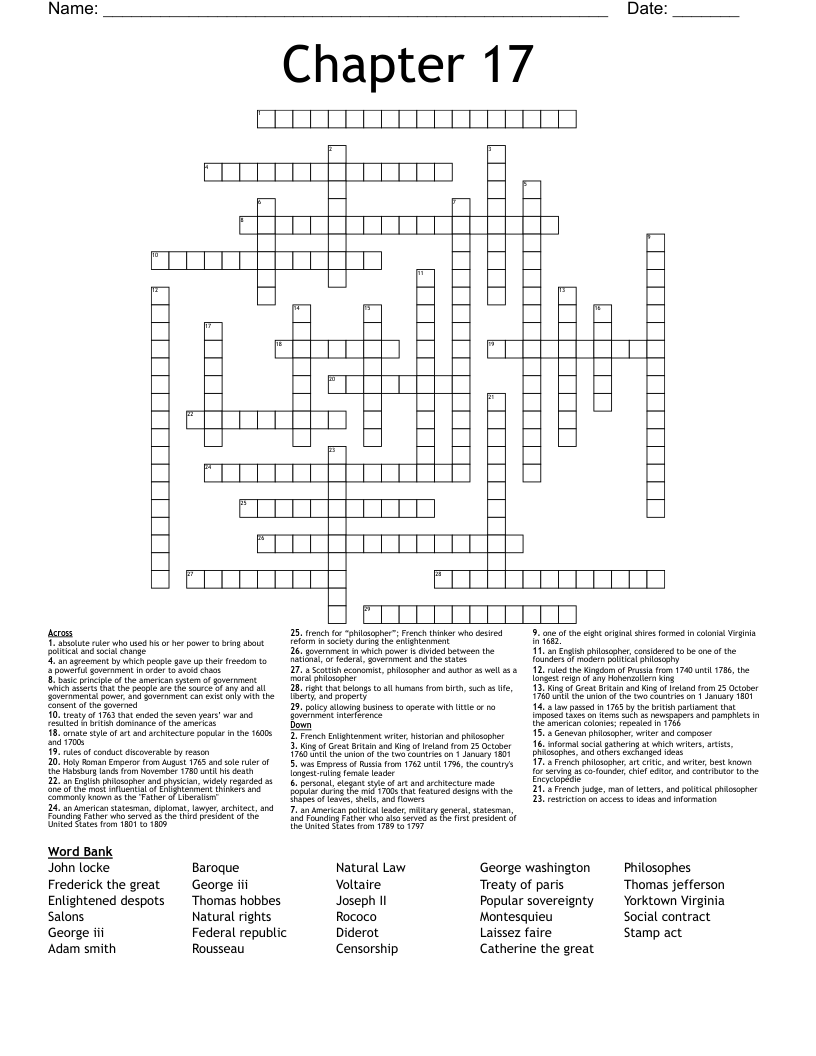
Rules of conduct discoverable by reason
English philosopher and author of the book Leviathan
English philosopher, also known as the Father of Liberalism
An agreement by which people gave up their freedom to a powerful government in order to avoid chase
Rights that belong to all humans from birth, such as life, liberty, and property
French for philosopher, French thinker who desired reform in society during the Enlightenment
Famous for his articulation of the theory of separation of powers, which is implemented in many constitutions throughout the world
French Enlightenment writer, historian and philosopher famous for his wit, his criticism of Christianity
French philosopher, art critic, and writer, best known for serving as co-founder, chief editor, and contributor to the Encyclopédie along with Jean le Rond d'Alembert
Genevan philosopher, writer and composer. His political philosophy influenced the progress of the Enlightenment throughout Europe
A policy or attitude of letting things take their own course, without interfering
Scottish economist, philosopher, and pioneer of political economy and a key figure during the Scottish Enlightenment
The suppression or prohibition of any parts of books, films, news, etc
A reception room in a large house
Relating to or denoting a style of European architecture, music, and art of the 17th and 18th centuries
An elaborately ornamental late baroque style of decoration prevalent in 18th-century Continental Europe, with asymmetrical patterns involving motifs and scrollwork
A form of government in the 18th century in which absolute monarchs pursued legal, social, and educational reforms inspired by the Enlightenment
Ruled the Kingdom of Prussia from 1740 until 1786, the longest reign of any Hohenzollern king
Born Princess Sophie of Anhalt-Zerbst, was Empress of Russia from 1762 until 1796
Holy Roman Emperor from August 1765 and sole ruler of the Habsburg lands from November 1780 until his death
King of Great Britain and King of Ireland from 25 October 1760
Act of the Parliament of Great Britain that imposed a direct tax on the British colonies and plantations in America
First American president
American statesman, diplomat, lawyer, architect, and Founding Father who served as the third president of the United States from 1801 to 1809
The principle that the authority of a state and its government are created and sustained by the consent of its people