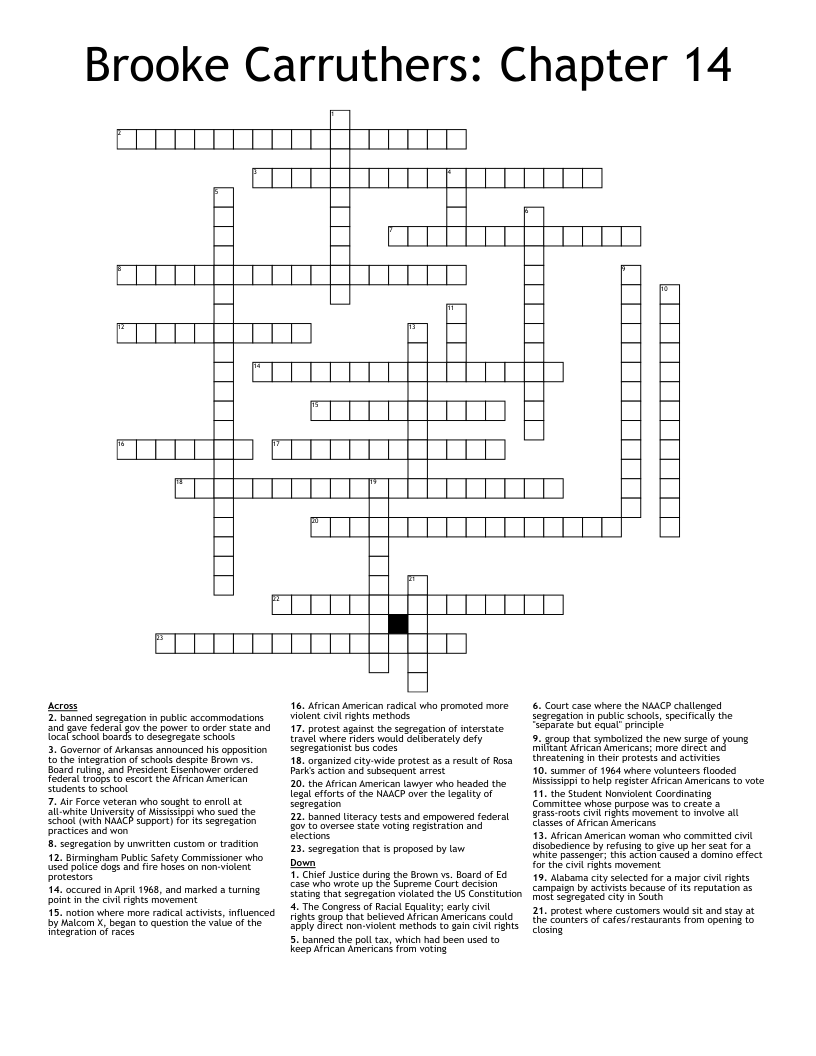
Brooke Carruthers: Chapter 14 Crossword
This printable crossword puzzle has 23 clues. Answers range from 4 to 21 letters long. This crossword is also available to download as a Microsoft Word document or a PDF.
Description
segregation that is proposed by law
segregation by unwritten custom or tradition
The Congress of Racial Equality; early civil rights group that believed African Americans could apply direct non-violent methods to gain civil rights
Court case where the NAACP challenged segregation in public schools, specifically the "separate but equal" principle
the African American lawyer who headed the legal efforts of the NAACP over the legality of segregation
Chief Justice during the Brown vs. Board of Ed case who wrote up the Supreme Court decision stating that segregation violated the US Constitution
Governor of Arkansas announced his opposition to the integration of schools despite Brown vs. Board ruling, and President Eisenhower ordered federal troops to escort the African American students to school
African American woman who committed civil disobedience by refusing to give up her seat for a white passenger; this action caused a domino effect for the civil rights movement
organized city-wide protest as a result of Rosa Park's action and subsequent arrest
protest where customers would sit and stay at the counters of cafes/restaurants from opening to closing
the Student Nonviolent Coordinating Committee whose purpose was to create a grass-roots civil rights movement to involve all classes of African Americans
protest against the segregation of interstate travel where riders would deliberately defy segregationist bus codes
Air Force veteran who sought to enroll at all-white University of Mississippi who sued the school (with NAACP support) for its segregation practices and won
Birmingham Public Safety Commissioner who used police dogs and fire hoses on non-violent protestors
Alabama city selected for a major civil rights campaign by activists because of its reputation as most segregated city in South
banned segregation in public accommodations and gave federal gov the power to order state and local school boards to desegregate schools
summer of 1964 where volunteers flooded Mississippi to help register African Americans to vote
banned literacy tests and empowered federal gov to oversee state voting registration and elections
banned the poll tax, which had been used to keep African Americans from voting
African American radical who promoted more violent civil rights methods
notion where more radical activists, influenced by Malcom X, began to question the value of the integration of races
group that symbolized the new surge of young militant African Americans; more direct and threatening in their protests and activities
occured in April 1968, and marked a turning point in the civil rights movement