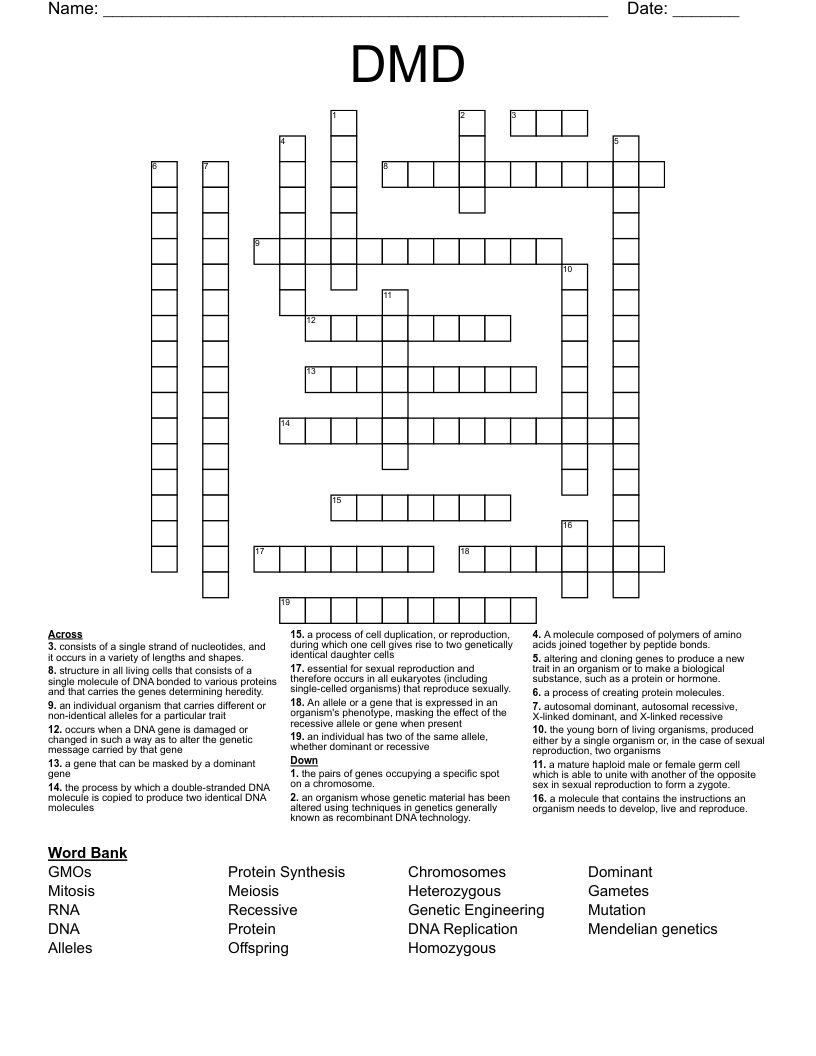
DMD Crossword
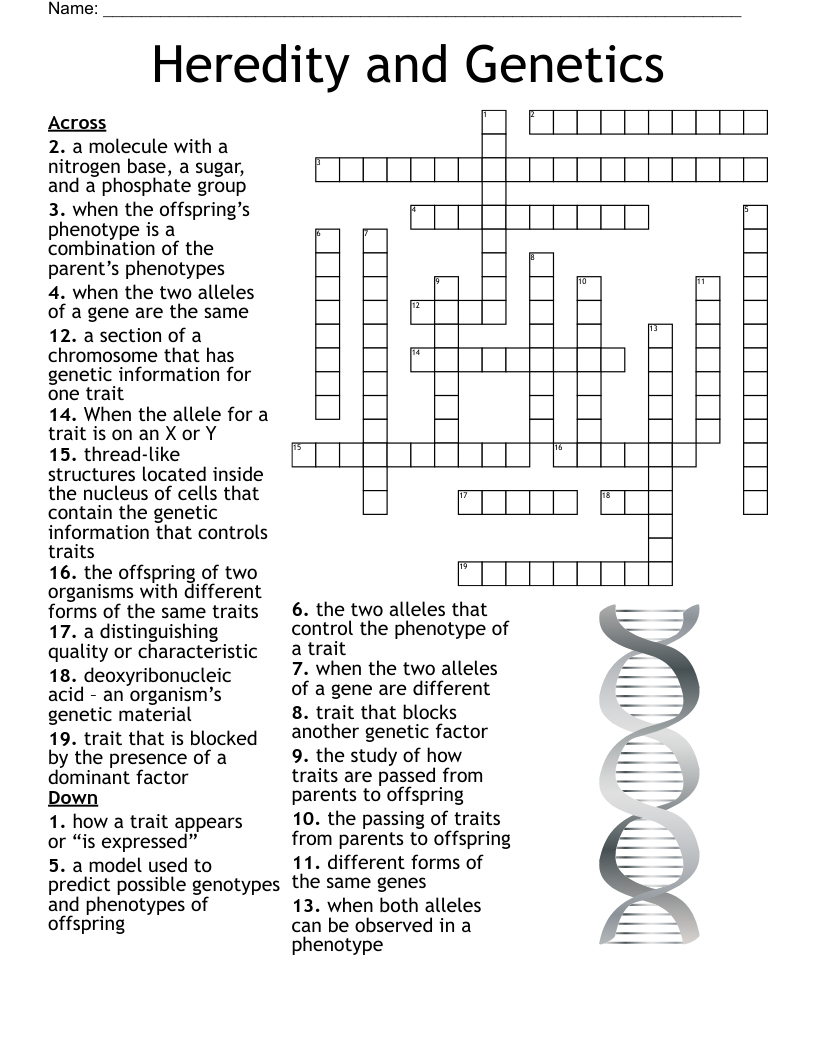
This printable crossword puzzle has 19 clues. Answers range from 3 to 18 letters long. This crossword is also available to download as a Microsoft Word document or a PDF.
Description
consists of a single strand of nucleotides, and it occurs in a variety of lengths and shapes.
the pairs of genes occupying a specific spot on a chromosome.
occurs when a DNA gene is damaged or changed in such a way as to alter the genetic message carried by that gene
the young born of living organisms, produced either by a single organism or, in the case of sexual reproduction, two organisms
a mature haploid male or female germ cell which is able to unite with another of the opposite sex in sexual reproduction to form a zygote.
a process of cell duplication, or reproduction, during which one cell gives rise to two genetically identical daughter cells
a gene that can be masked by a dominant gene
essential for sexual reproduction and therefore occurs in all eukaryotes (including single-celled organisms) that reproduce sexually.
structure in all living cells that consists of a single molecule of DNA bonded to various proteins and that carries the genes determining heredity.
the process by which a double-stranded DNA molecule is copied to produce two identical DNA molecules
A molecule composed of polymers of amino acids joined together by peptide bonds.
An allele or a gene that is expressed in an organism's phenotype, masking the effect of the recessive allele or gene when present
an individual has two of the same allele, whether dominant or recessive
an individual organism that carries different or non-identical alleles for a particular trait
a process of creating protein molecules.
autosomal dominant, autosomal recessive, X-linked dominant, and X-linked recessive
a molecule that contains the instructions an organism needs to develop, live and reproduce.
an organism whose genetic material has been altered using techniques in genetics generally known as recombinant DNA technology.
altering and cloning genes to produce a new trait in an organism or to make a biological substance, such as a protein or hormone.