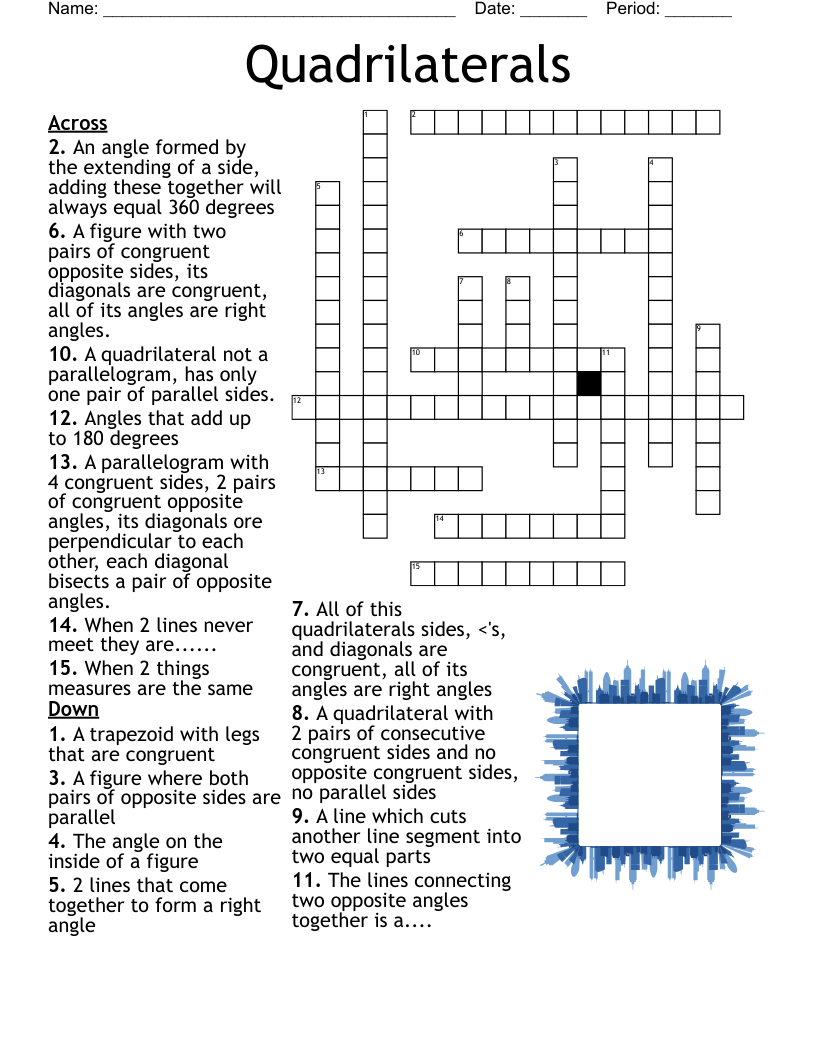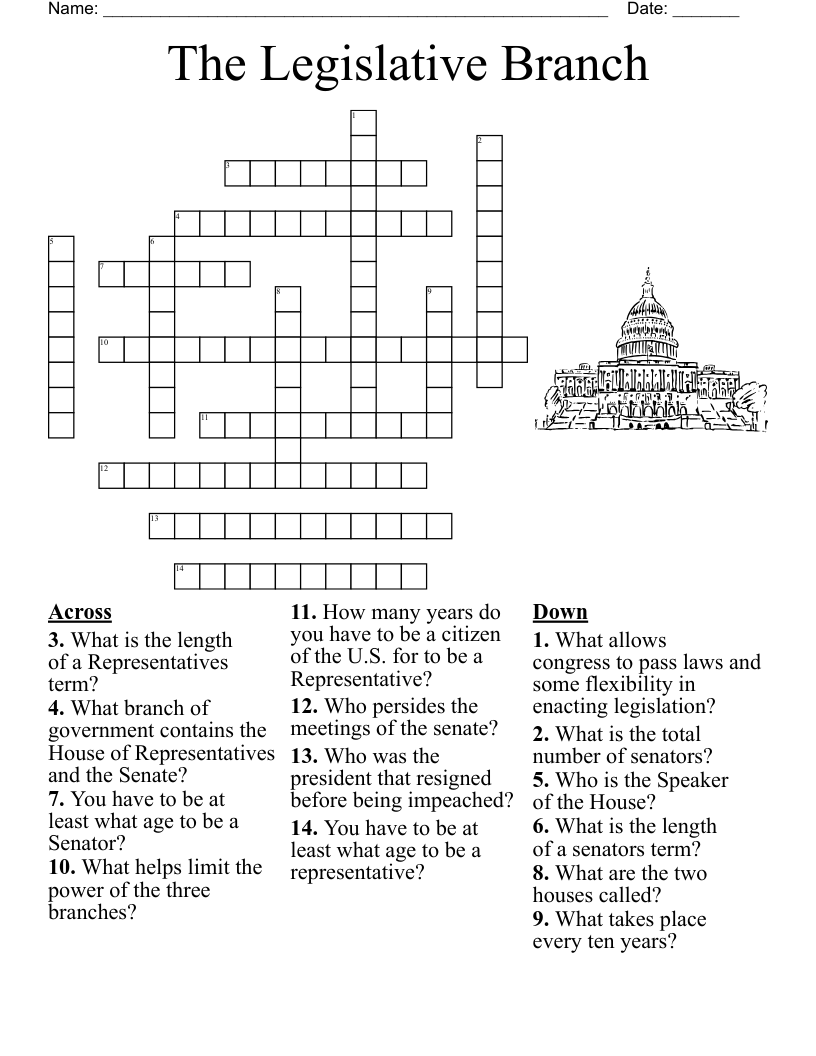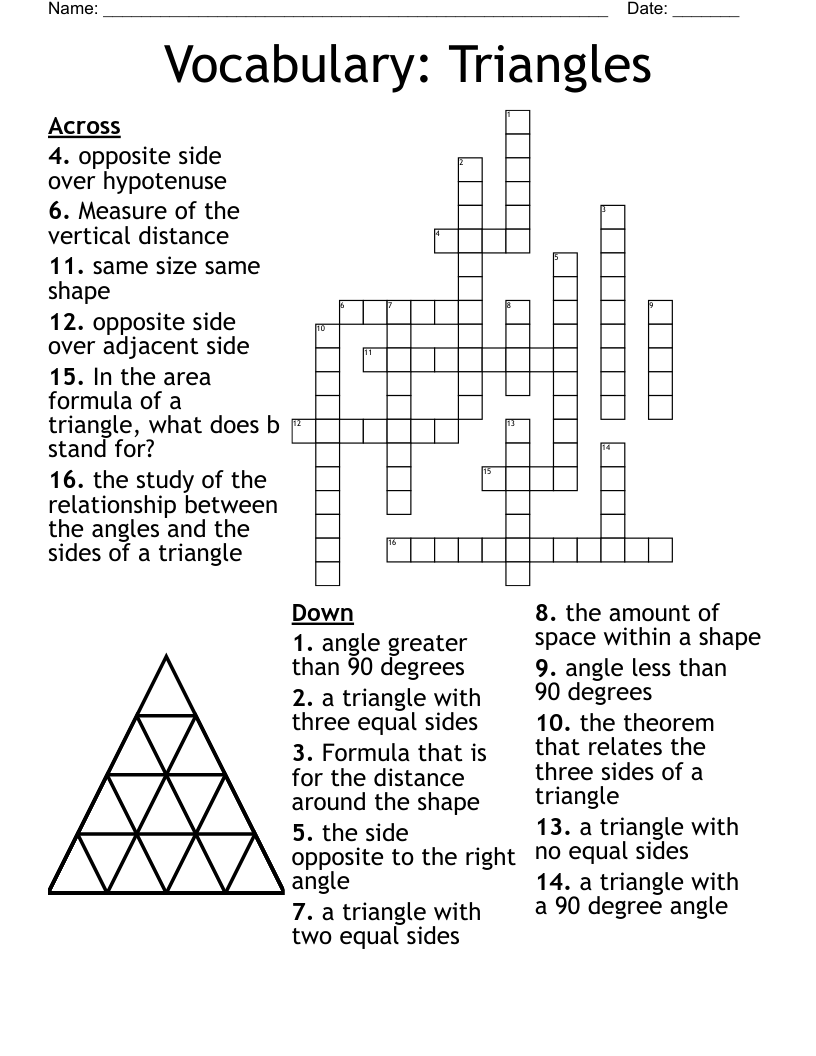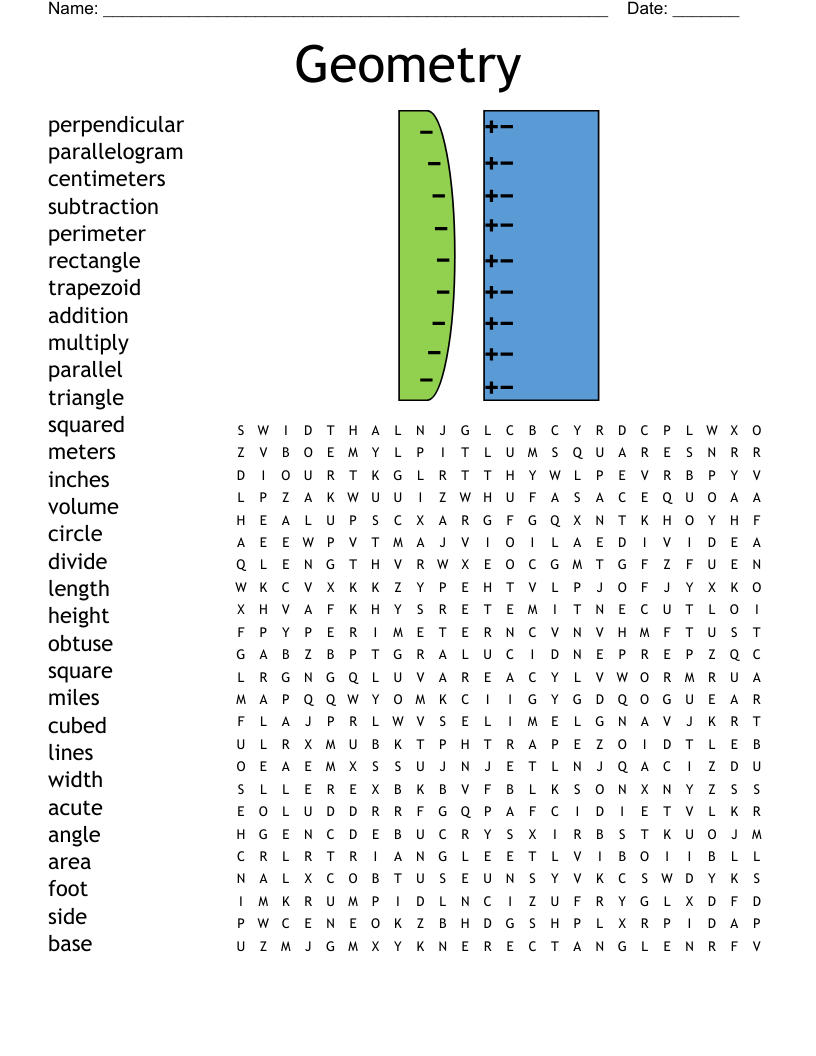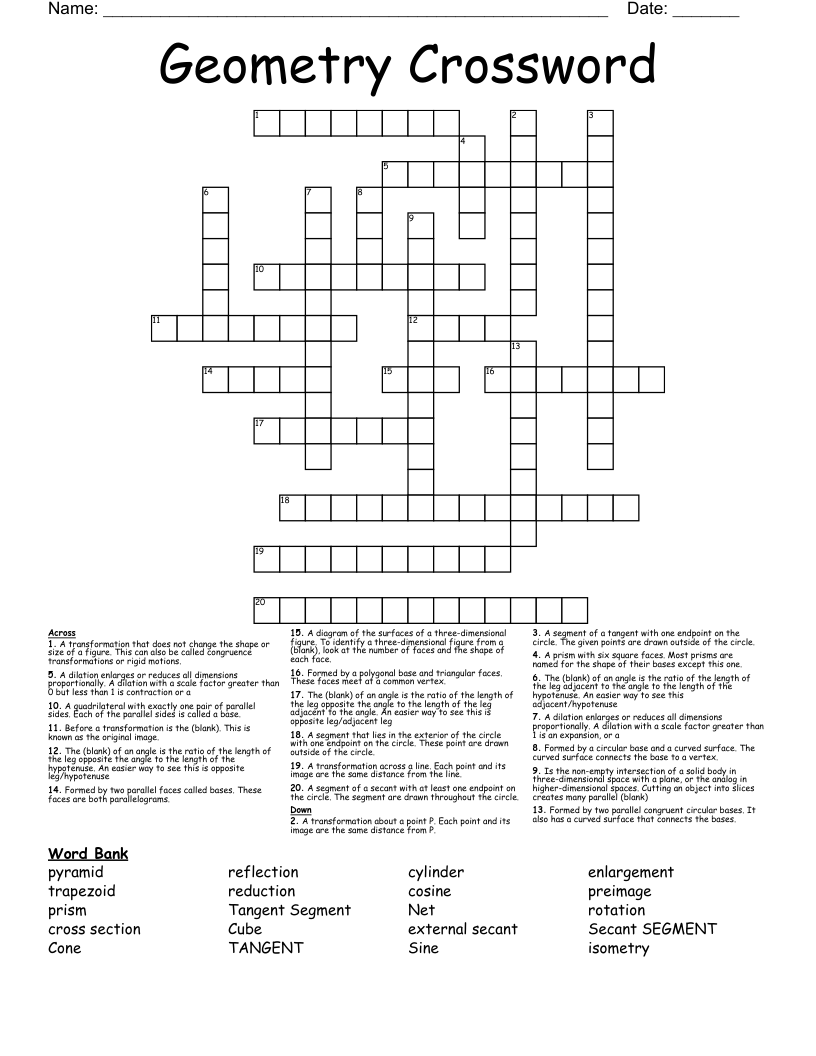
Geometry Crossword
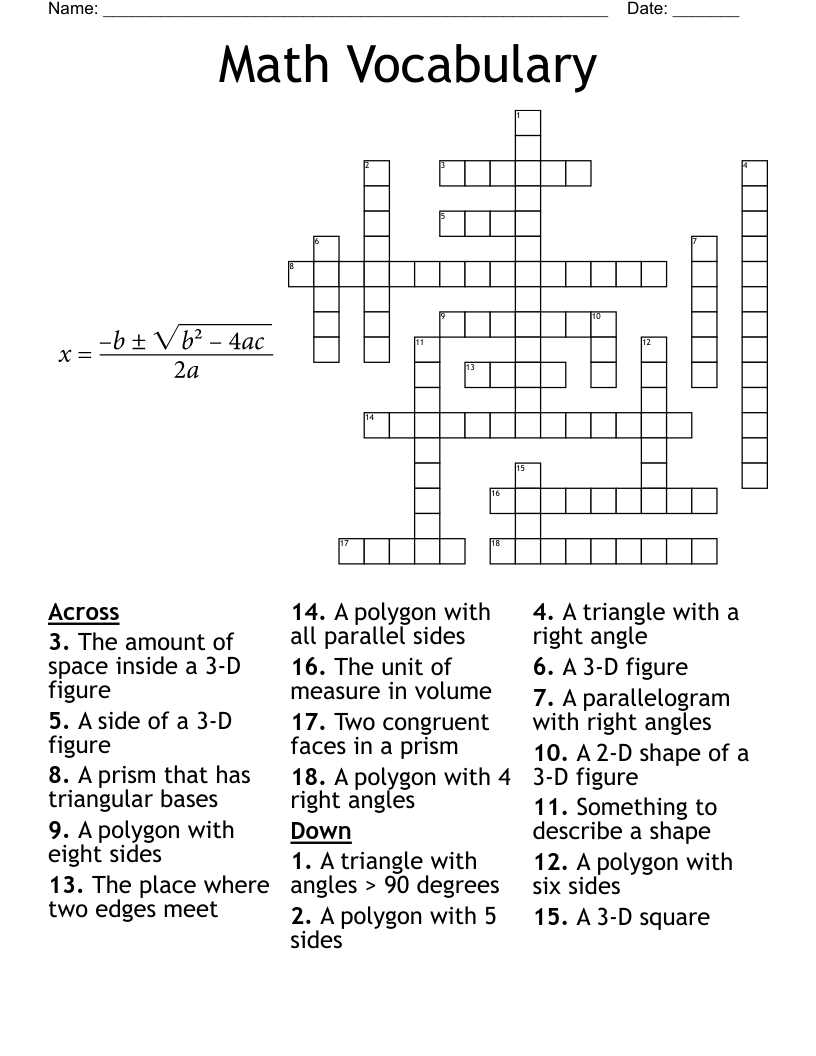
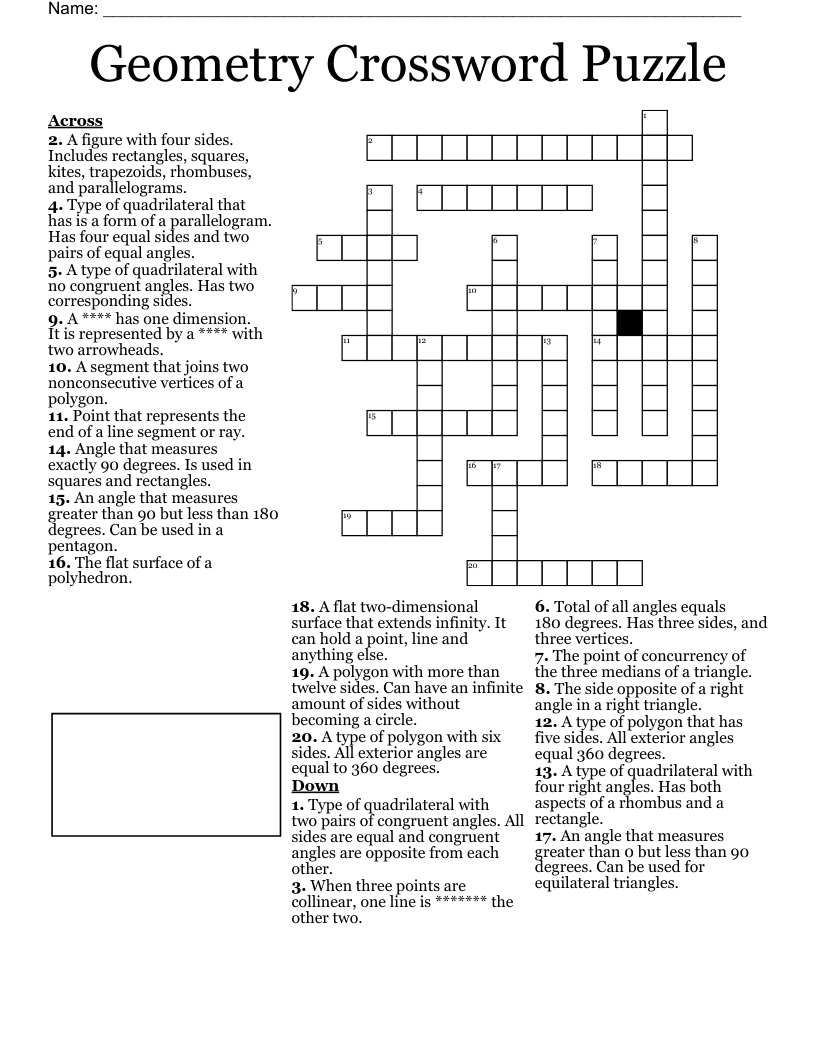
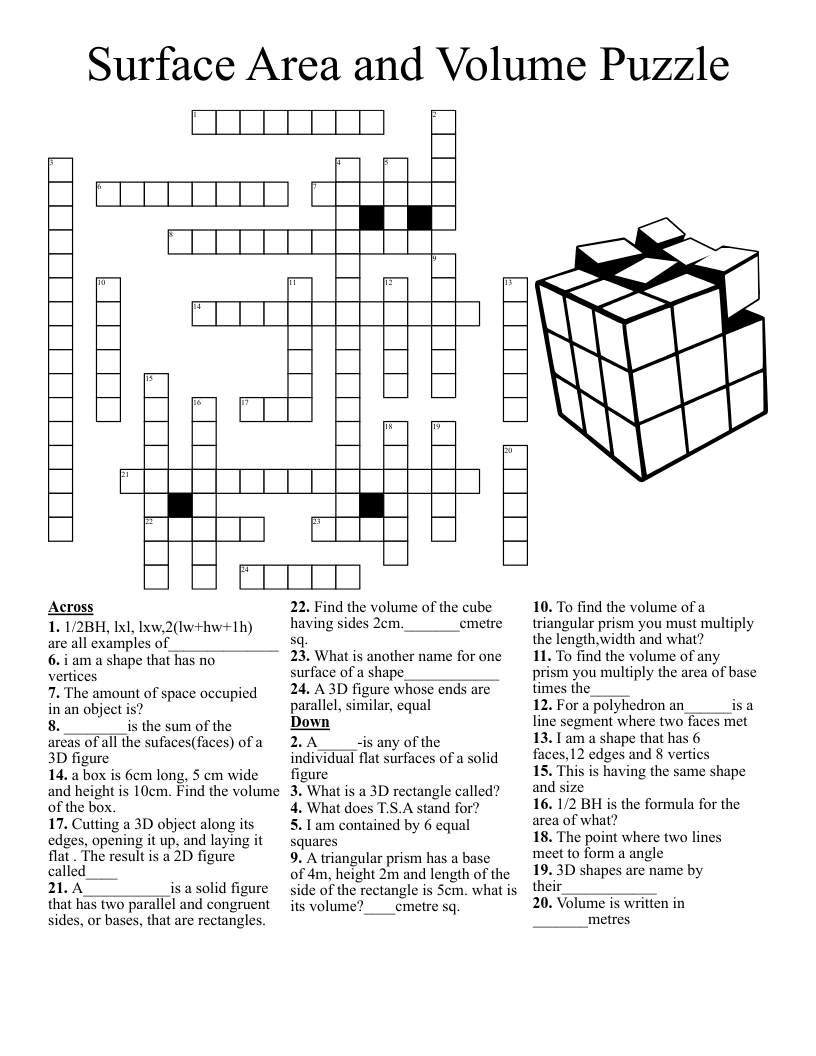
This printable crossword puzzle has 20 clues. Answers range from 3 to 14 letters long. This crossword is also available to download as a Microsoft Word document or a PDF.
Description
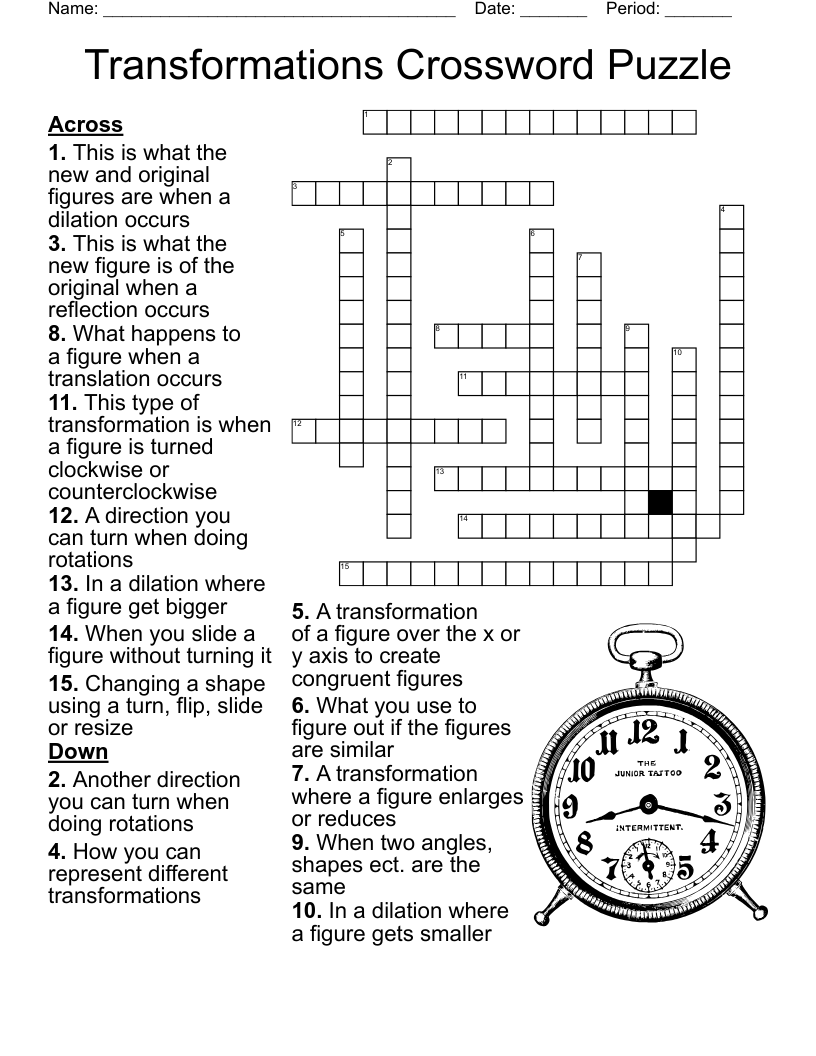
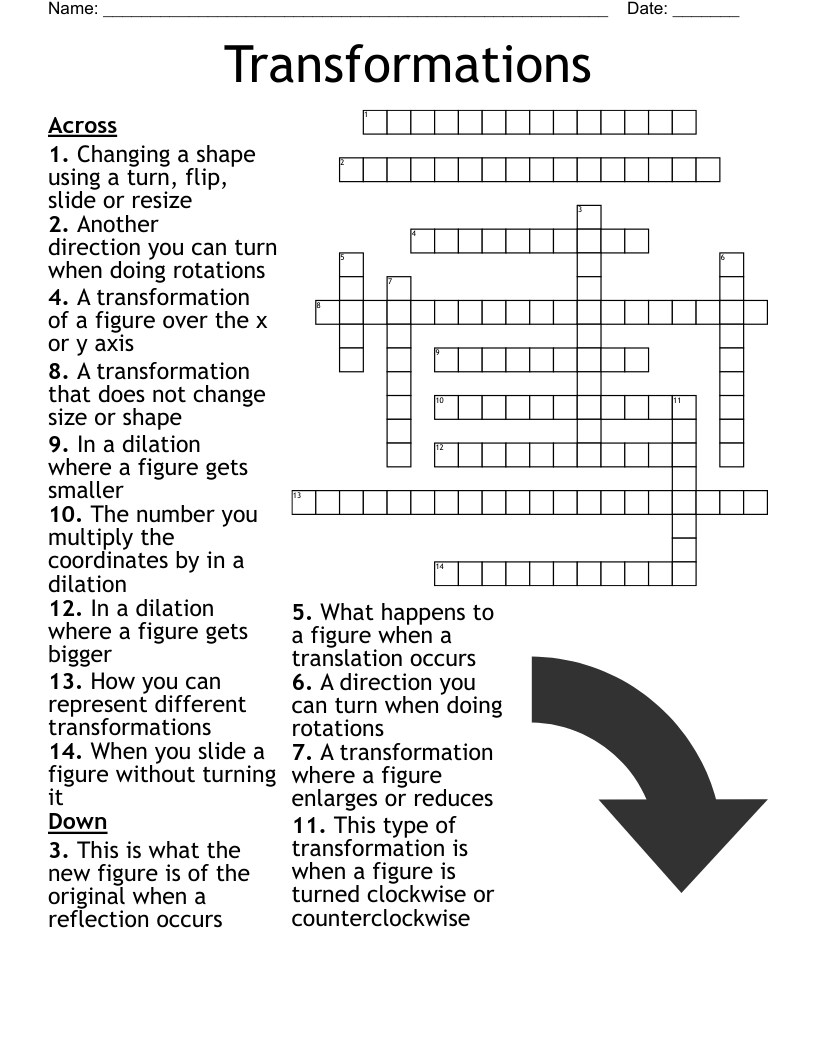
A transformation across a line. Each point and its image are the same distance from the line.
A transformation about a point P. Each point and its image are the same distance from P.
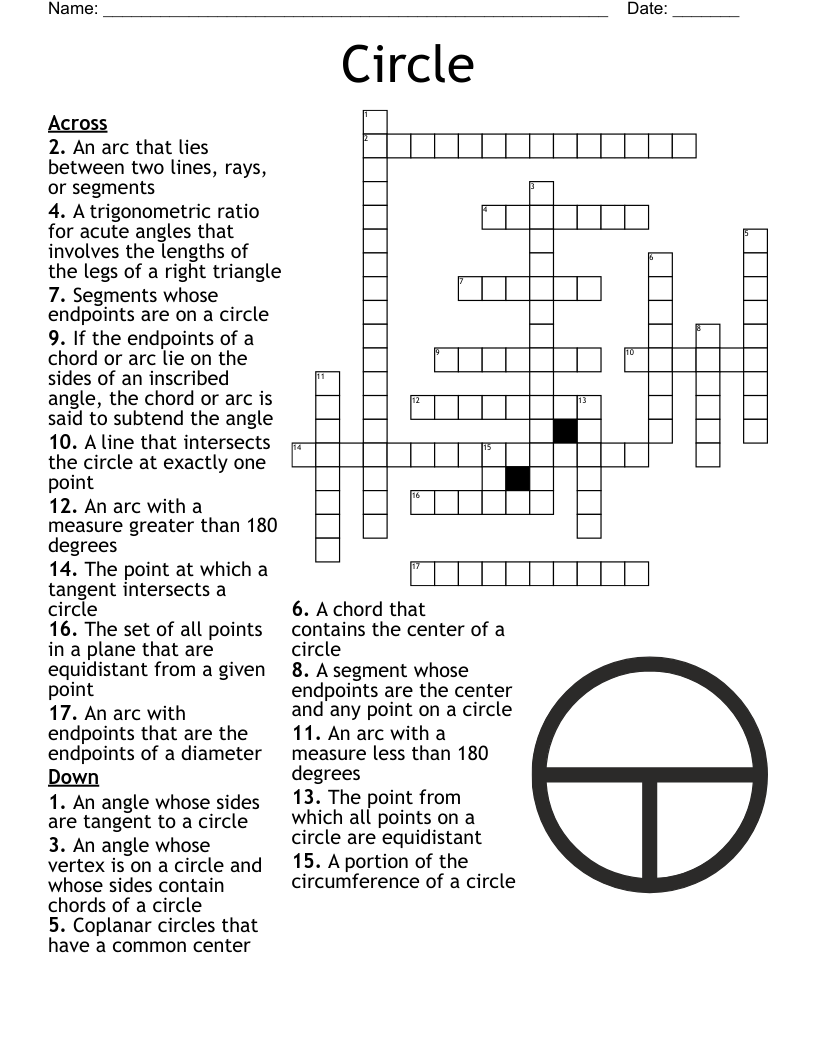
A segment of a tangent with one endpoint on the circle. The given points are drawn outside of the circle.
A segment of a secant with at least one endpoint on the circle. The segment are drawn throughout the circle.
A segment that lies in the exterior of the circle with one endpoint on the circle. These point are drawn outside of the circle.
A transformation that does not change the shape or size of a figure. This can also be called congruence transformations or rigid motions.
Formed by two parallel faces called bases. These faces are both parallelograms.
Formed by two parallel congruent circular bases. It also has a curved surface that connects the bases.
Formed by a polygonal base and triangular faces. These faces meet at a common vertex.
Formed by a circular base and a curved surface. The curved surface connects the base to a vertex.
A prism with six square faces. Most prisms are named for the shape of their bases except this one.
A diagram of the surfaces of a three-dimensional figure. To identify a three-dimensional figure from a (blank), look at the number of faces and the shape of each face.
Is the non-empty intersection of a solid body in three-dimensional space with a plane, or the analog in higher-dimensional spaces. Cutting an object into slices creates many parallel (blank)
The (blank) of an angle is the ratio of the length of the leg opposite the angle to the length of the hypotenuse. An easier way to see this is opposite leg/hypotenuse
The (blank) of an angle is the ratio of the length of the leg adjacent to the angle to the length of the hypotenuse. An easier way to see this adjacent/hypotenuse
The (blank) of an angle is the ratio of the length of the leg opposite the angle to the length of the leg adjacent to the angle. An easier way to see this is opposite leg/adjacent leg
A dilation enlarges or reduces all dimensions proportionally. A dilation with a scale factor greater than 1 is an expansion, or a
A dilation enlarges or reduces all dimensions proportionally. A dilation with a scale factor greater than 0 but less than 1 is contraction or a
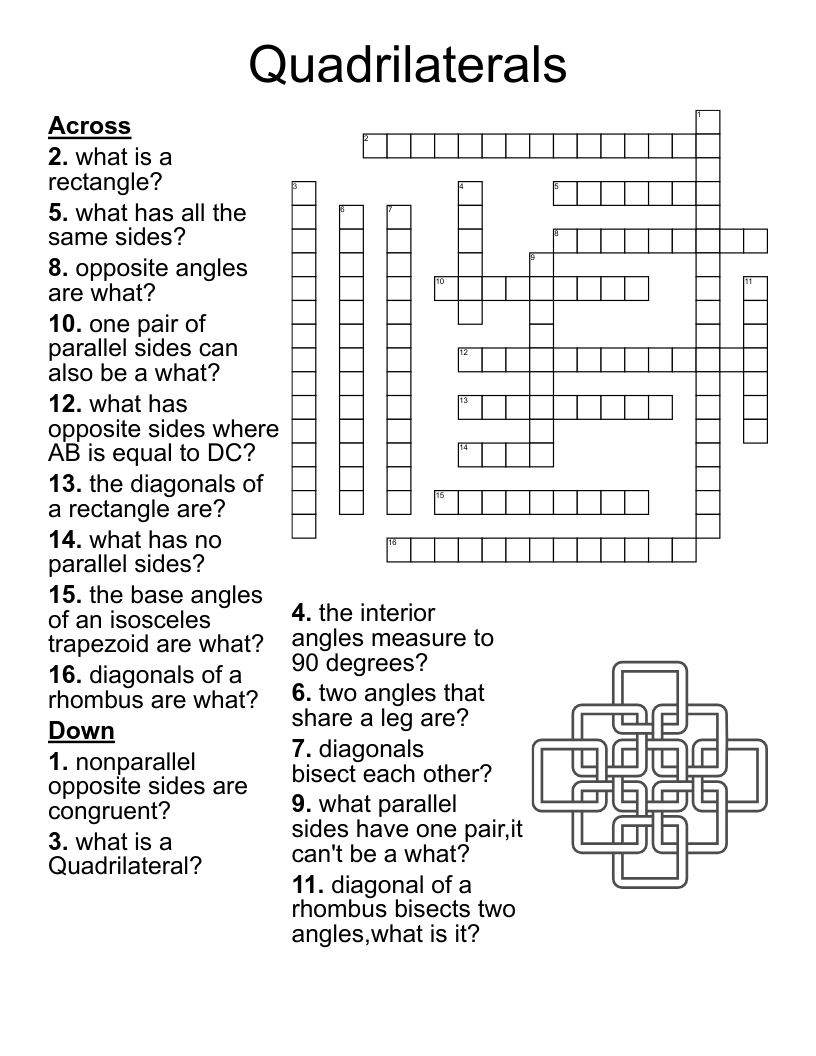
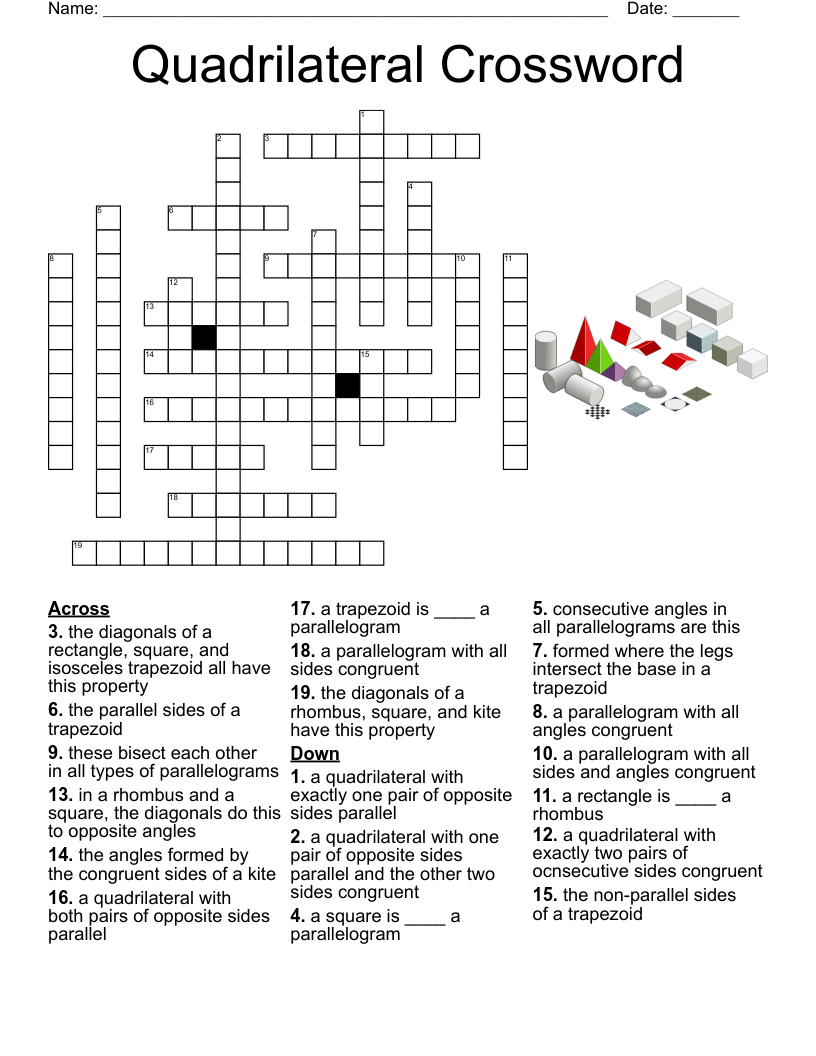
A quadrilateral with exactly one pair of parallel sides. Each of the parallel sides is called a base.
Before a transformation is the (blank). This is known as the original image.