Optics Worksheet
This printable matching worksheet has 26 questions and answers to match. This matching worksheet is also available to download as a Microsoft Word document or a PDF.
Description
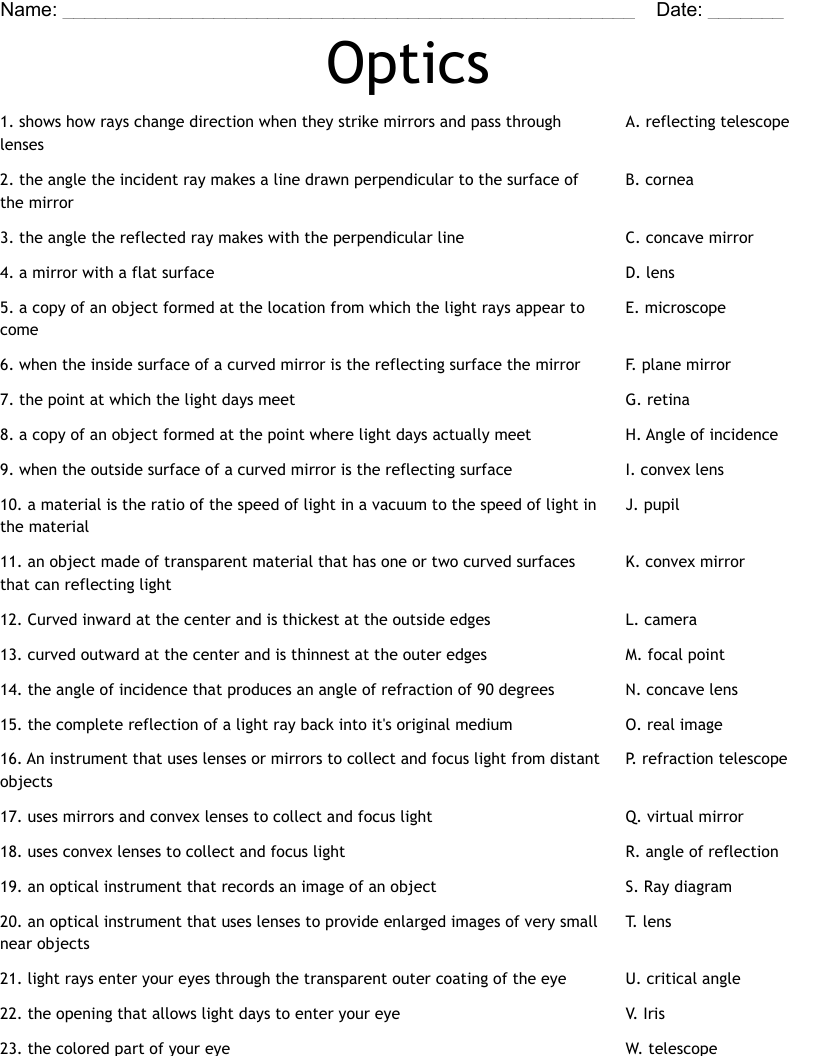
shows how rays change direction when they strike mirrors and pass through lenses
the angle the incident ray makes a line drawn perpendicular to the surface of the mirror
the angle the reflected ray makes with the perpendicular line
a mirror with a flat surface
a copy of an object formed at the location from which the light rays appear to come
when the inside surface of a curved mirror is the reflecting surface the mirror
the point at which the light days meet
a copy of an object formed at the point where light days actually meet
when the outside surface of a curved mirror is the reflecting surface
a material is the ratio of the speed of light in a vacuum to the speed of light in the material
an object made of transparent material that has one or two curved surfaces that can reflecting light
Curved inward at the center and is thickest at the outside edges
curved outward at the center and is thinnest at the outer edges
the angle of incidence that produces an angle of refraction of 90 degrees
the complete reflection of a light ray back into it's original medium
An instrument that uses lenses or mirrors to collect and focus light from distant objects
uses mirrors and convex lenses to collect and focus light
uses convex lenses to collect and focus light
an optical instrument that records an image of an object
an optical instrument that uses lenses to provide enlarged images of very small near objects
light rays enter your eyes through the transparent outer coating of the eye
the opening that allows light days to enter your eye
the colored part of your eye
a sealed capsule containing a cleat fluid
the inner surface of the eye
It's surface is covered by light sensitive nerve endings