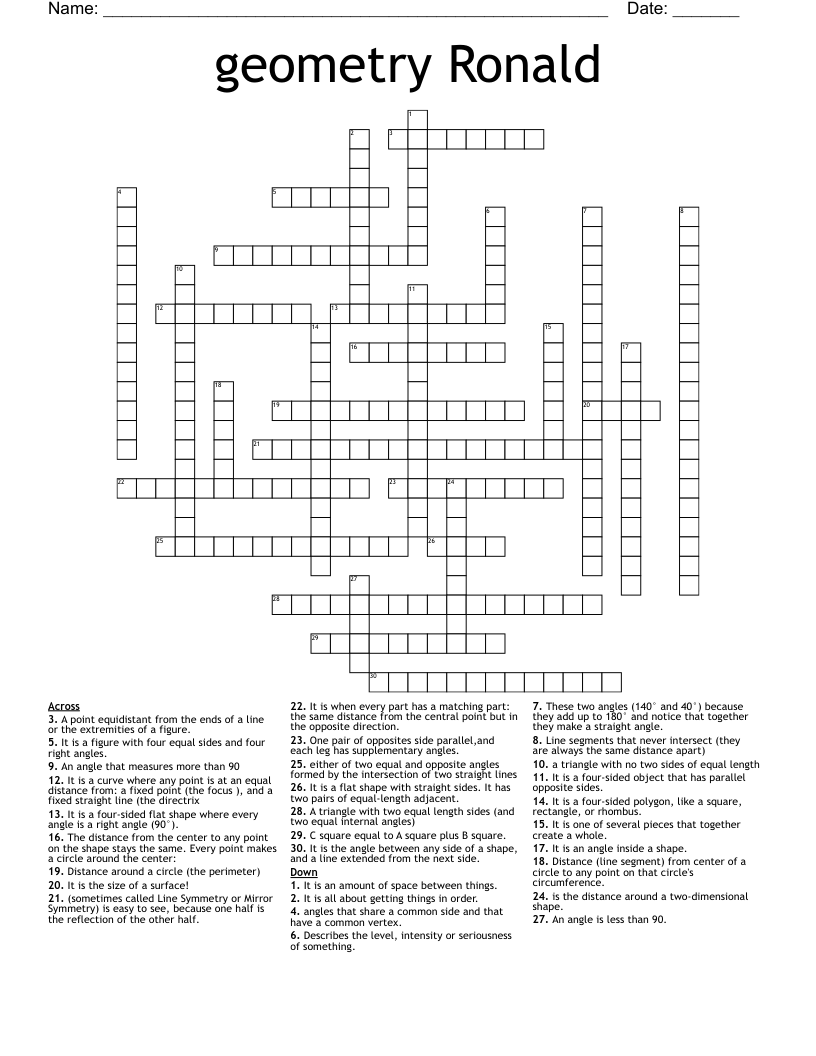
geometry Ronald Crossword
This printable crossword puzzle has 30 clues. Answers range from 4 to 20 letters long. This crossword is also available to download as a Microsoft Word document or a PDF.
Description
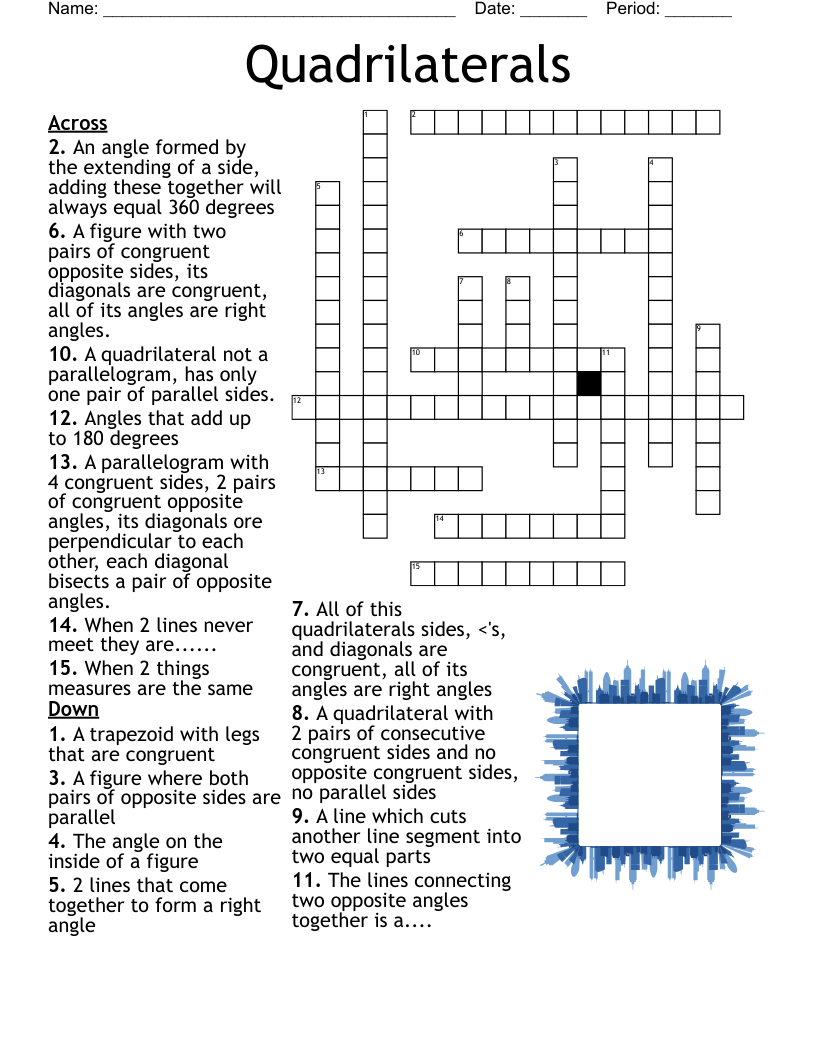
One pair of opposites side parallel,and each leg has supplementary angles.
is the distance around a two-dimensional shape.
The distance from the center to any point on the shape stays the same. Every point makes a circle around the center:
An angle is less than 90.
These two angles (140° and 40°) because they add up to 180° and notice that together they make a straight angle.
(sometimes called Line Symmetry or Mirror Symmetry) is easy to see, because one half is the reflection of the other half.
It is the size of a surface!
It is a four-sided flat shape where every angle is a right angle (90°).
It is an angle inside a shape.
An angle that measures more than 90
Line segments that never intersect (they are always the same distance apart)
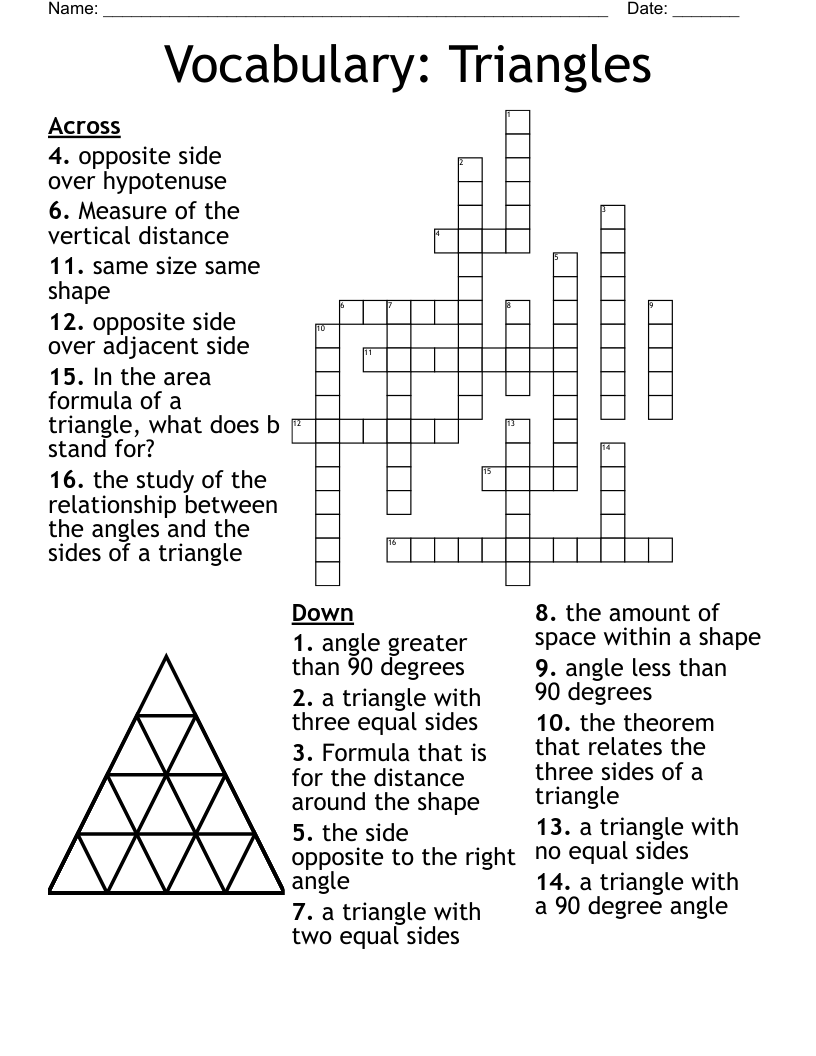
A triangle with two equal length sides (and two equal internal angles)
Distance (line segment) from center of a circle to any point on that circle's circumference.
Distance around a circle (the perimeter)
angles that share a common side and that have a common vertex.
It is a four-sided object that has parallel opposite sides.
It is a four-sided polygon, like a square, rectangle, or rhombus.
It is one of several pieces that together create a whole.
a triangle with no two sides of equal length
It is a figure with four equal sides and four right angles.
either of two equal and opposite angles formed by the intersection of two straight lines
It is all about getting things in order.
Describes the level, intensity or seriousness of something.
It is an amount of space between things.
It is a flat shape with straight sides. It has two pairs of equal-length adjacent.
It is the angle between any side of a shape, and a line extended from the next side.
C square equal to A square plus B square.
It is a curve where any point is at an equal distance from: a fixed point (the focus ), and a fixed straight line (the directrix
It is when every part has a matching part: the same distance from the central point but in the opposite direction.
A point equidistant from the ends of a line or the extremities of a figure.