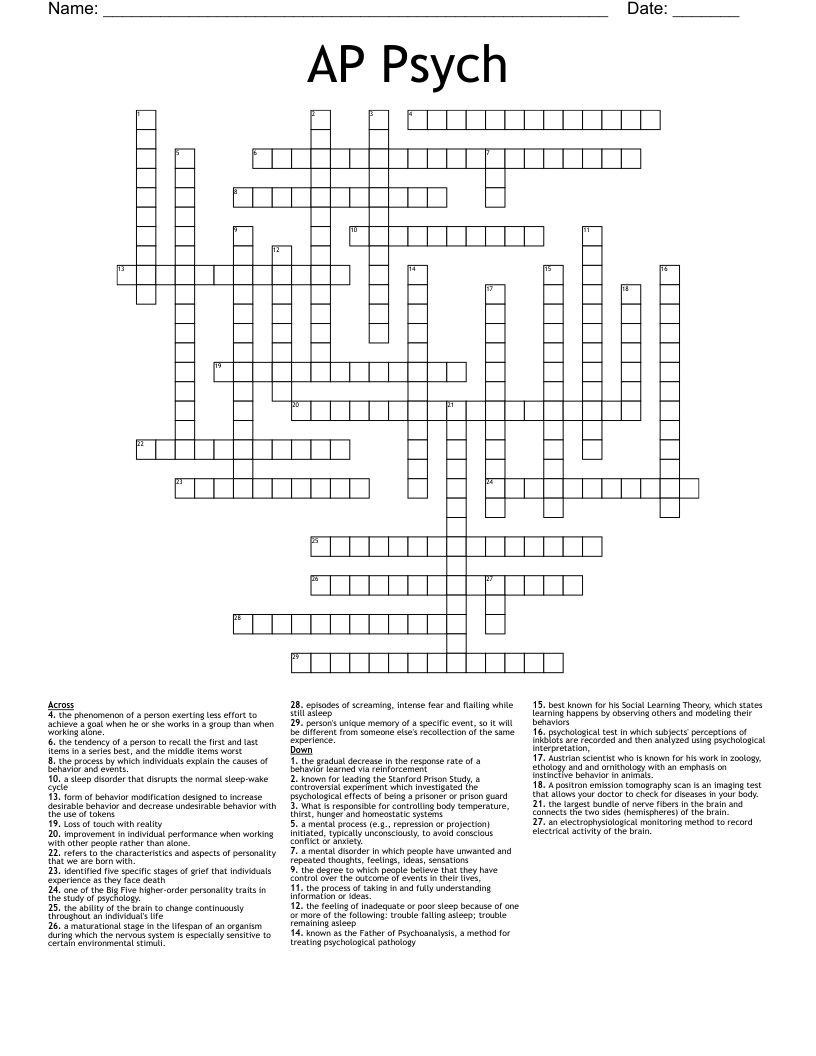
AP Psych Crossword
This printable crossword puzzle has 29 clues. Answers range from 3 to 20 letters long. This crossword is also available to download as a Microsoft Word document or a PDF.
Description
What is responsible for controlling body temperature, thirst, hunger and homeostatic systems
the process of taking in and fully understanding information or ideas.
refers to the characteristics and aspects of personality that we are born with.
known for leading the Stanford Prison Study, a controversial experiment which investigated the psychological effects of being a prisoner or prison guard
improvement in individual performance when working with other people rather than alone.
Austrian scientist who is known for his work in zoology, ethology and and ornithology with an emphasis on instinctive behavior in animals.
the feeling of inadequate or poor sleep because of one or more of the following: trouble falling asleep; trouble remaining asleep
person's unique memory of a specific event, so it will be different from someone else's recollection of the same experience.
one of the Big Five higher-order personality traits in the study of psychology.
the gradual decrease in the response rate of a behavior learned via reinforcement
the phenomenon of a person exerting less effort to achieve a goal when he or she works in a group than when working alone.
Loss of touch with reality
the process by which individuals explain the causes of behavior and events.
the tendency of a person to recall the first and last items in a series best, and the middle items worst
form of behavior modification designed to increase desirable behavior and decrease undesirable behavior with the use of tokens
the ability of the brain to change continuously throughout an individual's life
an electrophysiological monitoring method to record electrical activity of the brain.
best known for his Social Learning Theory, which states learning happens by observing others and modeling their behaviors
a maturational stage in the lifespan of an organism during which the nervous system is especially sensitive to certain environmental stimuli.
a mental disorder in which people have unwanted and repeated thoughts, feelings, ideas, sensations
a mental process (e.g., repression or projection) initiated, typically unconsciously, to avoid conscious conflict or anxiety.
the degree to which people believe that they have control over the outcome of events in their lives,
identified five specific stages of grief that individuals experience as they face death
psychological test in which subjects' perceptions of inkblots are recorded and then analyzed using psychological interpretation,
episodes of screaming, intense fear and flailing while still asleep
a sleep disorder that disrupts the normal sleep-wake cycle
known as the Father of Psychoanalysis, a method for treating psychological pathology
the largest bundle of nerve fibers in the brain and connects the two sides (hemispheres) of the brain.
A positron emission tomography scan is an imaging test that allows your doctor to check for diseases in your body.