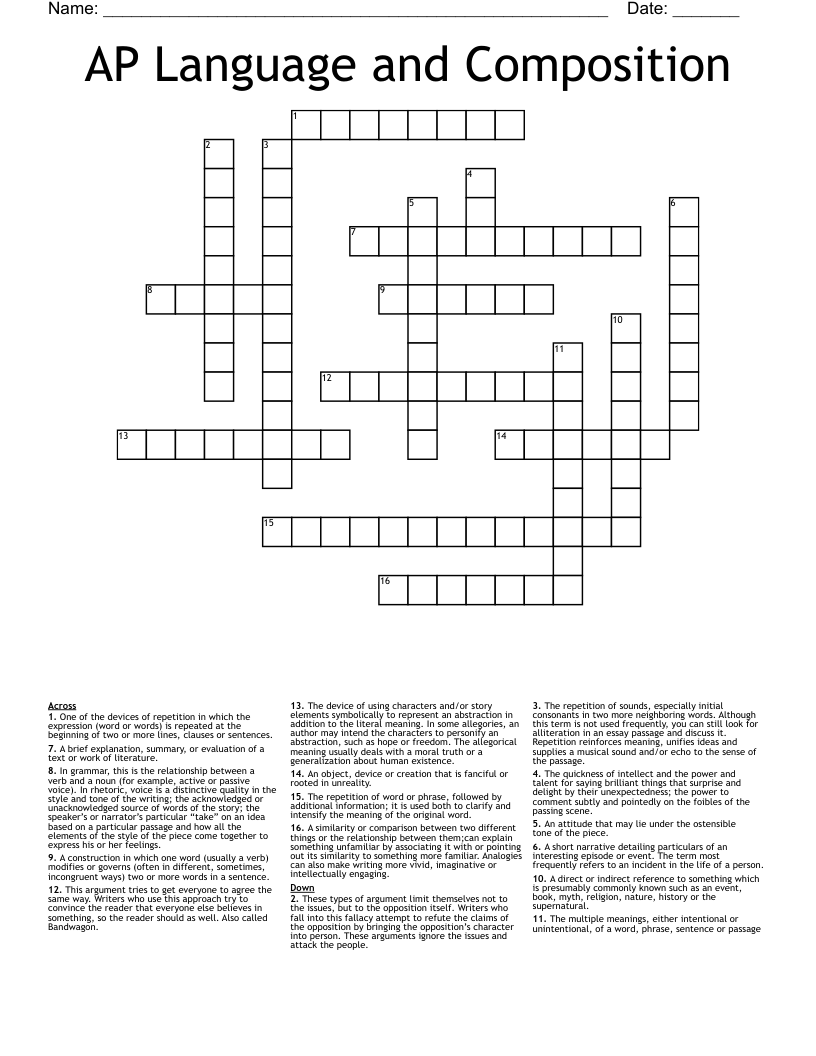
AP Language and Composition Crossword
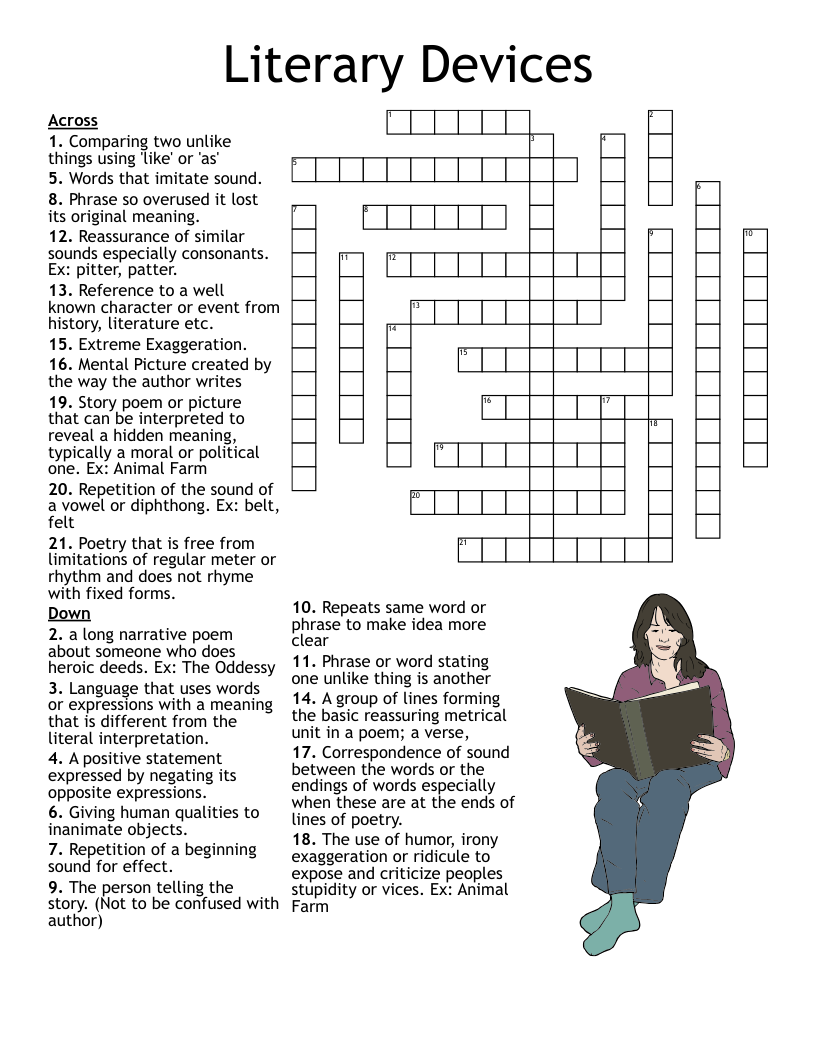
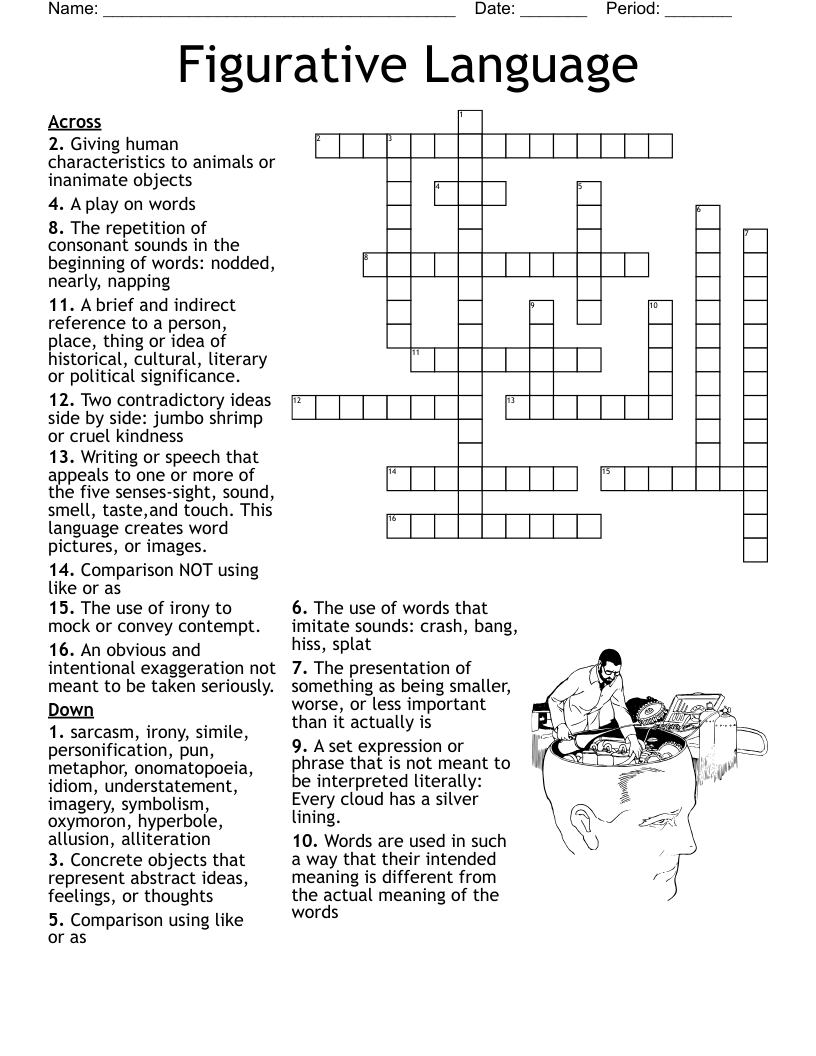
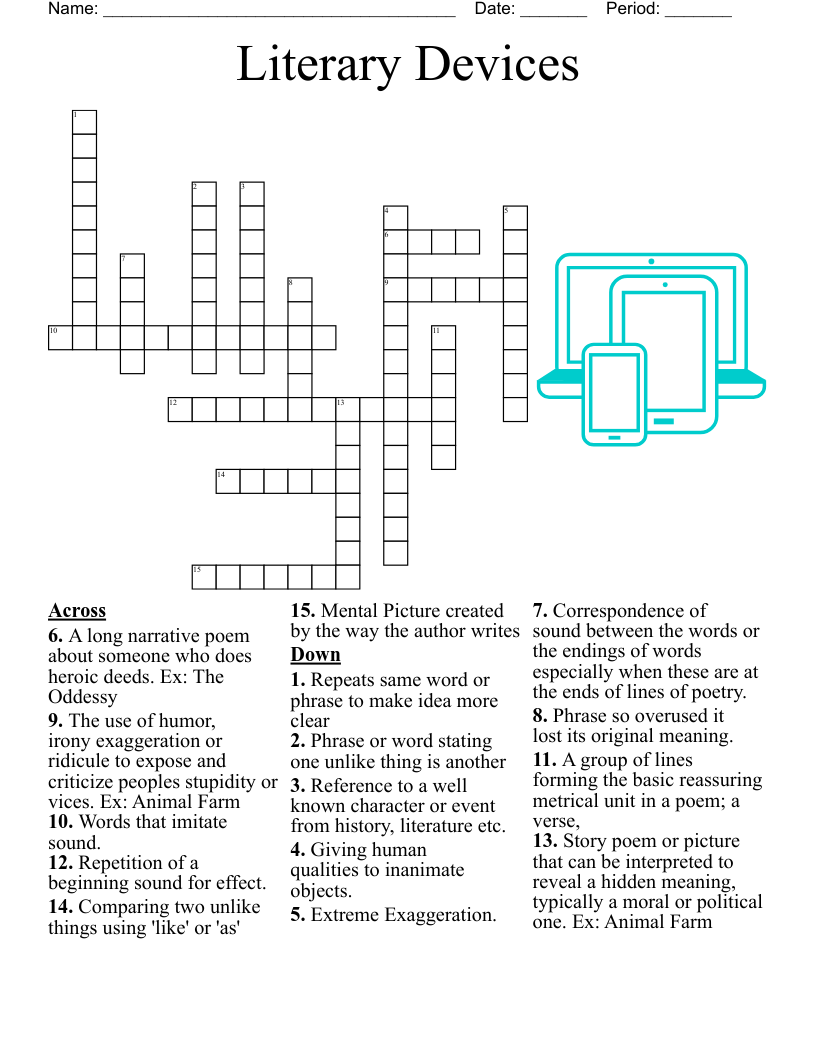
This printable crossword puzzle on the topic of Figurative Language & Literary Devices has 16 clues. Answers range from 3 to 13 letters long. This crossword is also available to download as a Microsoft Word document or a PDF.
Description
These types of argument limit themselves not to the issues, but to the opposition itself. Writers who fall into this fallacy attempt to refute the claims of the opposition by bringing the opposition’s character into person. These arguments ignore the issues and attack the people.
A construction in which one word (usually a verb) modifies or governs (often in different, sometimes, incongruent ways) two or more words in a sentence.
This argument tries to get everyone to agree the same way. Writers who use this approach try to convince the reader that everyone else believes in something, so the reader should as well. Also called Bandwagon.
The device of using characters and/or story elements symbolically to represent an abstraction in addition to the literal meaning. In some allegories, an author may intend the characters to personify an abstraction, such as hope or freedom. The allegorical meaning usually deals with a moral truth or a generalization about human existence.
The repetition of sounds, especially initial consonants in two more neighboring words. Although this term is not used frequently, you can still look for alliteration in an essay passage and discuss it. Repetition reinforces meaning, unifies ideas and supplies a musical sound and/or echo to the sense of the passage.
A direct or indirect reference to something which is presumably commonly known such as an event, book, myth, religion, nature, history or the supernatural.
The multiple meanings, either intentional or unintentional, of a word, phrase, sentence or passage
The repetition of word or phrase, followed by additional information; it is used both to clarify and intensify the meaning of the original word.
A similarity or comparison between two different things or the relationship between them;can explain something unfamiliar by associating it with or pointing out its similarity to something more familiar. Analogies can also make writing more vivid, imaginative or intellectually engaging.
One of the devices of repetition in which the expression (word or words) is repeated at the beginning of two or more lines, clauses or sentences.
A short narrative detailing particulars of an interesting episode or event. The term most frequently refers to an incident in the life of a person.
A brief explanation, summary, or evaluation of a text or work of literature.
The quickness of intellect and the power and talent for saying brilliant things that surprise and delight by their unexpectedness; the power to comment subtly and pointedly on the foibles of the passing scene.
An object, device or creation that is fanciful or rooted in unreality.
In grammar, this is the relationship between a verb and a noun (for example, active or passive voice). In rhetoric, voice is a distinctive quality in the style and tone of the writing; the acknowledged or unacknowledged source of words of the story; the speaker’s or narrator’s particular “take” on an idea based on a particular passage and how all the elements of the style of the piece come together to express his or her feelings.
An attitude that may lie under the ostensible tone of the piece.