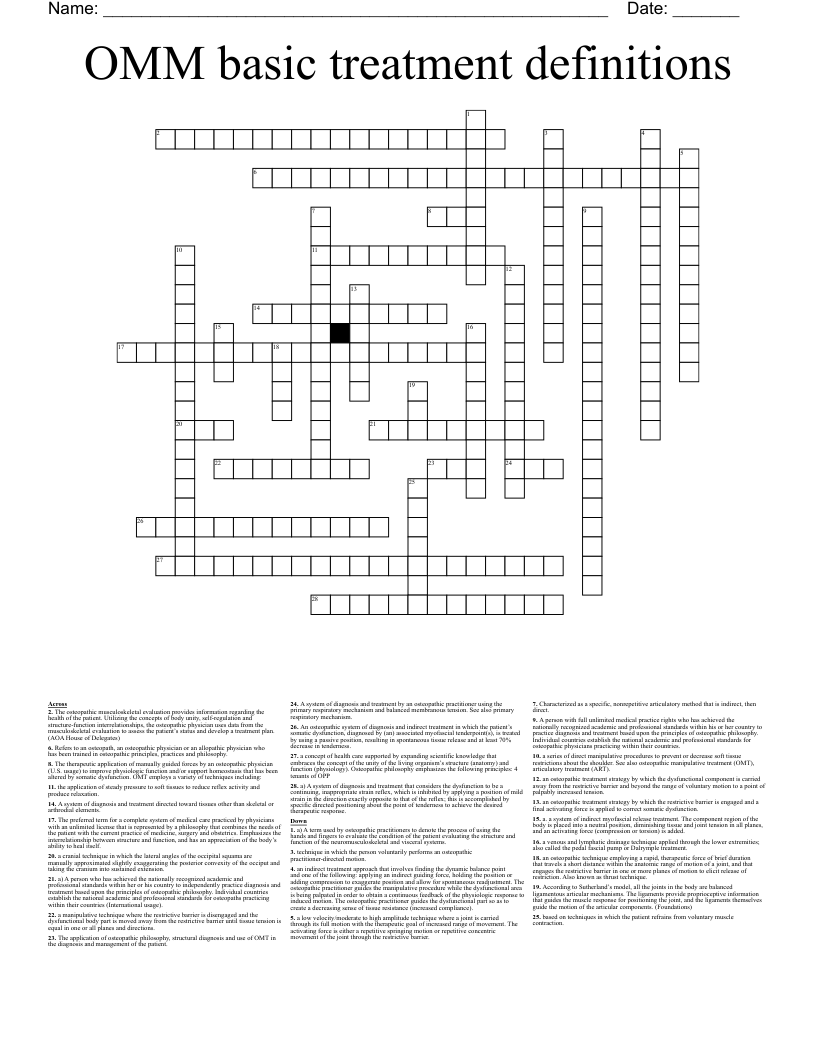
OMM basic treatment definitions Crossword
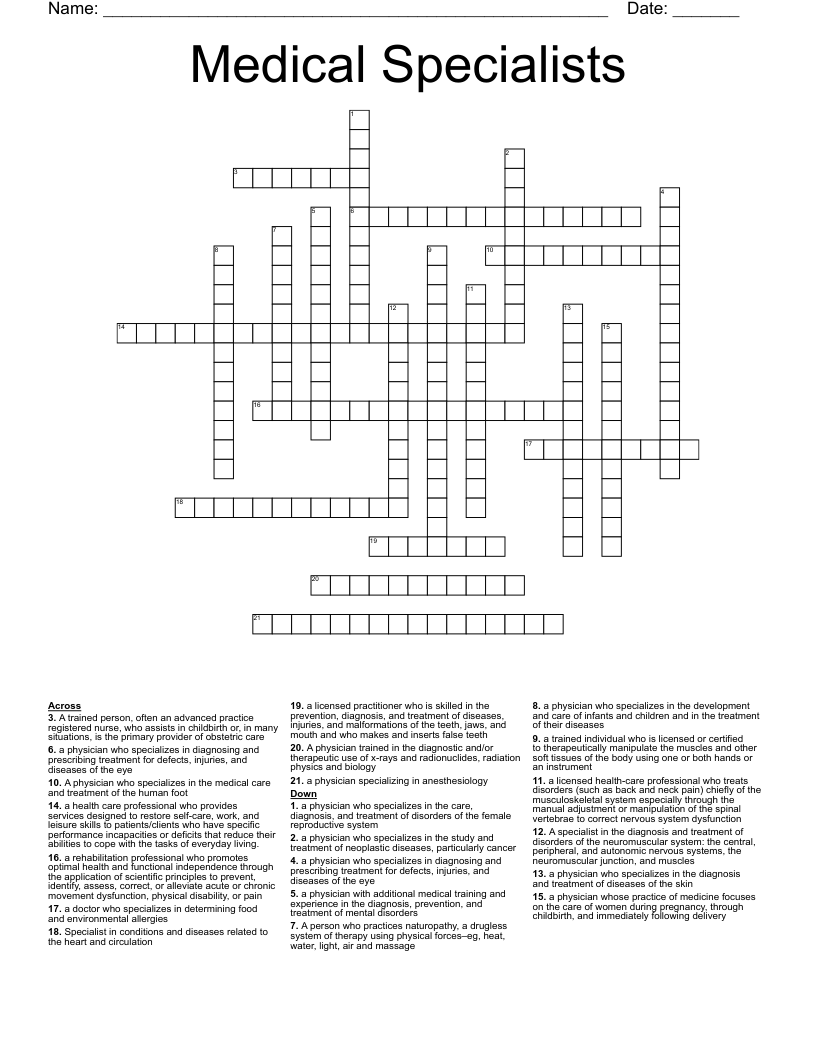
This printable crossword puzzle on the topic of Medical Terminology has 28 clues. Answers range from 3 to 23 letters long. This crossword is also available to download as a Microsoft Word document or a PDF.
Description
a) A person who has achieved the nationally recognized academic and professional standards within her or his country to independently practice diagnosis and treatment based upon the principles of osteopathic philosophy. Individual countries establish the national academic and professional standards for osteopaths practicing within their countries (International usage).
The application of osteopathic philosophy, structural diagnosis and use of OMT in the diagnosis and management of the patient.
The therapeutic application of manually guided forces by an osteopathic physician (U.S. usage) to improve physiologic function and/or support homeostasis that has been altered by somatic dysfunction. OMT employs a variety of techniques including:
technique in which the person voluntarily performs an osteopathic practitioner-directed motion.
a low velocity/moderate to high amplitude technique where a joint is carried through its full motion with the therapeutic goal of increased range of movement. The activating force is either a repetitive springing motion or repetitive concentric movement of the joint through the restrictive barrier.
According to Sutherland’s model, all the joints in the body are balanced ligamentous articular mechanisms. The ligaments provide proprioceptive information that guides the muscle response for positioning the joint, and the ligaments themselves guide the motion of the articular components. (Foundations)
a cranial technique in which the lateral angles of the occipital squama are manually approximated slightly exaggerating the posterior convexity of the occiput and taking the cranium into sustained extension.
a) A system of diagnosis and treatment that considers the dysfunction to be a continuing, inappropriate strain reflex, which is inhibited by applying a position of mild strain in the direction exactly opposite to that of the reflex; this is accomplished by specific directed positioning about the point of tenderness to achieve the desired therapeutic response.
an osteopathic treatment strategy by which the restrictive barrier is engaged and a final activating force is applied to correct somatic dysfunction.
an osteopathic treatment strategy by which the dysfunctional component is carried away from the restrictive barrier and beyond the range of voluntary motion to a point of palpably increased tension.
a. a system of indirect myofascial release treatment. The component region of the body is placed into a neutral position, diminishing tissue and joint tension in all planes, and an activating force (compression or torsion) is added.
an indirect treatment approach that involves finding the dynamic balance point and one of the following: applying an indirect guiding force, holding the position or adding compression to exaggerate position and allow for spontaneous readjustment. The osteopathic practitioner guides the manipulative procedure while the dysfunctional area is being palpated in order to obtain a continuous feedback of the physiologic response to induced motion. The osteopathic practitioner guides the dysfunctional part so as to create a decreasing sense of tissue resistance (increased compliance).
an osteopathic technique employing a rapid, therapeutic force of brief duration that travels a short distance within the anatomic range of motion of a joint, and that engages the restrictive barrier in one or more planes of motion to elicit release of restriction. Also known as thrust technique.
a manipulative technique where the restrictive barrier is disengaged and the dysfunctional body part is moved away from the restrictive barrier until tissue tension is equal in one or all planes and directions.
the application of steady pressure to soft tissues to reduce reflex activity and produce relaxation.
a venous and lymphatic drainage technique applied through the lower extremities; also called the pedal fascial pump or Dalrymple treatment.
A system of diagnosis and treatment by an osteopathic practitioner using the primary respiratory mechanism and balanced membranous tension. See also primary respiratory mechanism.
based on techniques in which the patient refrains from voluntary muscle contraction.
A system of diagnosis and treatment directed toward tissues other than skeletal or arthrodial elements.
a series of direct manipulative procedures to prevent or decrease soft tissue restrictions about the shoulder. See also osteopathic manipulative treatment (OMT), articulatory treatment (ART).
Characterized as a specific, nonrepetitive articulatory method that is indirect, then direct.
An osteopathic system of diagnosis and indirect treatment in which the patient’s somatic dysfunction, diagnosed by (an) associated myofascial tenderpoint(s), is treated by using a passive position, resulting in spontaneous tissue release and at least 70% decrease in tenderness.
The preferred term for a complete system of medical care practiced by physicians with an unlimited license that is represented by a philosophy that combines the needs of the patient with the current practice of medicine, surgery and obstetrics. Emphasizes the interrelationship between structure and function, and has an appreciation of the body’s ability to heal itself.
The osteopathic musculoskeletal evaluation provides information regarding the health of the patient. Utilizing the concepts of body unity, self-regulation and structure-function interrelationships, the osteopathic physician uses data from the musculoskeletal evaluation to assess the patient’s status and develop a treatment plan. (AOA House of Delegates)
a concept of health care supported by expanding scientific knowledge that embraces the concept of the unity of the living organism’s structure (anatomy) and function (physiology). Osteopathic philosophy emphasizes the following principles: 4 tenants of OPP
A person with full unlimited medical practice rights who has achieved the nationally recognized academic and professional standards within his or her country to practice diagnosis and treatment based upon the principles of osteopathic philosophy. Individual countries establish the national academic and professional standards for osteopathic physicians practicing within their countries.
Refers to an osteopath, an osteopathic physician or an allopathic physician who has been trained in osteopathic principles, practices and philosophy.
a) A term used by osteopathic practitioners to denote the process of using the hands and fingers to evaluate the condition of the patient evaluating the structure and function of the neuromusculoskeletal and visceral systems.