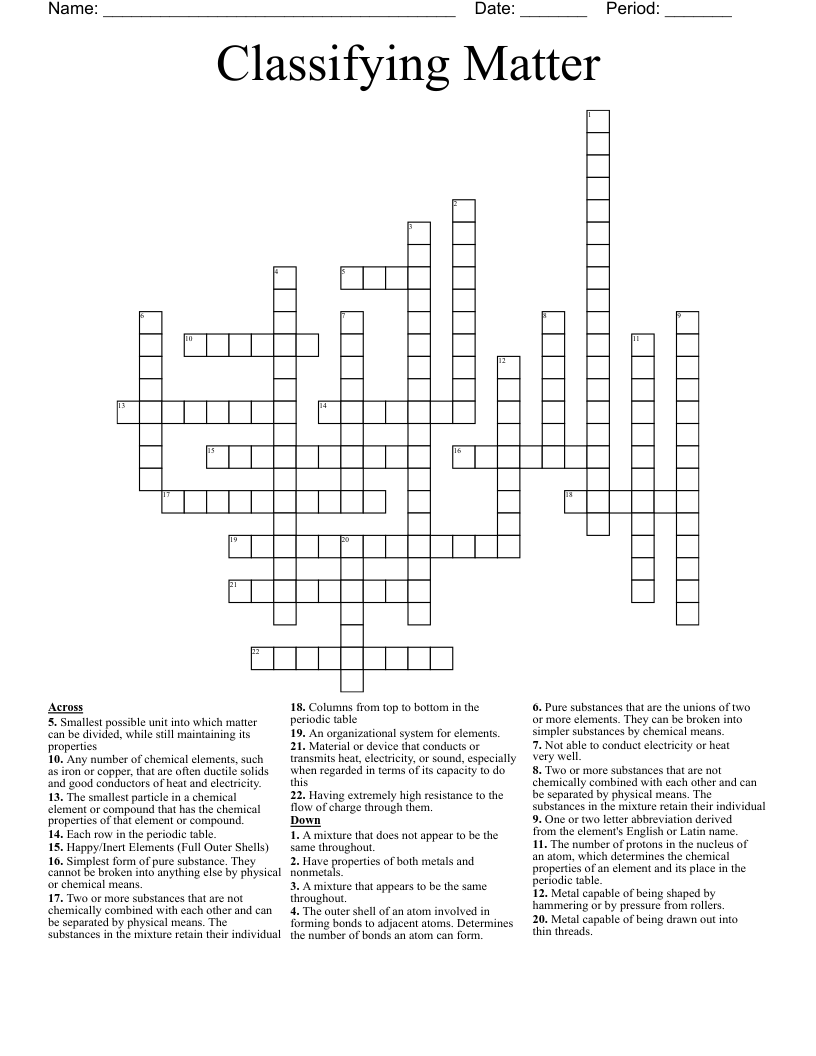
Classifying Matter Crossword
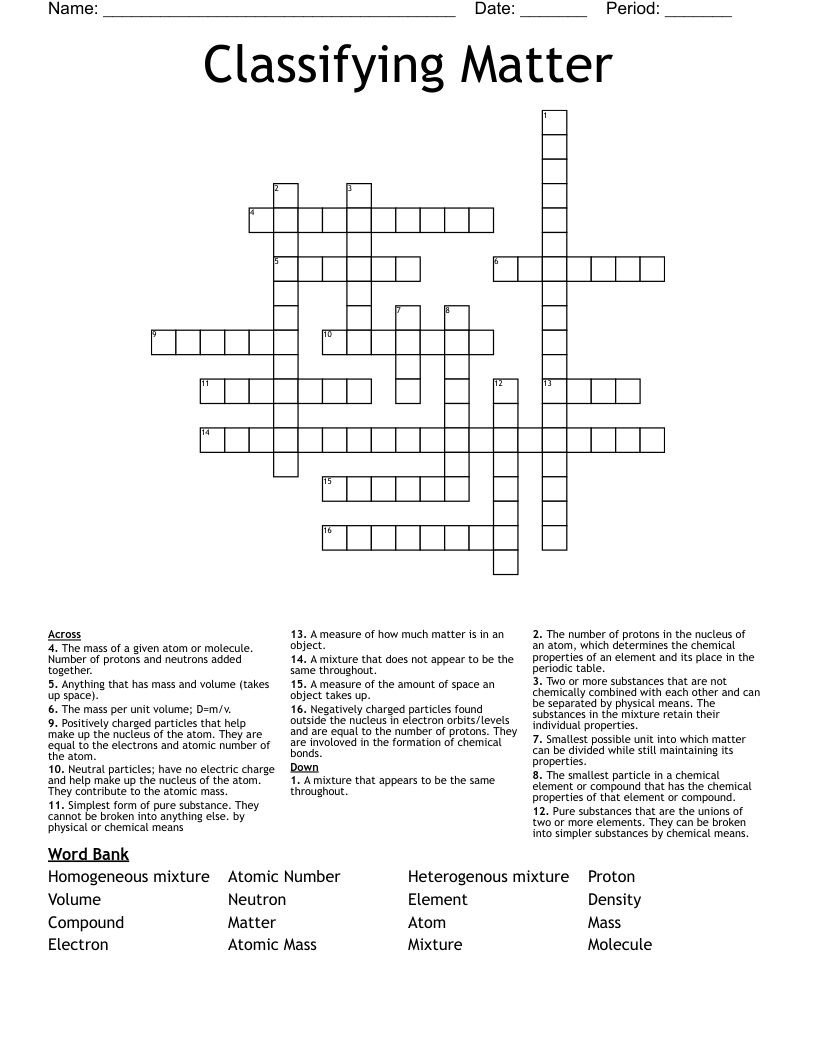
This printable crossword puzzle on the topic of Chemical Bonding & Reactions has 22 clues. Answers range from 4 to 19 letters long. This crossword is also available to download as a Microsoft Word document or a PDF.
Description
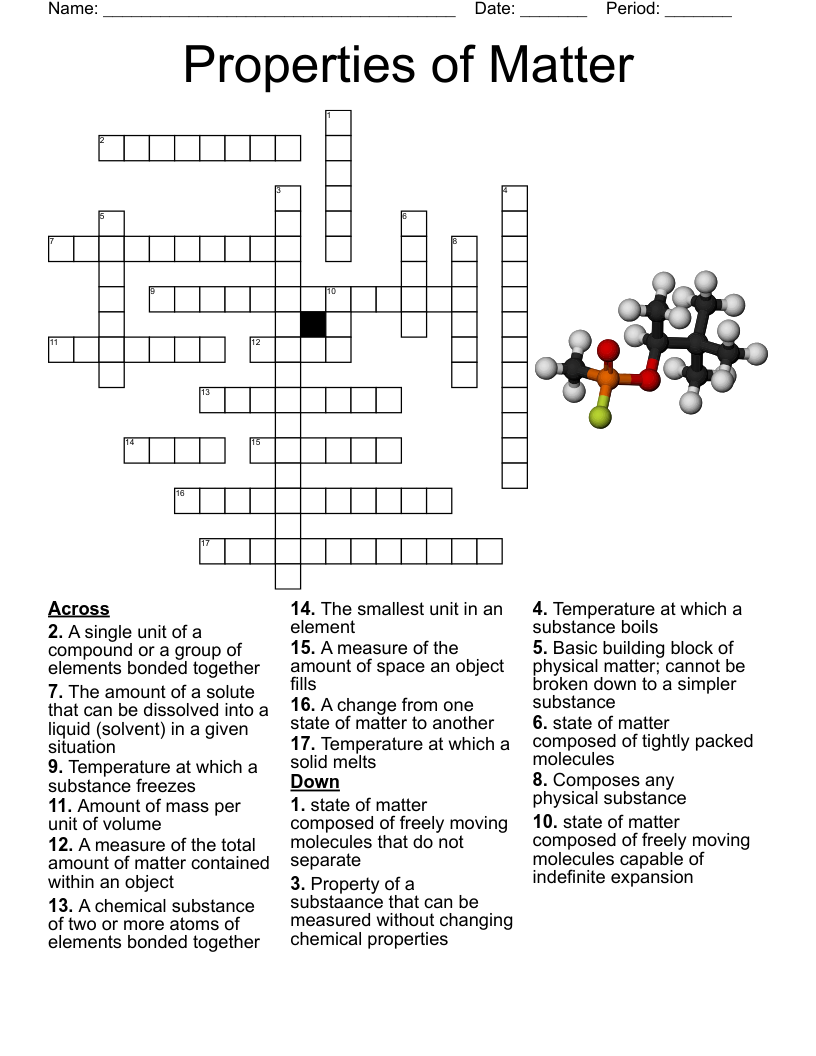
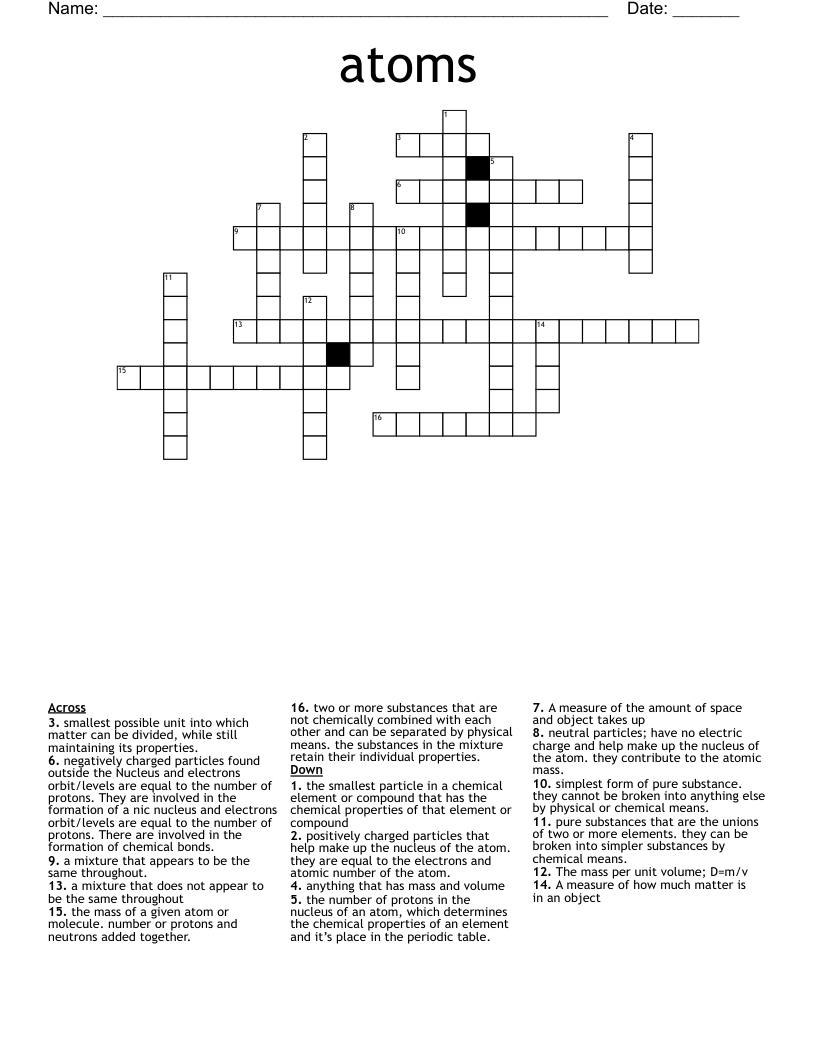
Smallest possible unit into which matter can be divided, while still maintaining its properties
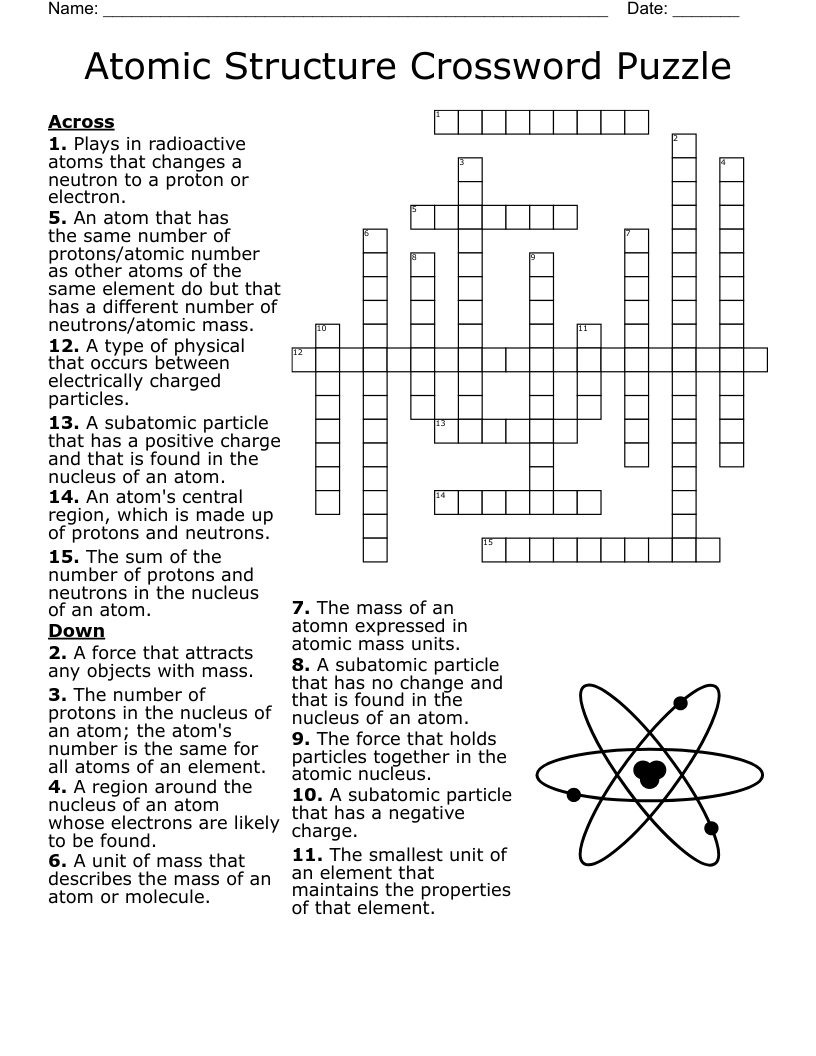
The smallest particle in a chemical element or compound that has the chemical properties of that element or compound.
Simplest form of pure substance. They cannot be broken into anything else by physical or chemical means.
Pure substances that are the unions of two or more elements. They can be broken into simpler substances by chemical means.
Two or more substances that are not chemically combined with each other and can be separated by physical means. The substances in the mixture retain their individual
Two or more substances that are not chemically combined with each other and can be separated by physical means. The substances in the mixture retain their individual
The number of protons in the nucleus of an atom, which determines the chemical properties of an element and its place in the periodic table.
A mixture that appears to be the same throughout.
A mixture that does not appear to be the same throughout.
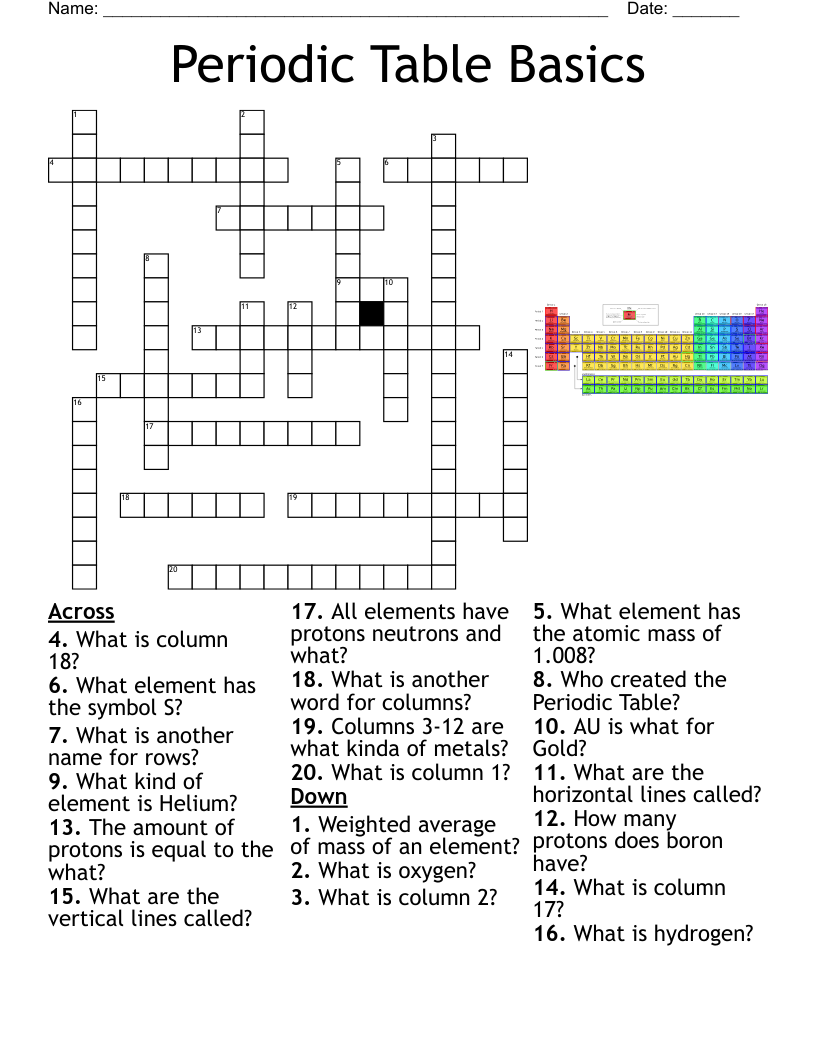
An organizational system for elements.
One or two letter abbreviation derived from the element's English or Latin name.
Columns from top to bottom in the periodic table
Each row in the periodic table.
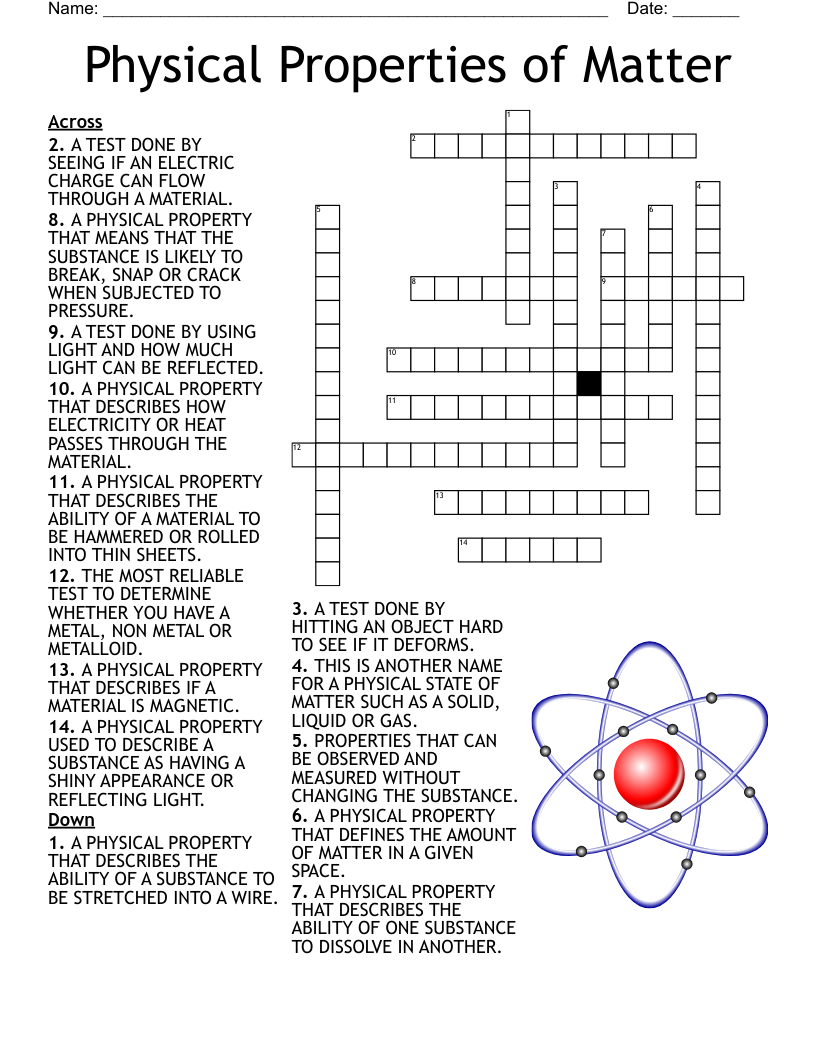
Any number of chemical elements, such as iron or copper, that are often ductile solids and good conductors of heat and electricity.
Have properties of both metals and nonmetals.
Not able to conduct electricity or heat very well.
Happy/Inert Elements (Full Outer Shells)
Metal capable of being drawn out into thin threads.
Metal capable of being shaped by hammering or by pressure from rollers.
Having extremely high resistance to the flow of charge through them.
Material or device that conducts or transmits heat, electricity, or sound, especially when regarded in terms of its capacity to do this
The outer shell of an atom involved in forming bonds to adjacent atoms. Determines the number of bonds an atom can form.