Chapter 5: The Human Body-The Axial Skeletal System Worksheet
This printable matching worksheet on the topic of Anatomy has 26 questions and answers to match. This matching worksheet is also available to download as a Microsoft Word document or a PDF.
Description
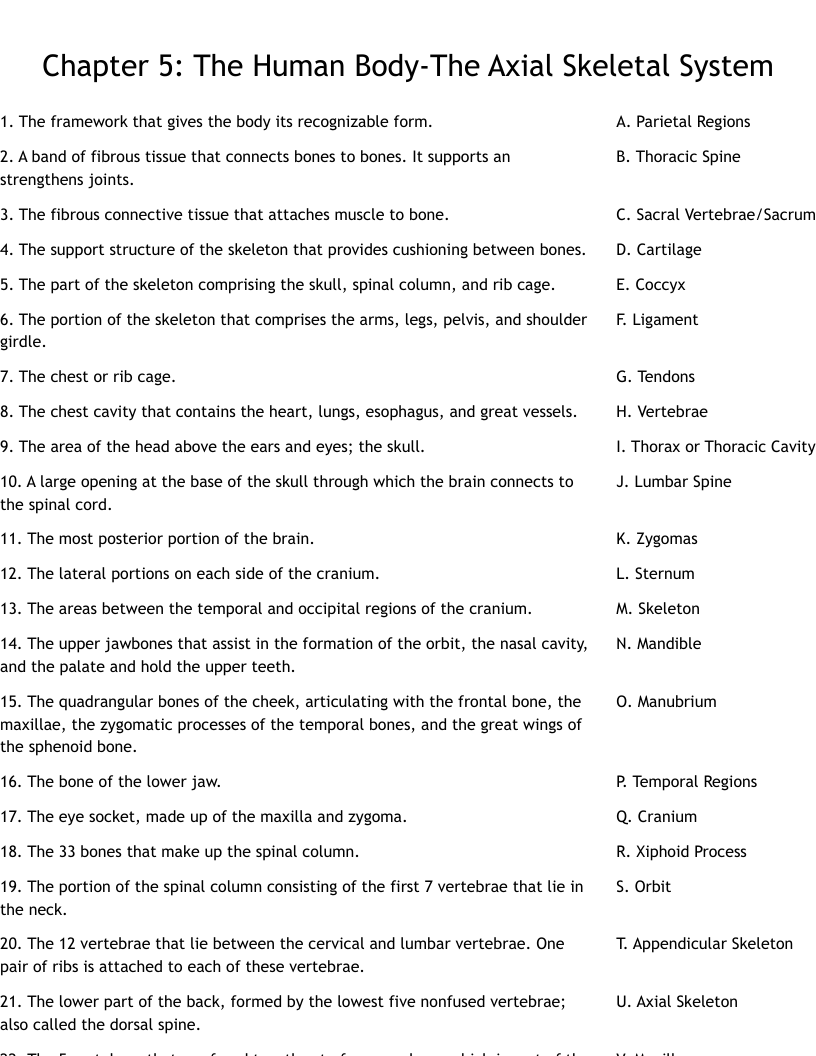
The framework that gives the body its recognizable form.
A band of fibrous tissue that connects bones to bones. It supports an strengthens joints.
The fibrous connective tissue that attaches muscle to bone.
The support structure of the skeleton that provides cushioning between bones.
The part of the skeleton comprising the skull, spinal column, and rib cage.
The portion of the skeleton that comprises the arms, legs, pelvis, and shoulder girdle.
The chest or rib cage.
The chest cavity that contains the heart, lungs, esophagus, and great vessels.
The area of the head above the ears and eyes; the skull.
A large opening at the base of the skull through which the brain connects to the spinal cord.
The most posterior portion of the brain.
The lateral portions on each side of the cranium.
The areas between the temporal and occipital regions of the cranium.
The upper jawbones that assist in the formation of the orbit, the nasal cavity, and the palate and hold the upper teeth.
The quadrangular bones of the cheek, articulating with the frontal bone, the maxillae, the zygomatic processes of the temporal bones, and the great wings of the sphenoid bone.
The bone of the lower jaw.
The eye socket, made up of the maxilla and zygoma.
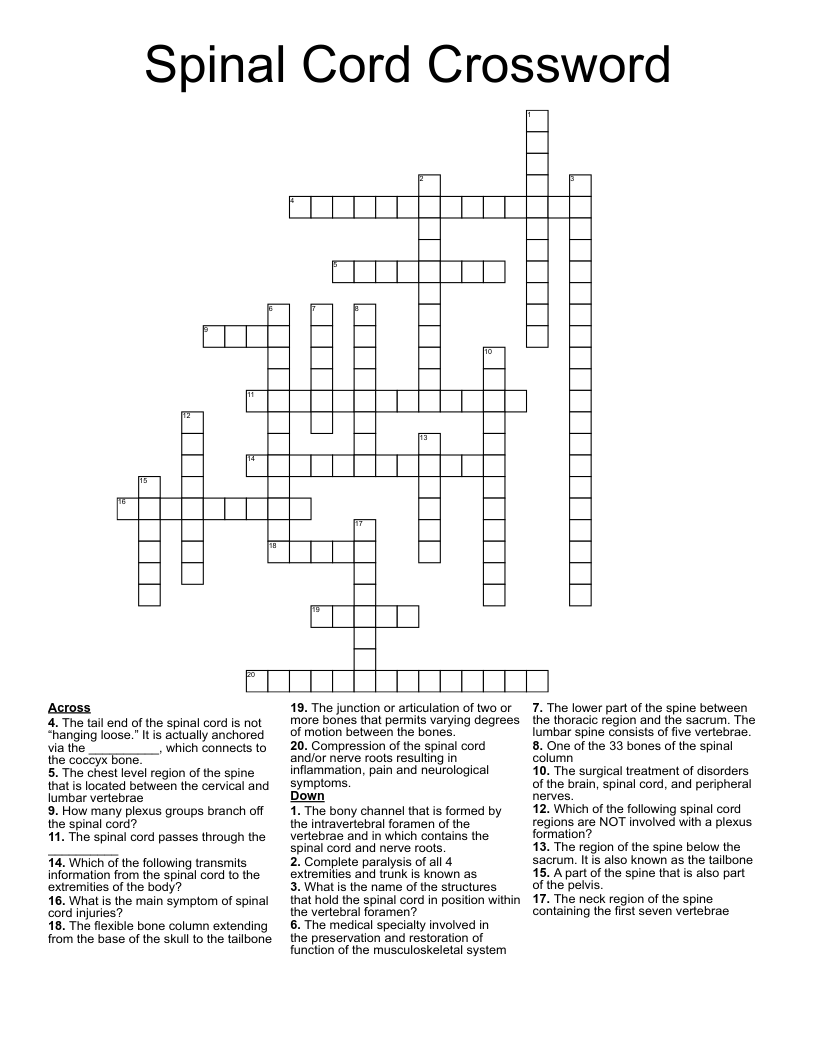
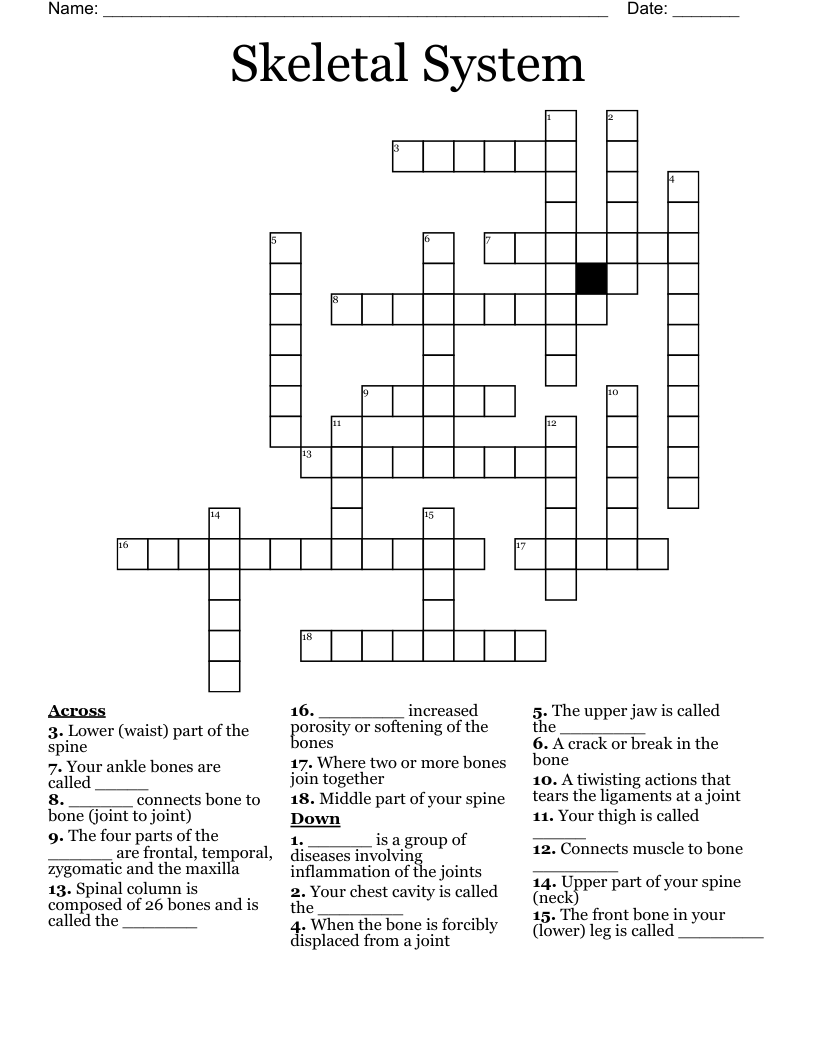
The 33 bones that make up the spinal column.
The portion of the spinal column consisting of the first 7 vertebrae that lie in the neck.
The 12 vertebrae that lie between the cervical and lumbar vertebrae. One pair of ribs is attached to each of these vertebrae.
The lower part of the back, formed by the lowest five nonfused vertebrae; also called the dorsal spine.
The 5 vertebrae that are fused together to form one bone which is part of the pelvis.
The last 3 or 4 vertebrae of the spine; the tailbone.
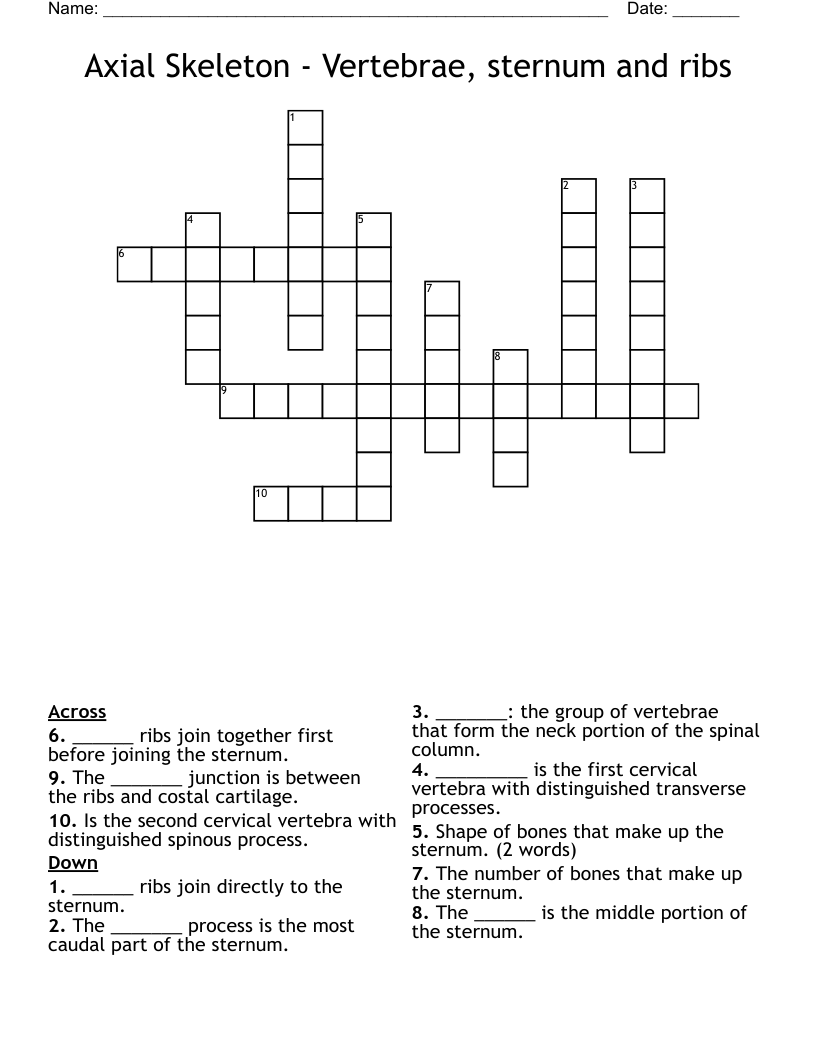
The breastbone.
The upper section of the sternum.
The narrow, cartilaginous lower tip of the sternum.