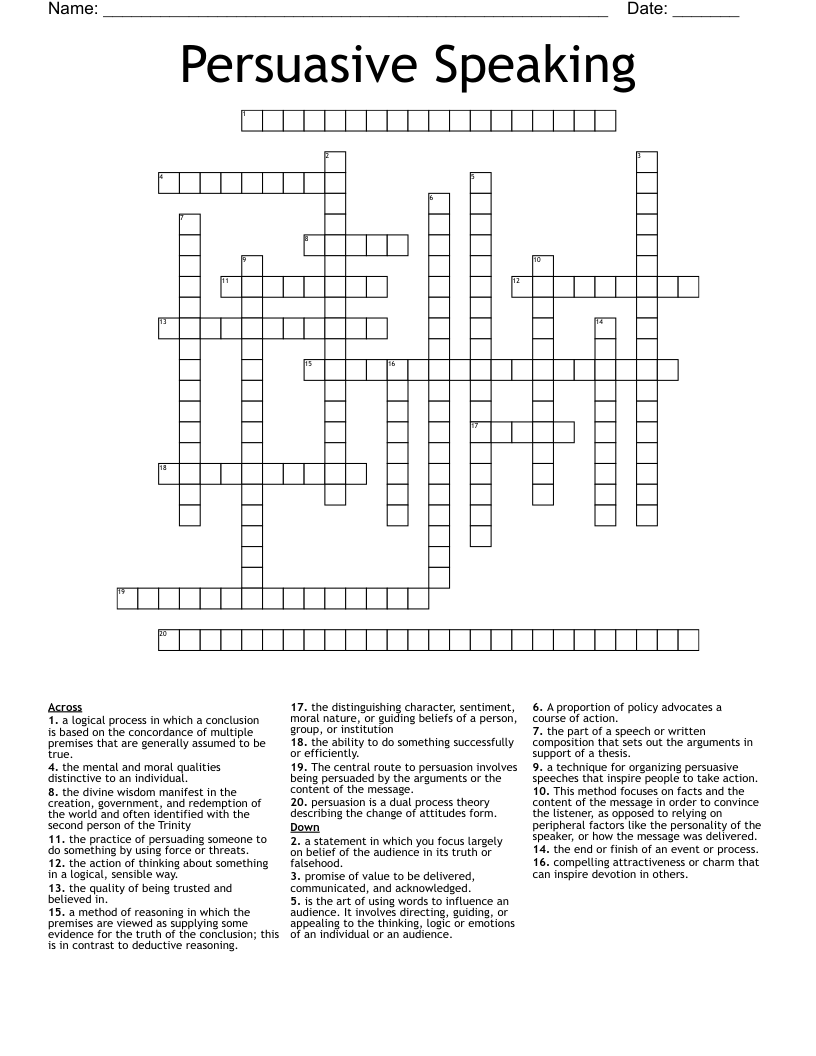
Persuasive Speaking Crossword
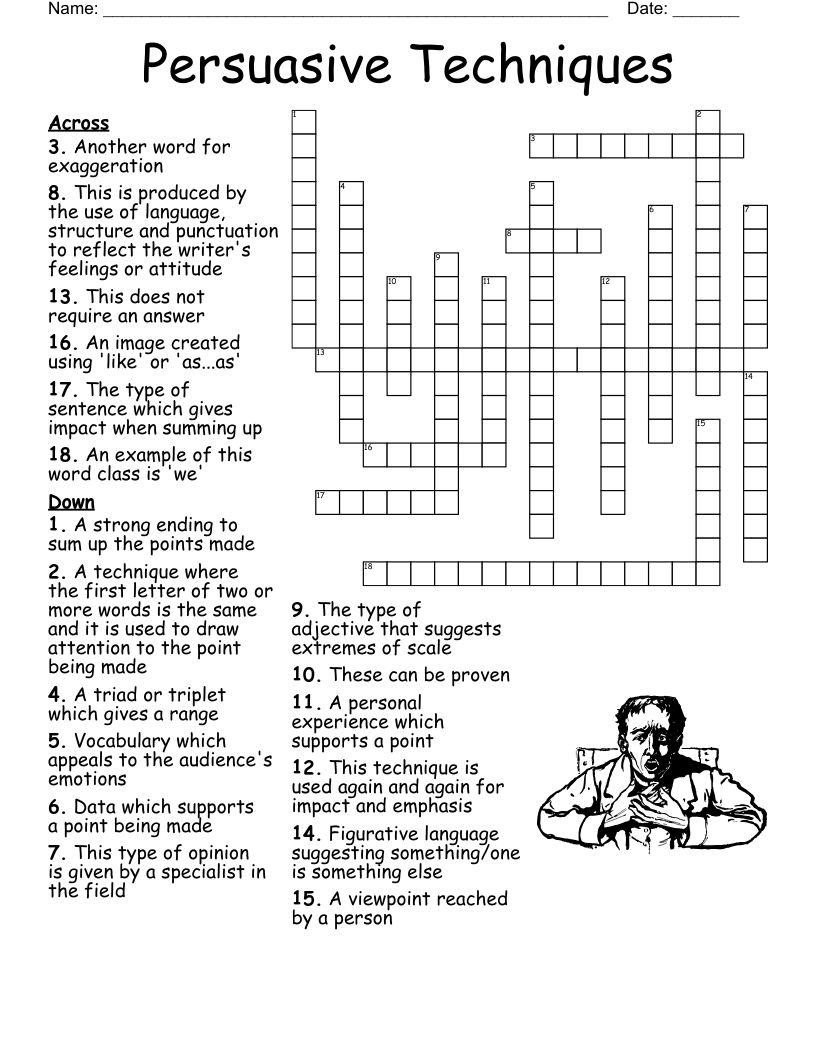
This printable crossword puzzle on the topic of Figurative Language & Literary Devices has 20 clues. Answers range from 5 to 26 letters long. This crossword is also available to download as a Microsoft Word document or a PDF.
Description
is the art of using words to influence an audience. It involves directing, guiding, or appealing to the thinking, logic or emotions of an individual or an audience.
the practice of persuading someone to do something by using force or threats.
a statement in which you focus largely on belief of the audience in its truth or falsehood.
promise of value to be delivered, communicated, and acknowledged.
A proportion of policy advocates a course of action.
persuasion is a dual process theory describing the change of attitudes form.
This method focuses on facts and the content of the message in order to convince the listener, as opposed to relying on peripheral factors like the personality of the speaker, or how the message was delivered.
The central route to persuasion involves being persuaded by the arguments or the content of the message.
the quality of being trusted and believed in.
the distinguishing character, sentiment, moral nature, or guiding beliefs of a person, group, or institution
the part of a speech or written composition that sets out the arguments in support of a thesis.
the mental and moral qualities distinctive to an individual.
the ability to do something successfully or efficiently.
compelling attractiveness or charm that can inspire devotion in others.
the divine wisdom manifest in the creation, government, and redemption of the world and often identified with the second person of the Trinity
a technique for organizing persuasive speeches that inspire people to take action.
the action of thinking about something in a logical, sensible way.
a logical process in which a conclusion is based on the concordance of multiple premises that are generally assumed to be true.
a method of reasoning in which the premises are viewed as supplying some evidence for the truth of the conclusion; this is in contrast to deductive reasoning.
the end or finish of an event or process.