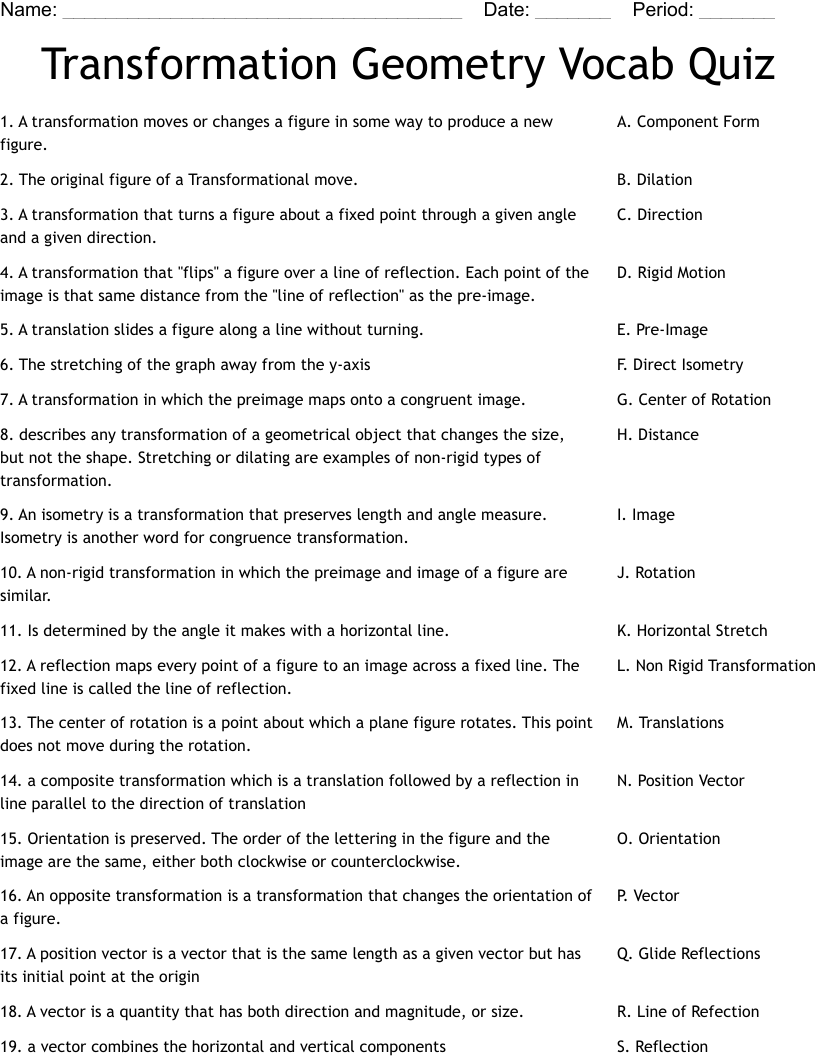
Transformation Geometry Vocab Quiz Worksheet
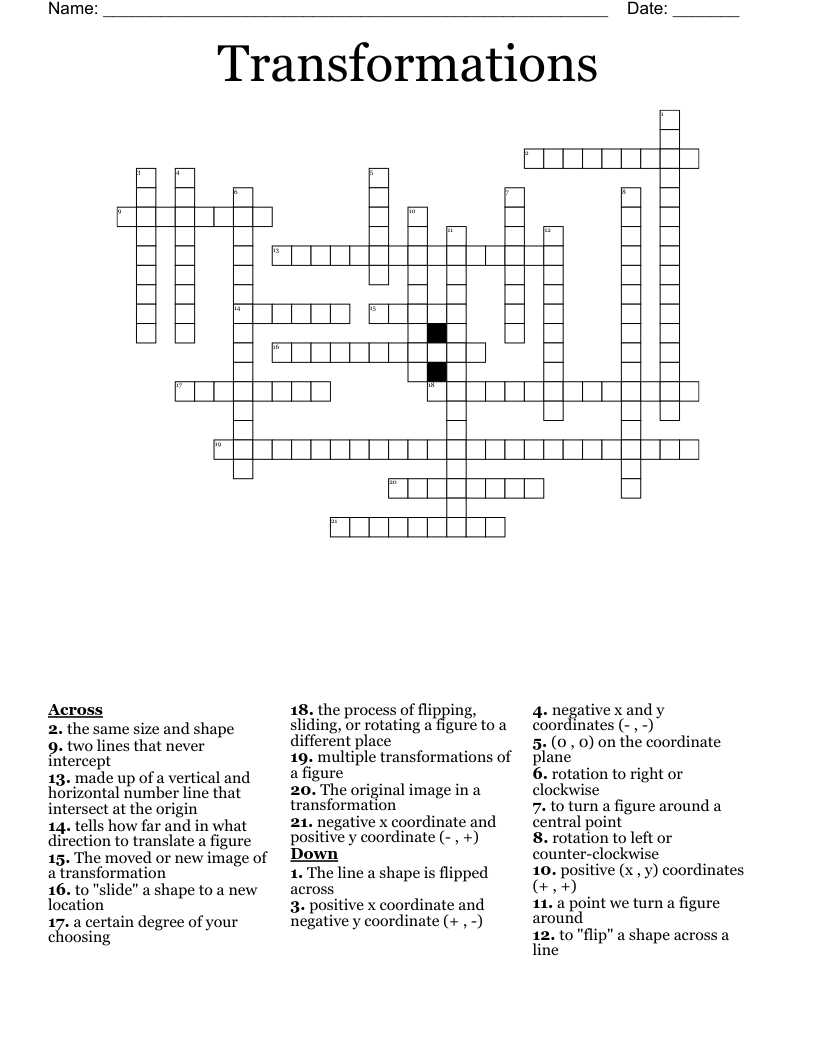
This printable matching worksheet on the topic of Geometry has 21 questions and answers to match. This matching worksheet is also available to download as a Microsoft Word document or a PDF.
Description
A transformation moves or changes a figure in some way to produce a new figure.
The original figure of a Transformational move.
A transformation that turns a figure about a fixed point through a given angle and a given direction.
A transformation that "flips" a figure over a line of reflection. Each point of the image is that same distance from the "line of reflection" as the pre-image.
A translation slides a figure along a line without turning.
The stretching of the graph away from the y-axis
A transformation in which the preimage maps onto a congruent image.
describes any transformation of a geometrical object that changes the size, but not the shape. Stretching or dilating are examples of non-rigid types of transformation.
An isometry is a transformation that preserves length and angle measure. Isometry is another word for congruence transformation.
A non-rigid transformation in which the preimage and image of a figure are similar.
Is determined by the angle it makes with a horizontal line.
A reflection maps every point of a figure to an image across a fixed line. The fixed line is called the line of reflection.
The center of rotation is a point about which a plane figure rotates. This point does not move during the rotation.
a composite transformation which is a translation followed by a reflection in line parallel to the direction of translation
Orientation is preserved. The order of the lettering in the figure and the image are the same, either both clockwise or counterclockwise.
An opposite transformation is a transformation that changes the orientation of a figure.
A position vector is a vector that is the same length as a given vector but has its initial point at the origin
A vector is a quantity that has both direction and magnitude, or size.
a vector combines the horizontal and vertical components
ordering of the letters (vertices)
lengths of segments