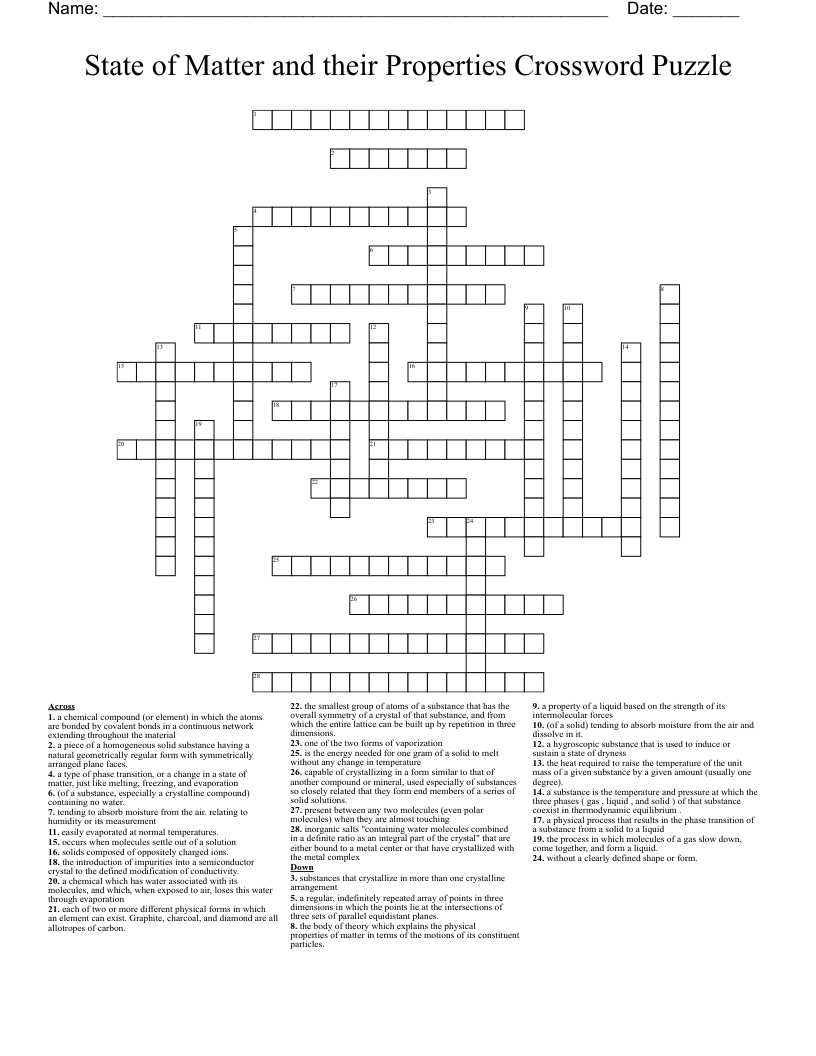
State of Matter and their Properties Crossword Puzzle
This printable crossword puzzle on the topic of Physics has 28 clues. Answers range from 7 to 15 letters long. This crossword is also available to download as a Microsoft Word document or a PDF.
Description
a piece of a homogeneous solid substance having a natural geometrically regular form with symmetrically arranged plane faces.
the smallest group of atoms of a substance that has the overall symmetry of a crystal of that substance, and from which the entire lattice can be built up by repetition in three dimensions.
solids composed of oppositely charged ions.
a chemical compound (or element) in which the atoms are bonded by covalent bonds in a continuous network extending throughout the material
a regular, indefinitely repeated array of points in three dimensions in which the points lie at the intersections of three sets of parallel equidistant planes.
(of a substance, especially a crystalline compound) containing no water.
inorganic salts "containing water molecules combined in a definite ratio as an integral part of the crystal" that are either bound to a metal center or that have crystallized with the metal complex
the introduction of impurities into a semiconductor crystal to the defined modification of conductivity.
each of two or more different physical forms in which an element can exist. Graphite, charcoal, and diamond are all allotropes of carbon.
without a clearly defined shape or form.
capable of crystallizing in a form similar to that of another compound or mineral, used especially of substances so closely related that they form end members of a series of solid solutions.
substances that crystallize in more than one crystalline arrangement
a property of a liquid based on the strength of its intermolecular forces
easily evaporated at normal temperatures.
the heat required to raise the temperature of the unit mass of a given substance by a given amount (usually one degree).
a hygroscopic substance that is used to induce or sustain a state of dryness
(of a solid) tending to absorb moisture from the air and dissolve in it.
a chemical which has water associated with its molecules, and which, when exposed to air, loses this water through evaporation
tending to absorb moisture from the air. relating to humidity or its measurement
present between any two molecules (even polar molecules) when they are almost touching
the body of theory which explains the physical properties of matter in terms of the motions of its constituent particles.
a type of phase transition, or a change in a state of matter, just like melting, freezing, and evaporation
occurs when molecules settle out of a solution
the process in which molecules of a gas slow down, come together, and form a liquid.
one of the two forms of vaporization
a physical process that results in the phase transition of a substance from a solid to a liquid
is the energy needed for one gram of a solid to melt without any change in temperature
a substance is the temperature and pressure at which the three phases ( gas , liquid , and solid ) of that substance coexist in thermodynamic equilibrium .