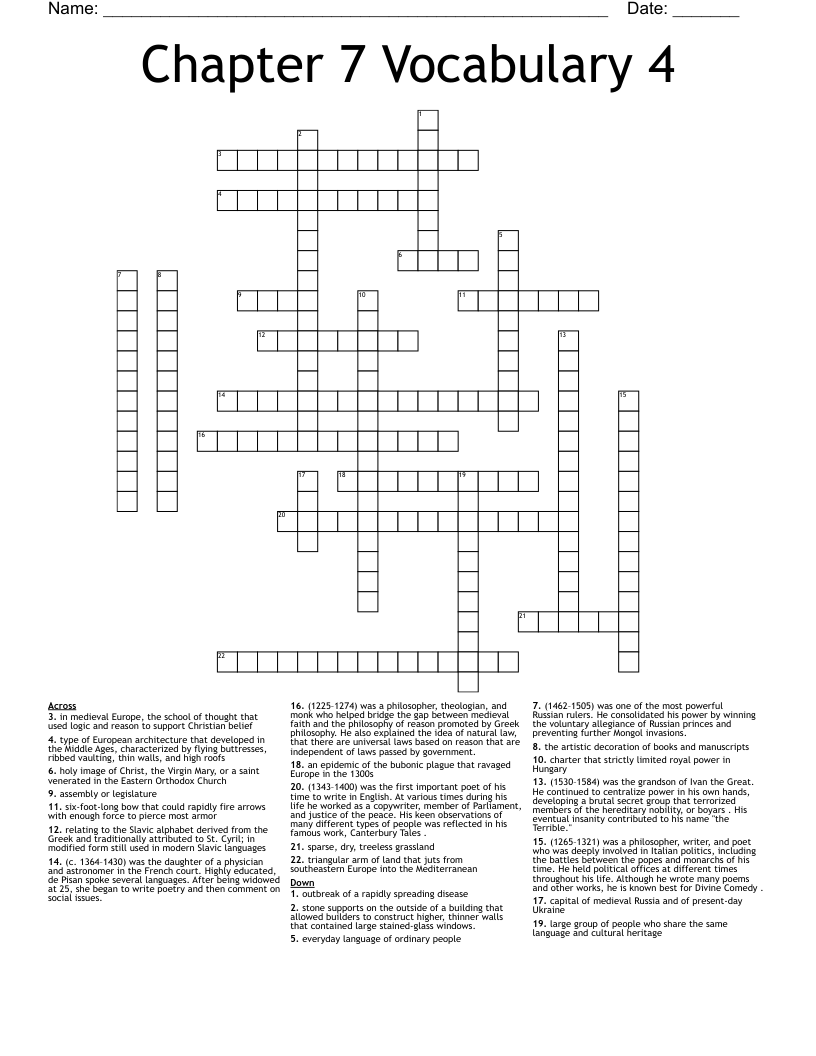
Chapter 7 Vocabulary 4 Crossword
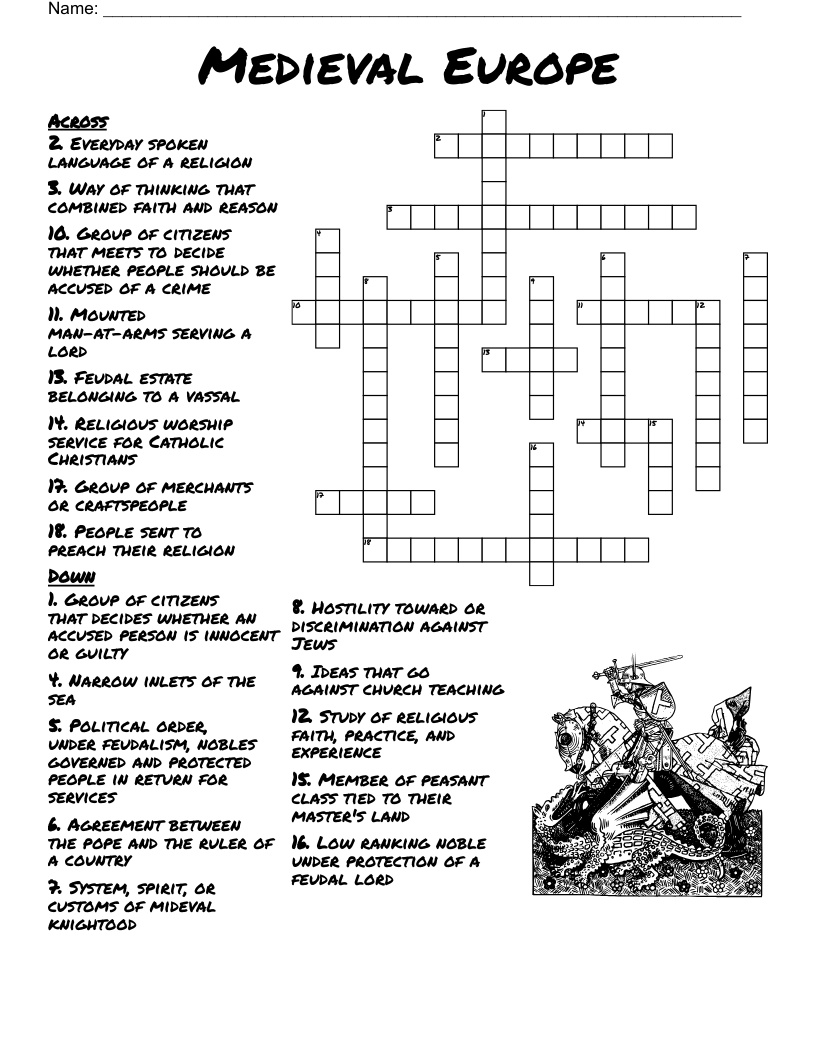
This printable crossword puzzle on the topic of Medieval History has 22 clues. Answers range from 4 to 16 letters long. This crossword is also available to download as a Microsoft Word document or a PDF.
Description
in medieval Europe, the school of thought that used logic and reason to support Christian belief
(1225–1274) was a philosopher, theologian, and monk who helped bridge the gap between medieval faith and the philosophy of reason promoted by Greek philosophy. He also explained the idea of natural law, that there are universal laws based on reason that are independent of laws passed by government.
everyday language of ordinary people
(1265–1321) was a philosopher, writer, and poet who was deeply involved in Italian politics, including the battles between the popes and monarchs of his time. He held political offices at different times throughout his life. Although he wrote many poems and other works, he is known best for Divine Comedy .
(1343–1400) was the first important poet of his time to write in English. At various times during his life he worked as a copywriter, member of Parliament, and justice of the peace. His keen observations of many different types of people was reflected in his famous work, Canterbury Tales .
type of European architecture that developed in the Middle Ages, characterized by flying buttresses, ribbed vaulting, thin walls, and high roofs
stone supports on the outside of a building that allowed builders to construct higher, thinner walls that contained large stained-glass windows.
the artistic decoration of books and manuscripts
(c. 1364–1430) was the daughter of a physician and astronomer in the French court. Highly educated, de Pisan spoke several languages. After being widowed at 25, she began to write poetry and then comment on social issues.
holy image of Christ, the Virgin Mary, or a saint venerated in the Eastern Orthodox Church
an epidemic of the bubonic plague that ravaged Europe in the 1300s
outbreak of a rapidly spreading disease
six-foot-long bow that could rapidly fire arrows with enough force to pierce most armor
sparse, dry, treeless grassland
capital of medieval Russia and of present-day Ukraine
relating to the Slavic alphabet derived from the Greek and traditionally attributed to St. Cyril; in modified form still used in modern Slavic languages
(1462–1505) was one of the most powerful Russian rulers. He consolidated his power by winning the voluntary allegiance of Russian princes and preventing further Mongol invasions.
(1530–1584) was the grandson of Ivan the Great. He continued to centralize power in his own hands, developing a brutal secret group that terrorized members of the hereditary nobility, or boyars . His eventual insanity contributed to his name "the Terrible."
triangular arm of land that juts from southeastern Europe into the Mediterranean
large group of people who share the same language and cultural heritage
assembly or legislature
charter that strictly limited royal power in Hungary