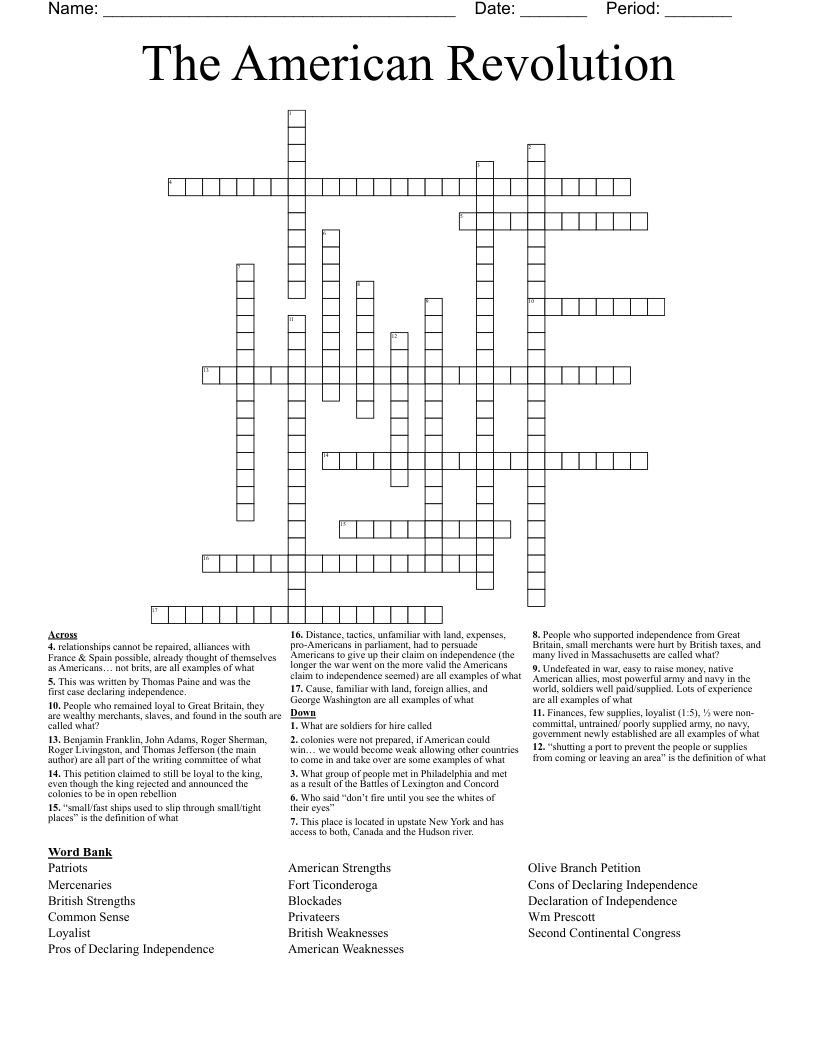
The American Revolution Crossword
This printable crossword puzzle on the topic of American Revolution & Colonial Era has 17 clues. Answers range from 8 to 27 letters long. This crossword is also available to download as a Microsoft Word document or a PDF.
Description
What group of people met in Philadelphia and met as a result of the Battles of Lexington and Concord
This petition claimed to still be loyal to the king, even though the king rejected and announced the colonies to be in open rebellion
People who remained loyal to Great Britain, they are wealthy merchants, slaves, and found in the south are called what?
People who supported independence from Great Britain, small merchants were hurt by British taxes, and many lived in Massachusetts are called what?
Undefeated in war, easy to raise money, native American allies, most powerful army and navy in the world, soldiers well paid/supplied. Lots of experience are all examples of what
Distance, tactics, unfamiliar with land, expenses, pro-Americans in parliament, had to persuade Americans to give up their claim on independence (the longer the war went on the more valid the Americans claim to independence seemed) are all examples of what
Cause, familiar with land, foreign allies, and George Washington are all examples of what
Finances, few supplies, loyalist (1:5), ½ were non- committal, untrained/ poorly supplied army, no navy, government newly established are all examples of what
This place is located in upstate New York and has access to both, Canada and the Hudson river.
Who said “don’t fire until you see the whites of their eyes”
What are soldiers for hire called
This was written by Thomas Paine and was the first case declaring independence.
relationships cannot be repaired, alliances with France & Spain possible, already thought of themselves as Americans… not brits, are all examples of what
colonies were not prepared, if American could win… we would become weak allowing other countries to come in and take over are some examples of what
“shutting a port to prevent the people or supplies from coming or leaving an area” is the definition of what
“small/fast ships used to slip through small/tight places” is the definition of what
Benjamin Franklin, John Adams, Roger Sherman, Roger Livingston, and Thomas Jefferson (the main author) are all part of the writing committee of what