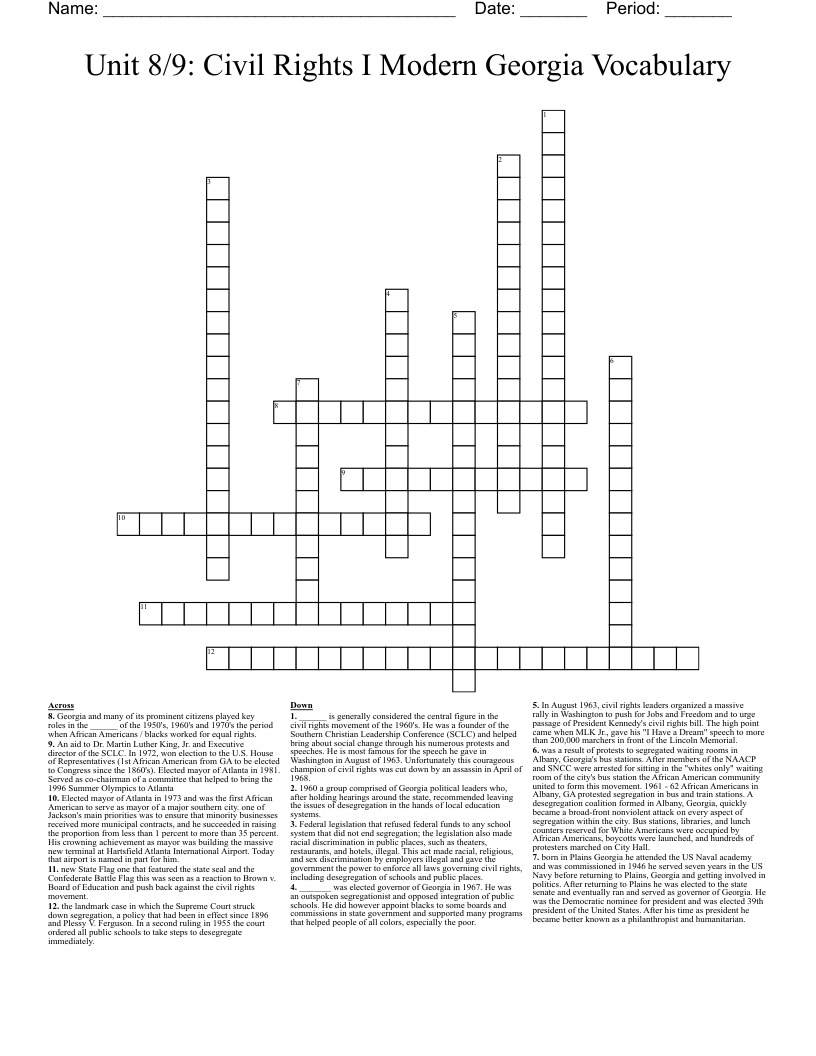
Unit 8/9: Civil Rights I Modern Georgia Vocabulary Crossword
This printable crossword puzzle on the topic of Civil Rights & Social Movements has 12 clues. Answers range from 11 to 23 letters long. This crossword is also available to download as a Microsoft Word document or a PDF.
Description
new State Flag one that featured the state seal and the Confederate Battle Flag this was seen as a reaction to Brown v. Board of Education and push back against the civil rights movement.
1960 a group comprised of Georgia political leaders who, after holding hearings around the state, recommended leaving the issues of desegregation in the hands of local education systems.
was a result of protests to segregated waiting rooms in Albany, Georgia's bus stations. After members of the NAACP and SNCC were arrested for sitting in the "whites only" waiting room of the city's bus station the African American community united to form this movement. 1961 - 62 African Americans in Albany, GA protested segregation in bus and train stations. A desegregation coalition formed in Albany, Georgia, quickly became a broad-front nonviolent attack on every aspect of segregation within the city. Bus stations, libraries, and lunch counters reserved for White Americans were occupied by African Americans, boycotts were launched, and hundreds of protesters marched on City Hall.
In August 1963, civil rights leaders organized a massive rally in Washington to push for Jobs and Freedom and to urge passage of President Kennedy's civil rights bill. The high point came when MLK Jr., gave his "I Have a Dream" speech to more than 200,000 marchers in front of the Lincoln Memorial.
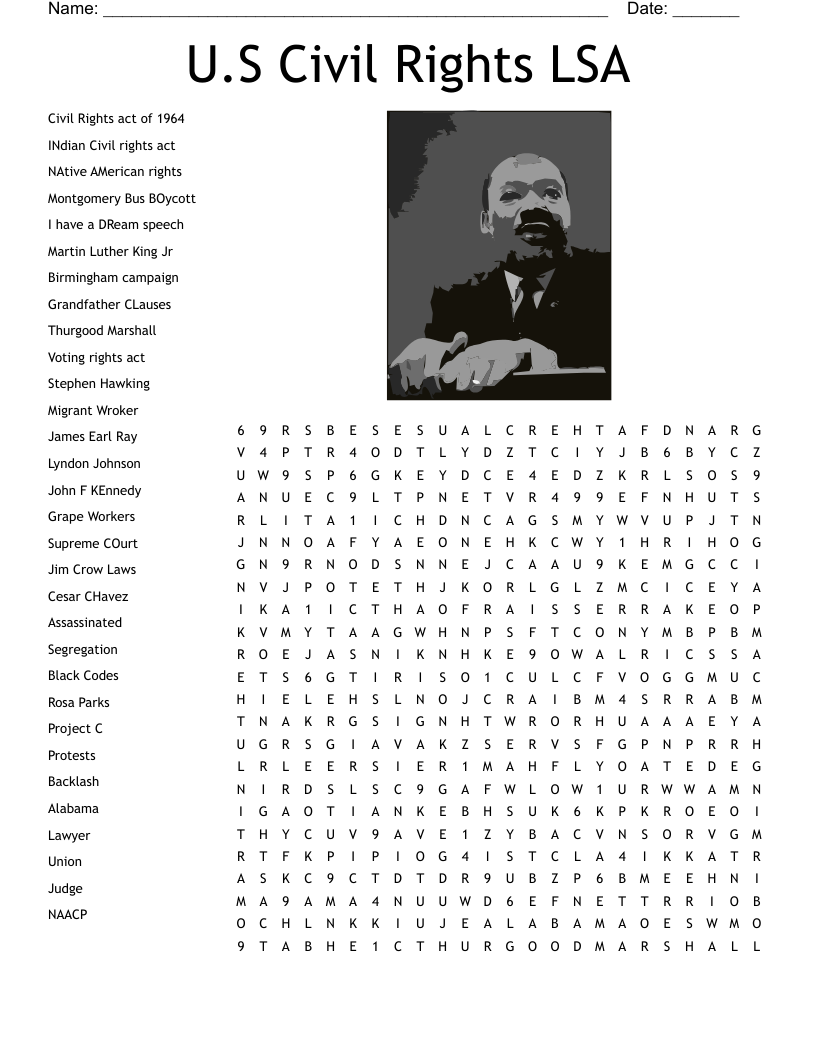
Georgia and many of its prominent citizens played key roles in the ______ of the 1950's, 1960's and 1970's the period when African Americans / blacks worked for equal rights.
_______ was elected governor of Georgia in 1967. He was an outspoken segregationist and opposed integration of public schools. He did however appoint blacks to some boards and commissions in state government and supported many programs that helped people of all colors, especially the poor.
the landmark case in which the Supreme Court struck down segregation, a policy that had been in effect since 1896 and Plessy V. Ferguson. In a second ruling in 1955 the court ordered all public schools to take steps to desegregate immediately.
Federal legislation that refused federal funds to any school system that did not end segregation; the legislation also made racial discrimination in public places, such as theaters, restaurants, and hotels, illegal. This act made racial, religious, and sex discrimination by employers illegal and gave the government the power to enforce all laws governing civil rights, including desegregation of schools and public places.
Elected mayor of Atlanta in 1973 and was the first African American to serve as mayor of a major southern city. one of Jackson's main priorities was to ensure that minority businesses received more municipal contracts, and he succeeded in raising the proportion from less than 1 percent to more than 35 percent. His crowning achievement as mayor was building the massive new terminal at Hartsfield Atlanta International Airport. Today that airport is named in part for him.
An aid to Dr. Martin Luther King, Jr. and Executive director of the SCLC. In 1972, won election to the U.S. House of Representatives (1st African American from GA to be elected to Congress since the 1860's). Elected mayor of Atlanta in 1981. Served as co-chairman of a committee that helped to bring the 1996 Summer Olympics to Atlanta
born in Plains Georgia he attended the US Naval academy and was commissioned in 1946 he served seven years in the US Navy before returning to Plains, Georgia and getting involved in politics. After returning to Plains he was elected to the state senate and eventually ran and served as governor of Georgia. He was the Democratic nominee for president and was elected 39th president of the United States. After his time as president he became better known as a philanthropist and humanitarian.
______ is generally considered the central figure in the civil rights movement of the 1960's. He was a founder of the Southern Christian Leadership Conference (SCLC) and helped bring about social change through his numerous protests and speeches. He is most famous for the speech he gave in Washington in August of 1963. Unfortunately this courageous champion of civil rights was cut down by an assassin in April of 1968.