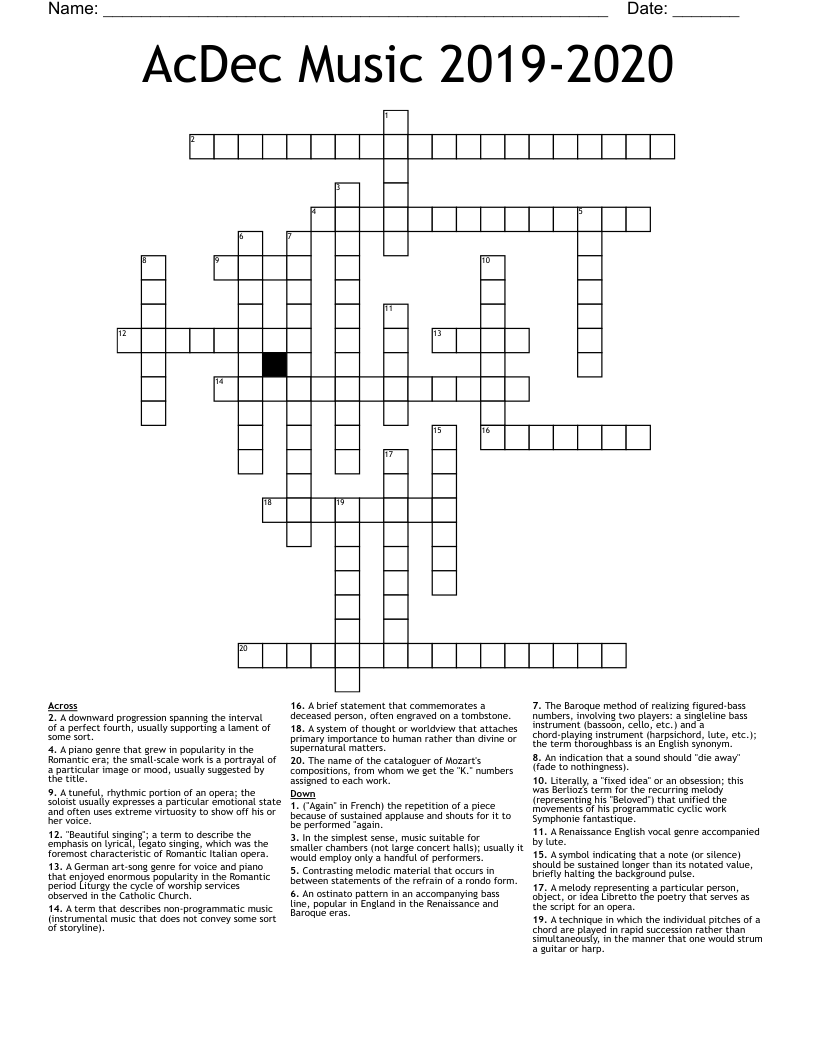
AcDec Music 2019-2020 Crossword
This printable crossword puzzle on the topic of Music has 20 clues. Answers range from 4 to 20 letters long. This crossword is also available to download as a Microsoft Word document or a PDF.
Description
A term that describes non-programmatic music (instrumental music that does not convey some sort of storyline).
A tuneful, rhythmic portion of an opera; the soloist usually expresses a particular emotional state and often uses extreme virtuosity to show off his or her voice.
A technique in which the individual pitches of a chord are played in rapid succession rather than simultaneously, in the manner that one would strum a guitar or harp.
A Renaissance English vocal genre accompanied by lute.
The Baroque method of realizing figured-bass numbers, involving two players: a singleline bass instrument (bassoon, cello, etc.) and a chord-playing instrument (harpsichord, lute, etc.); the term thoroughbass is an English synonym.
"Beautiful singing"; a term to describe the emphasis on lyrical, legato singing, which was the foremost characteristic of Romantic Italian opera.
In the simplest sense, music suitable for smaller chambers (not large concert halls); usually it would employ only a handful of performers.
A piano genre that grew in popularity in the Romantic era; the small-scale work is a portrayal of a particular image or mood, usually suggested by the title.
A downward progression spanning the interval of a perfect fourth, usually supporting a lament of some sort.
("Again" in French) the repetition of a piece because of sustained applause and shouts for it to be performed "again.
Contrasting melodic material that occurs in between statements of the refrain of a rondo form.
A brief statement that commemorates a deceased person, often engraved on a tombstone.
A symbol indicating that a note (or silence) should be sustained longer than its notated value, briefly halting the background pulse.
An ostinato pattern in an accompanying bass line, popular in England in the Renaissance and Baroque eras.
A system of thought or worldview that attaches primary importance to human rather than divine or supernatural matters.
Literally, a "fixed idea" or an obsession; this was Berlioz's term for the recurring melody (representing his "Beloved") that unified the movements of his programmatic cyclic work Symphonie fantastique.
The name of the cataloguer of Mozart's compositions, from whom we get the "K." numbers assigned to each work.
A melody representing a particular person, object, or idea Libretto the poetry that serves as the script for an opera.
A German art-song genre for voice and piano that enjoyed enormous popularity in the Romantic period Liturgy the cycle of worship services observed in the Catholic Church.
An indication that a sound should "die away" (fade to nothingness).