NF Unit 14 - Suctioning Upper Airway & Oxygen Therapy - Part 1 Worksheet
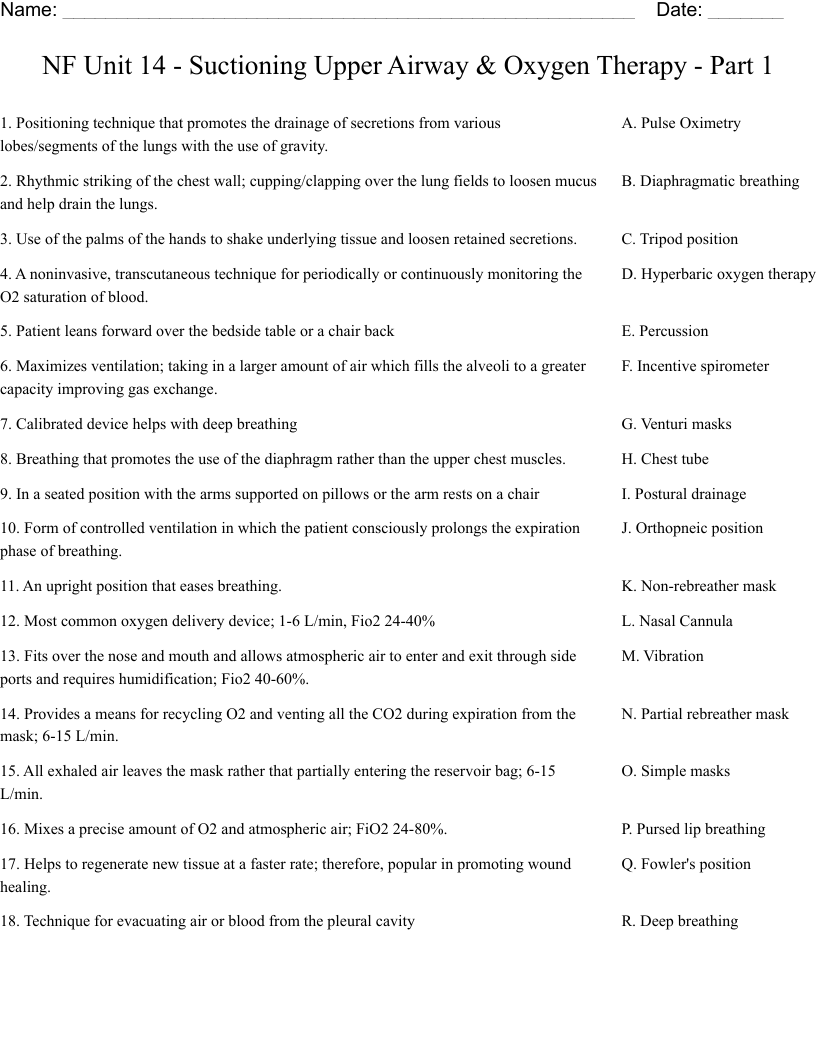
This printable matching worksheet on the topic of Nursing & Healthcare Careers has 18 questions and answers to match. This matching worksheet is also available to download as a Microsoft Word document or a PDF.
Description
Positioning technique that promotes the drainage of secretions from various lobes/segments of the lungs with the use of gravity.
Rhythmic striking of the chest wall; cupping/clapping over the lung fields to loosen mucus and help drain the lungs.
Use of the palms of the hands to shake underlying tissue and loosen retained secretions.
A noninvasive, transcutaneous technique for periodically or continuously monitoring the O2 saturation of blood.
Patient leans forward over the bedside table or a chair back
Maximizes ventilation; taking in a larger amount of air which fills the alveoli to a greater capacity improving gas exchange.
Calibrated device helps with deep breathing
Breathing that promotes the use of the diaphragm rather than the upper chest muscles.
In a seated position with the arms supported on pillows or the arm rests on a chair
Form of controlled ventilation in which the patient consciously prolongs the expiration phase of breathing.
An upright position that eases breathing.
Most common oxygen delivery device; 1-6 L/min, Fio2 24-40%
Fits over the nose and mouth and allows atmospheric air to enter and exit through side ports and requires humidification; Fio2 40-60%.
Provides a means for recycling O2 and venting all the CO2 during expiration from the mask; 6-15 L/min.
All exhaled air leaves the mask rather that partially entering the reservoir bag; 6-15 L/min.
Mixes a precise amount of O2 and atmospheric air; FiO2 24-80%.
Helps to regenerate new tissue at a faster rate; therefore, popular in promoting wound healing.
Technique for evacuating air or blood from the pleural cavity