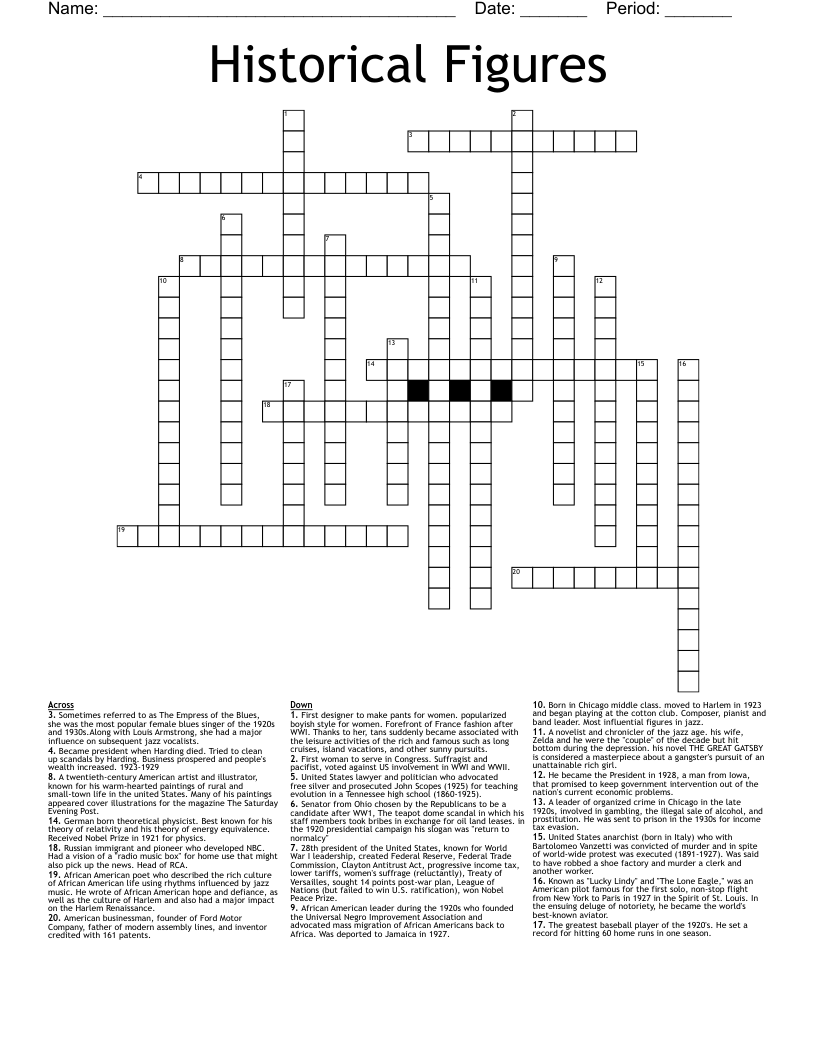
Historical Figures Crossword
This printable crossword puzzle on the topic of Westward Expansion & Industrialization has 20 clues. Answers range from 8 to 20 letters long. This crossword is also available to download as a Microsoft Word document or a PDF.
Description
First designer to make pants for women. popularized boyish style for women. Forefront of France fashion after WWI. Thanks to her, tans suddenly became associated with the leisure activities of the rich and famous such as long cruises, island vacations, and other sunny pursuits.
A novelist and chronicler of the jazz age. his wife, Zelda and he were the "couple" of the decade but hit bottom during the depression. his novel THE GREAT GATSBY is considered a masterpiece about a gangster's pursuit of an unattainable rich girl.
Known as "Lucky Lindy" and "The Lone Eagle," was an American pilot famous for the first solo, non-stop flight from New York to Paris in 1927 in the Spirit of St. Louis. In the ensuing deluge of notoriety, he became the world's best-known aviator.
A leader of organized crime in Chicago in the late 1920s, involved in gambling, the illegal sale of alcohol, and prostitution. He was sent to prison in the 1930s for income tax evasion.
The greatest baseball player of the 1920's. He set a record for hitting 60 home runs in one season.
German born theoretical physicist. Best known for his theory of relativity and his theory of energy equivalence. Received Nobel Prize in 1921 for physics.
Born in Chicago middle class. moved to Harlem in 1923 and began playing at the cotton club. Composer, pianist and band leader. Most influential figures in jazz.
Sometimes referred to as The Empress of the Blues, she was the most popular female blues singer of the 1920s and 1930s.Along with Louis Armstrong, she had a major influence on subsequent jazz vocalists.
28th president of the United States, known for World War I leadership, created Federal Reserve, Federal Trade Commission, Clayton Antitrust Act, progressive income tax, lower tariffs, women's suffrage (reluctantly), Treaty of Versailles, sought 14 points post-war plan, League of Nations (but failed to win U.S. ratification), won Nobel Peace Prize.
United States anarchist (born in Italy) who with Bartolomeo Vanzetti was convicted of murder and in spite of world-wide protest was executed (1891-1927). Was said to have robbed a shoe factory and murder a clerk and another worker.
African American leader during the 1920s who founded the Universal Negro Improvement Association and advocated mass migration of African Americans back to Africa. Was deported to Jamaica in 1927.
Senator from Ohio chosen by the Republicans to be a candidate after WW1, The teapot dome scandal in which his staff members took bribes in exchange for oil land leases. in the 1920 presidential campaign his slogan was "return to normalcy"
Became president when Harding died. Tried to clean up scandals by Harding. Business prospered and people's wealth increased. 1923-1929
He became the President in 1928, a man from Iowa, that promised to keep government intervention out of the nation's current economic problems.
American businessman, founder of Ford Motor Company, father of modern assembly lines, and inventor credited with 161 patents.
Russian immigrant and pioneer who developed NBC. Had a vision of a "radio music box" for home use that might also pick up the news. Head of RCA.
First woman to serve in Congress. Suffragist and pacifist, voted against US involvement in WWI and WWII.
African American poet who described the rich culture of African American life using rhythms influenced by jazz music. He wrote of African American hope and defiance, as well as the culture of Harlem and also had a major impact on the Harlem Renaissance.
A twentieth-century American artist and illustrator, known for his warm-hearted paintings of rural and small-town life in the united States. Many of his paintings appeared cover illustrations for the magazine The Saturday Evening Post.
United States lawyer and politician who advocated free silver and prosecuted John Scopes (1925) for teaching evolution in a Tennessee high school (1860-1925).