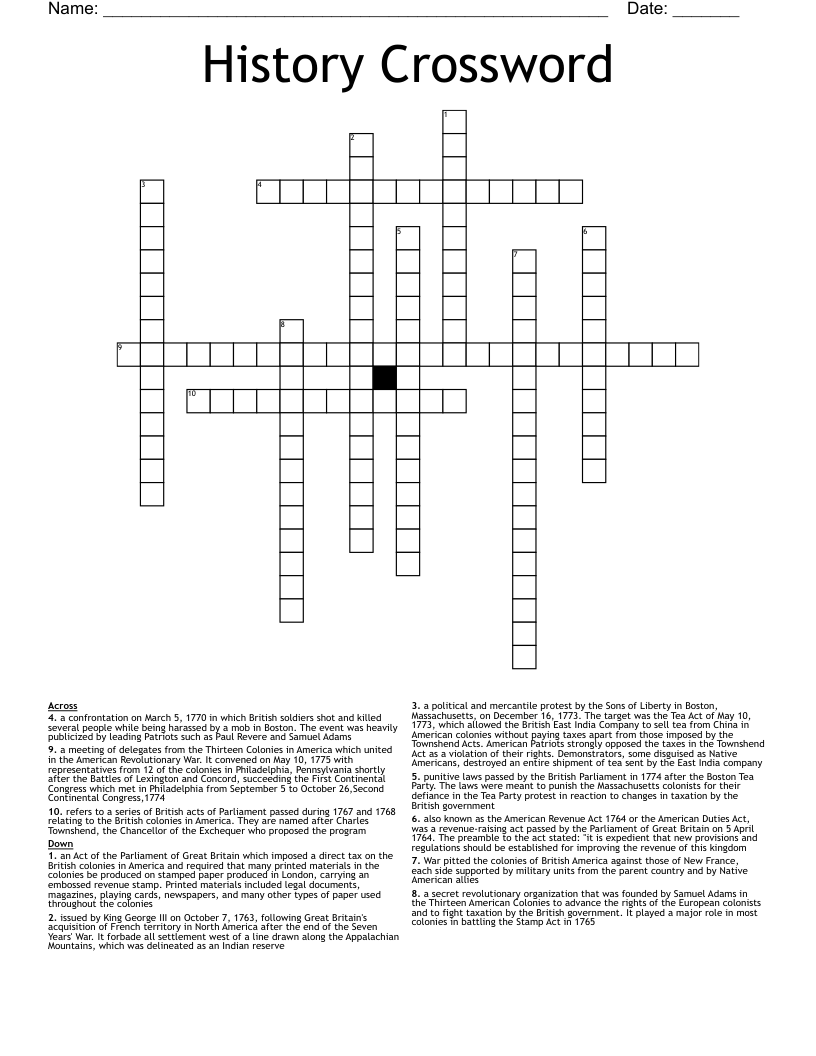
History Crossword
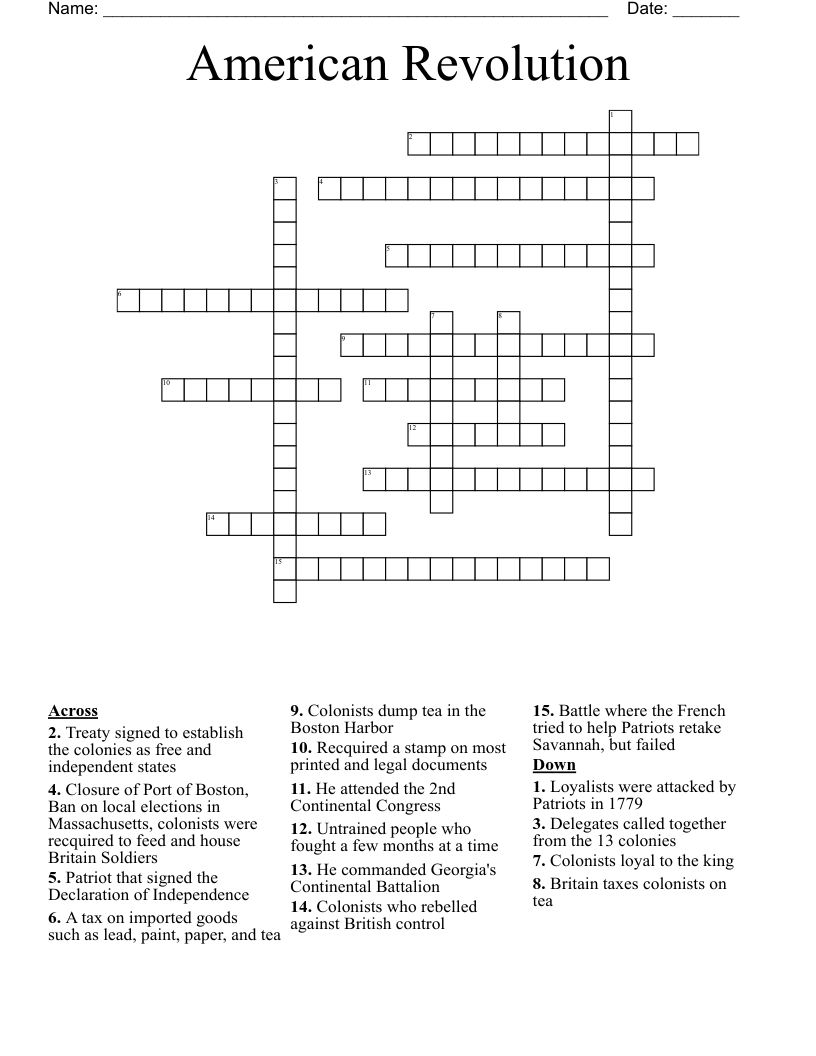
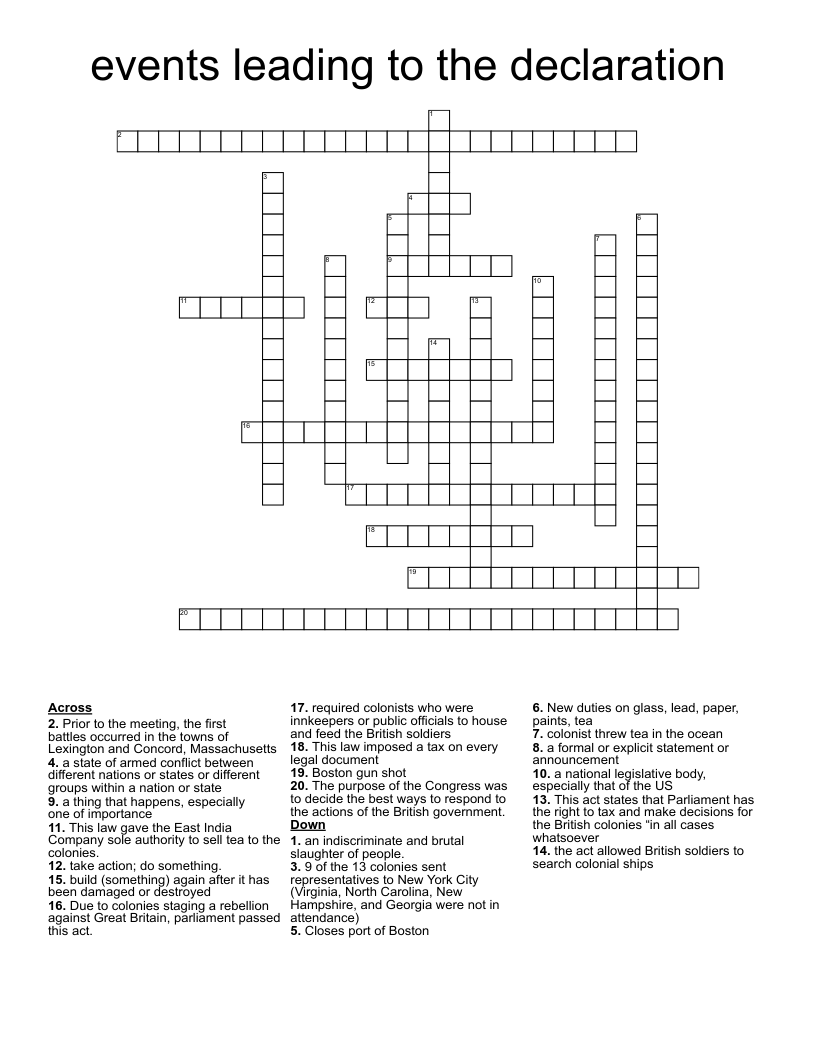
This printable crossword puzzle on the topic of American Revolution & Colonial Era has 10 clues. Answers range from 11 to 25 letters long. This crossword is also available to download as a Microsoft Word document or a PDF.
Description
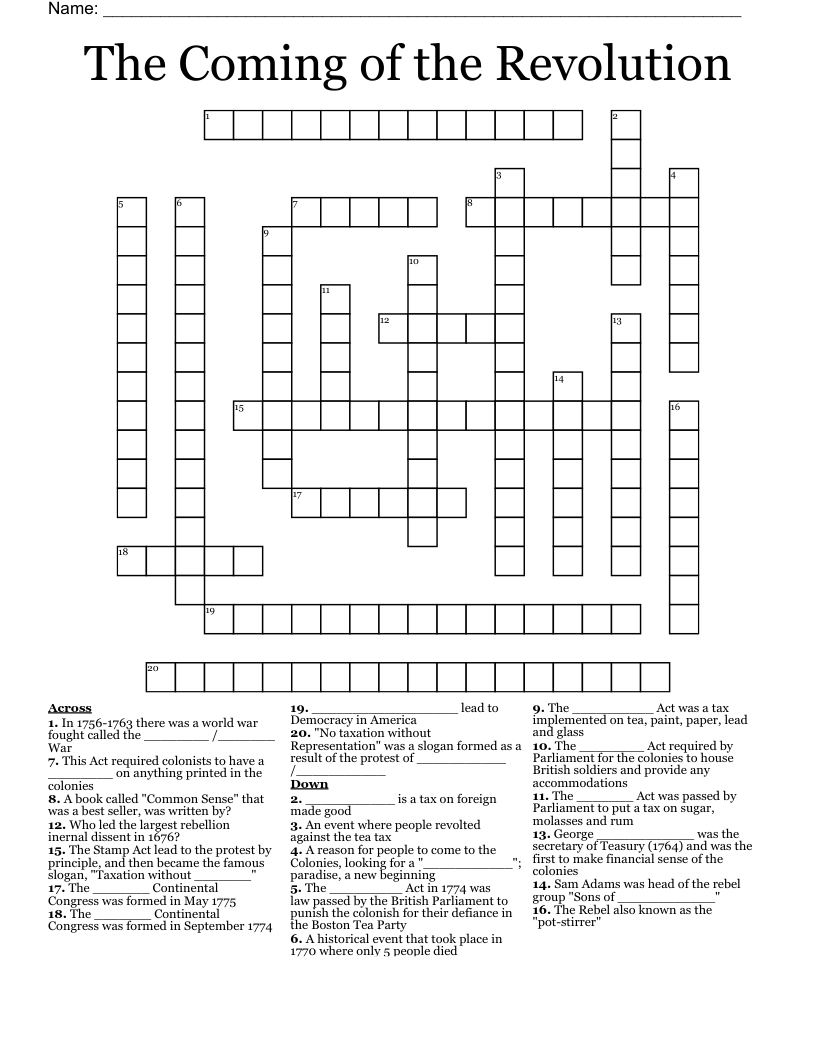
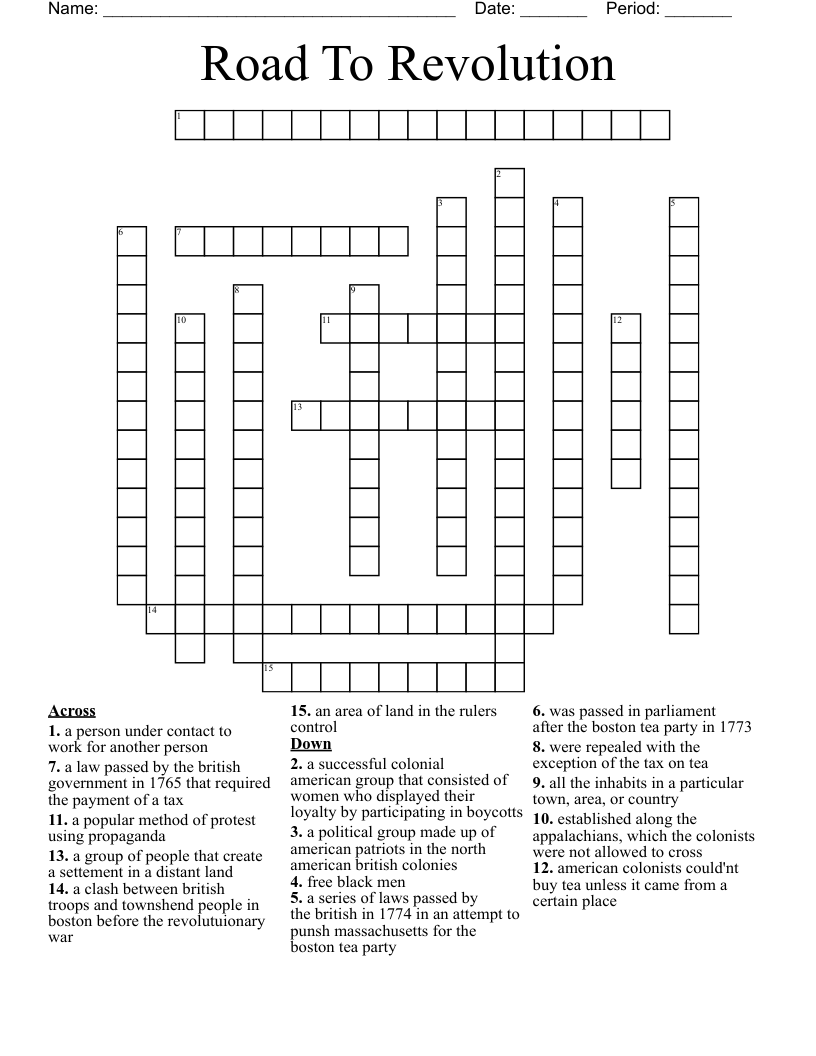
War pitted the colonies of British America against those of New France, each side supported by military units from the parent country and by Native American allies
issued by King George III on October 7, 1763, following Great Britain's acquisition of French territory in North America after the end of the Seven Years' War. It forbade all settlement west of a line drawn along the Appalachian Mountains, which was delineated as an Indian reserve
also known as the American Revenue Act 1764 or the American Duties Act, was a revenue-raising act passed by the Parliament of Great Britain on 5 April 1764. The preamble to the act stated: "it is expedient that new provisions and regulations should be established for improving the revenue of this kingdom
an Act of the Parliament of Great Britain which imposed a direct tax on the British colonies in America and required that many printed materials in the colonies be produced on stamped paper produced in London, carrying an embossed revenue stamp. Printed materials included legal documents, magazines, playing cards, newspapers, and many other types of paper used throughout the colonies
a secret revolutionary organization that was founded by Samuel Adams in the Thirteen American Colonies to advance the rights of the European colonists and to fight taxation by the British government. It played a major role in most colonies in battling the Stamp Act in 1765
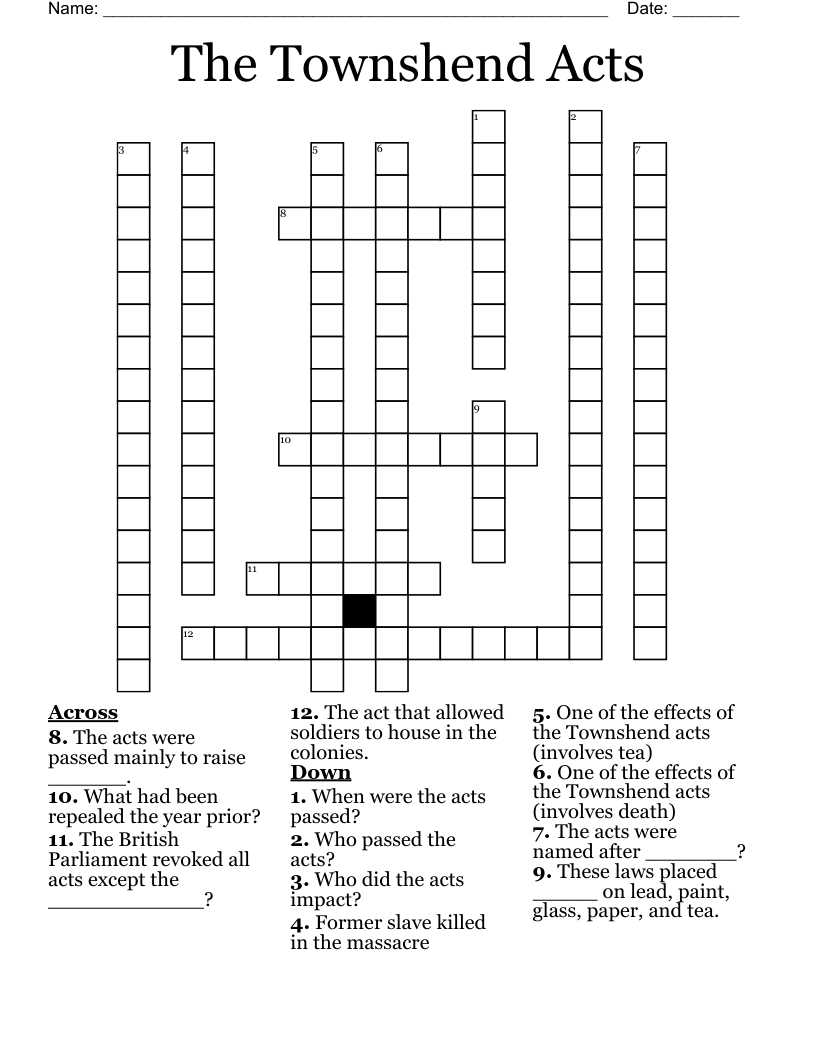
refers to a series of British acts of Parliament passed during 1767 and 1768 relating to the British colonies in America. They are named after Charles Townshend, the Chancellor of the Exchequer who proposed the program
punitive laws passed by the British Parliament in 1774 after the Boston Tea Party. The laws were meant to punish the Massachusetts colonists for their defiance in the Tea Party protest in reaction to changes in taxation by the British government
a political and mercantile protest by the Sons of Liberty in Boston, Massachusetts, on December 16, 1773. The target was the Tea Act of May 10, 1773, which allowed the British East India Company to sell tea from China in American colonies without paying taxes apart from those imposed by the Townshend Acts. American Patriots strongly opposed the taxes in the Townshend Act as a violation of their rights. Demonstrators, some disguised as Native Americans, destroyed an entire shipment of tea sent by the East India company
a confrontation on March 5, 1770 in which British soldiers shot and killed several people while being harassed by a mob in Boston. The event was heavily publicized by leading Patriots such as Paul Revere and Samuel Adams
a meeting of delegates from the Thirteen Colonies in America which united in the American Revolutionary War. It convened on May 10, 1775 with representatives from 12 of the colonies in Philadelphia, Pennsylvania shortly after the Battles of Lexington and Concord, succeeding the First Continental Congress which met in Philadelphia from September 5 to October 26,Second Continental Congress,1774