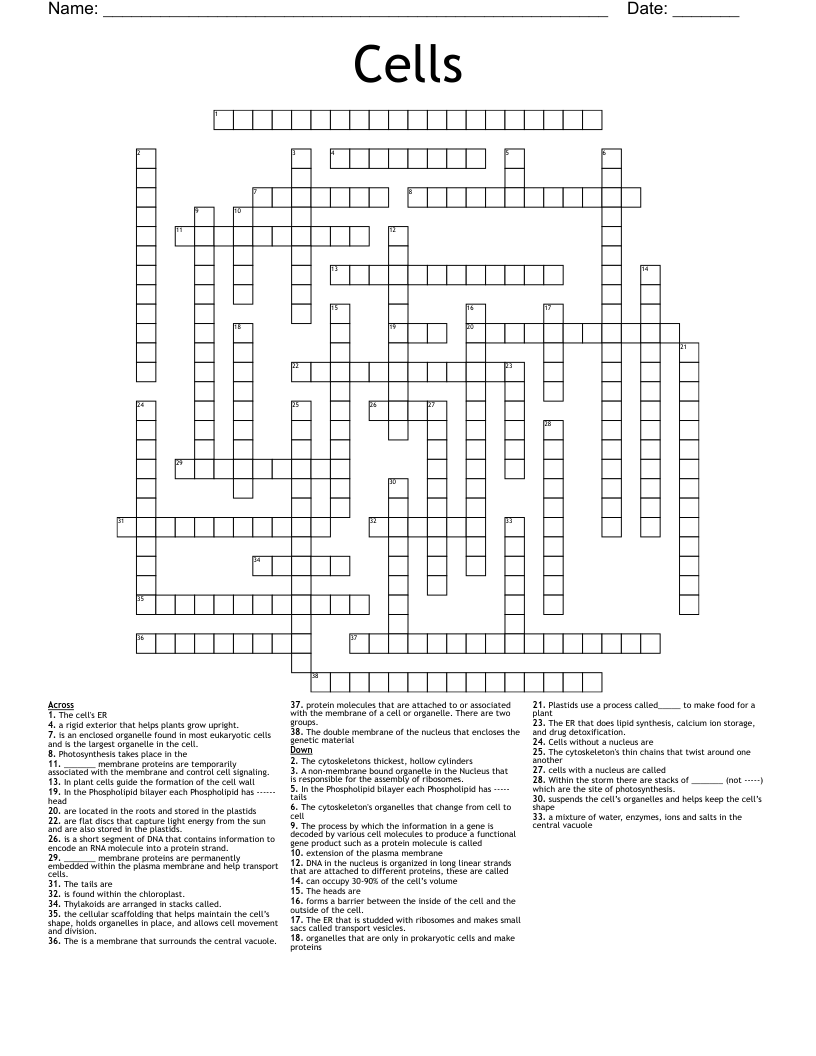
Cells Crossword
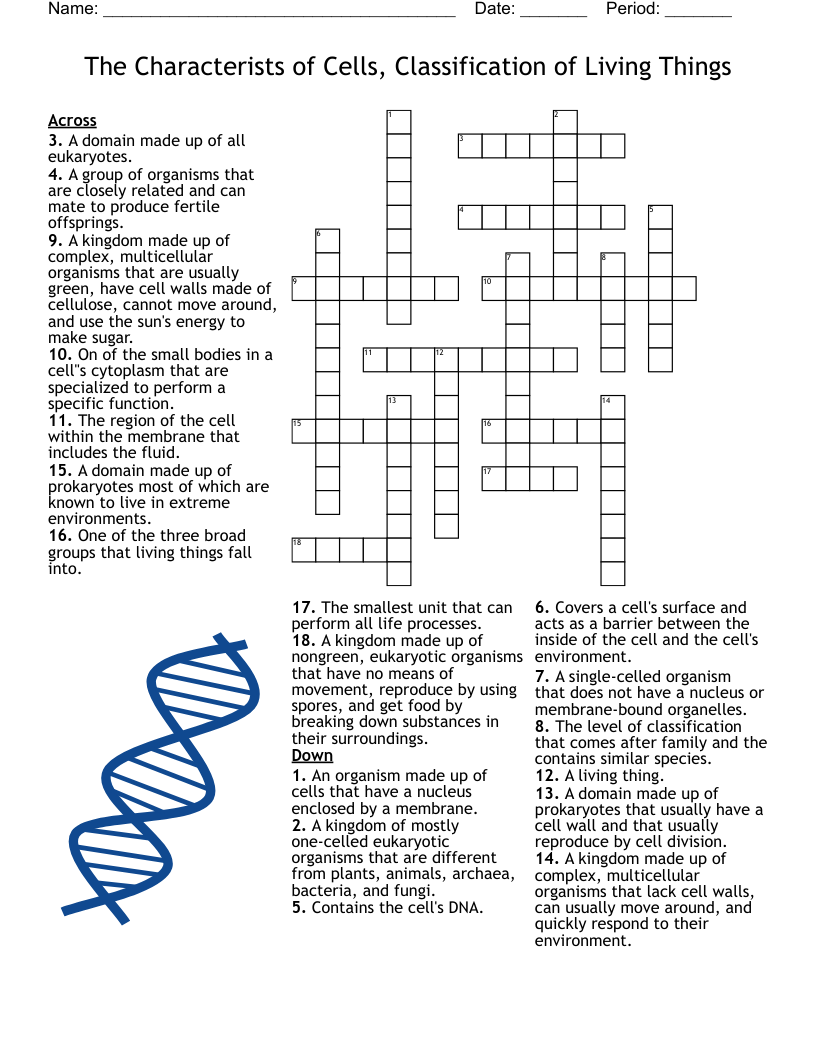
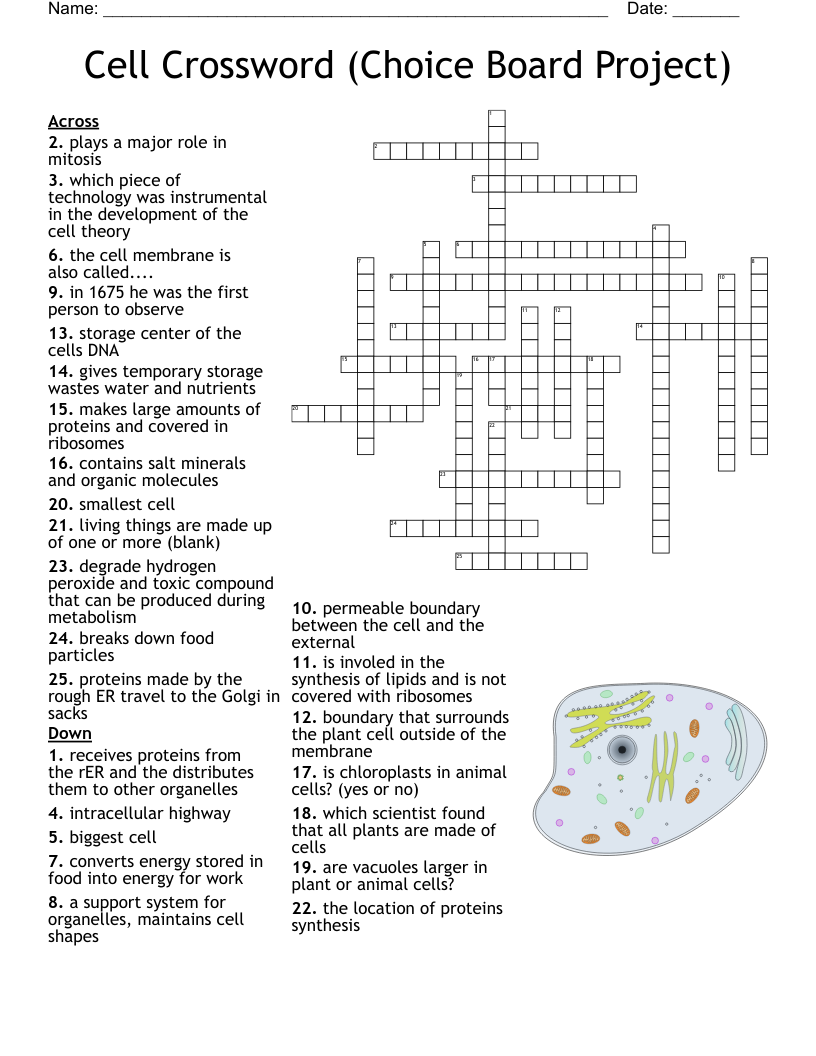
This printable crossword puzzle on the topic of Cell Biology has 38 clues. Answers range from 3 to 20 letters long. This crossword is also available to download as a Microsoft Word document or a PDF.
Description
a rigid exterior that helps plants grow upright.
In plant cells guide the formation of the cell wall
can occupy 30-90% of the cell’s volume
The is a membrane that surrounds the central vacuole.
a mixture of water, enzymes, ions and salts in the central vacuole
Plastids use a process called_____ to make food for a plant
are located in the roots and stored in the plastids
Photosynthesis takes place in the
are flat discs that capture light energy from the sun and are also stored in the plastids.
is found within the chloroplast.
Within the storm there are stacks of _______ (not -----) which are the site of photosynthesis.
Thylakoids are arranged in stacks called.
Cells without a nucleus are
cells with a nucleus are called
organelles that are only in prokaryotic cells and make proteins
forms a barrier between the inside of the cell and the outside of the cell.
In the Phospholipid bilayer each Phospholipid has ------ head
In the Phospholipid bilayer each Phospholipid has ----- tails
The heads are
The tails are
protein molecules that are attached to or associated with the membrane of a cell or organelle. There are two groups.
_______ membrane proteins are permanently embedded within the plasma membrane and help transport cells.
_______ membrane proteins are temporarily associated with the membrane and control cell signaling.
extension of the plasma membrane
suspends the cell’s organelles and helps keep the cell’s shape
the cellular scaffolding that helps maintain the cell’s shape, holds organelles in place, and allows cell movement and division.
The cytoskeletons thickest, hollow cylinders
The cytoskeleton's thin chains that twist around one another
The cytoskeleton's organelles that change from cell to cell
is an enclosed organelle found in most eukaryotic cells and is the largest organelle in the cell.
is a short segment of DNA that contains information to encode an RNA molecule into a protein strand.
DNA in the nucleus is organized in long linear strands that are attached to different proteins, these are called
The process by which the information in a gene is decoded by various cell molecules to produce a functional gene product such as a protein molecule is called
The double membrane of the nucleus that encloses the genetic material
A non-membrane bound organelle in the Nucleus that is responsible for the assembly of ribosomes.
The cell's ER
The ER that is studded with ribosomes and makes small sacs called transport vesicles.
The ER that does lipid synthesis, calcium ion storage, and drug detoxification.