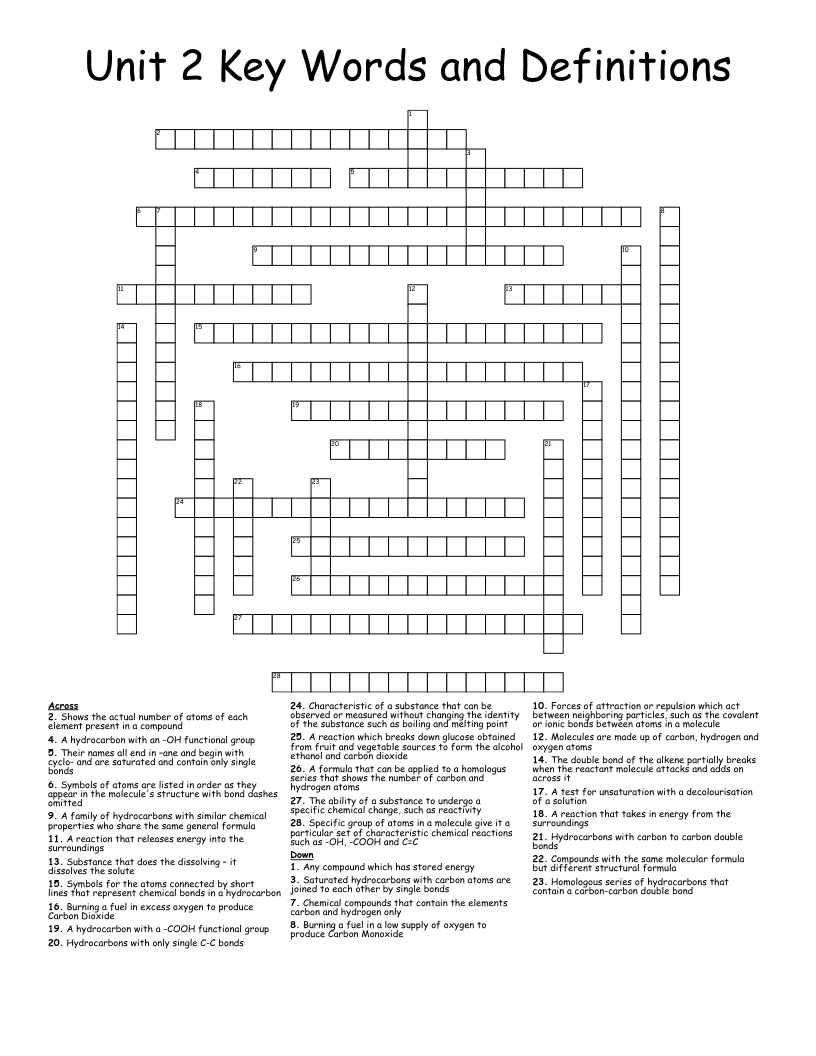
Unit 2 Key Words and Definitions Crossword
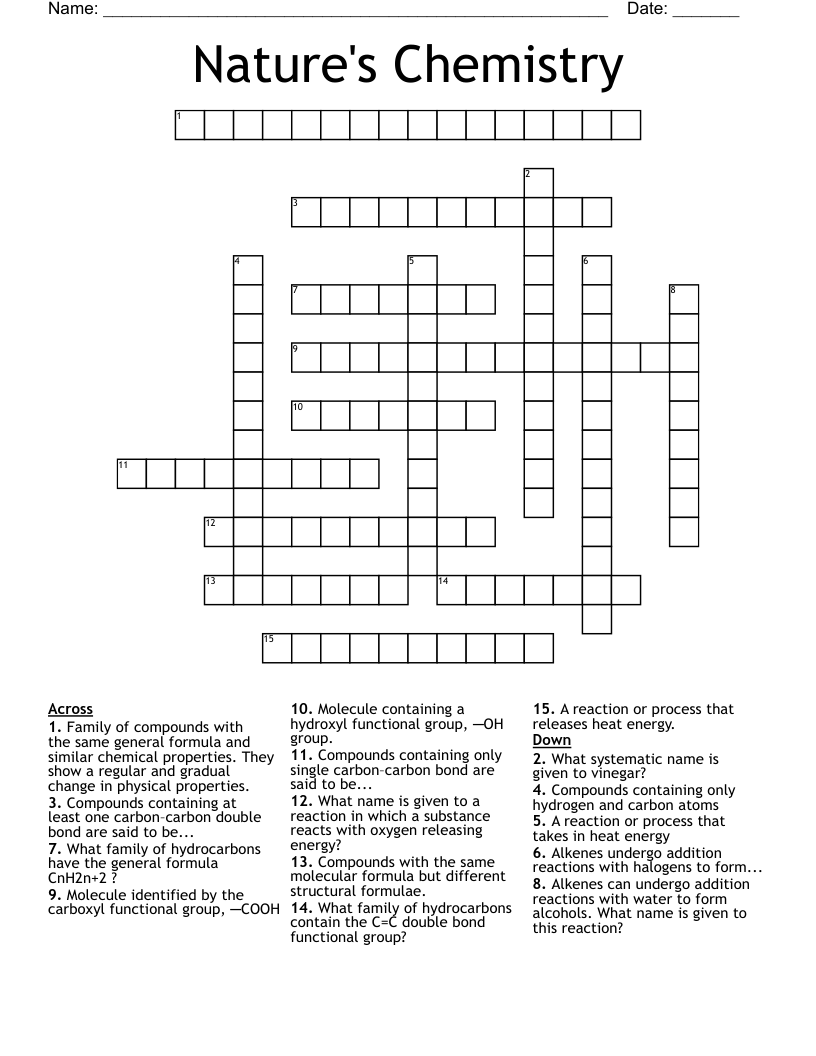
This printable crossword puzzle on the topic of Organic Chemistry & Biochemistry has 28 clues. Answers range from 4 to 26 letters long. This crossword is also available to download as a Microsoft Word document or a PDF.
Description
Chemical compounds that contain the elements carbon and hydrogen only
A family of hydrocarbons with similar chemical properties who share the same general formula
Saturated hydrocarbons with carbon atoms are joined to each other by single bonds
Homologous series of hydrocarbons that contain a carbon-carbon double bond
Their names all end in –ane and begin with cyclo- and are saturated and contain only single bonds
The double bond of the alkene partially breaks when the reactant molecule attacks and adds on across it
A formula that can be applied to a homologus series that shows the number of carbon and hydrogen atoms
Symbols for the atoms connected by short lines that represent chemical bonds in a hydrocarbon
Symbols of atoms are listed in order as they appear in the molecule's structure with bond dashes omitted
Shows the actual number of atoms of each element present in a compound
Characteristic of a substance that can be observed or measured without changing the identity of the substance such as boiling and melting point
The ability of a substance to undergo a specific chemical change, such as reactivity
Compounds with the same molecular formula but different structural formula
Molecules are made up of carbon, hydrogen and oxygen atoms
Hydrocarbons with only single C-C bonds
Hydrocarbons with carbon to carbon double bonds
A test for unsaturation with a decolourisation of a solution
A reaction which breaks down glucose obtained from fruit and vegetable sources to form the alcohol ethanol and carbon dioxide
Specific group of atoms in a molecule give it a particular set of characteristic chemical reactions such as -OH, -COOH and C=C
Substance that does the dissolving – it dissolves the solute
Any compound which has stored energy
Burning a fuel in excess oxygen to produce Carbon Dioxide
Burning a fuel in a low supply of oxygen to produce Carbon Monoxide
A reaction that releases energy into the surroundings
A reaction that takes in energy from the surroundings
A hydrocarbon with an -OH functional group
A hydrocarbon with a -COOH functional group
Forces of attraction or repulsion which act between neighboring particles, such as the covalent or ionic bonds between atoms in a molecule