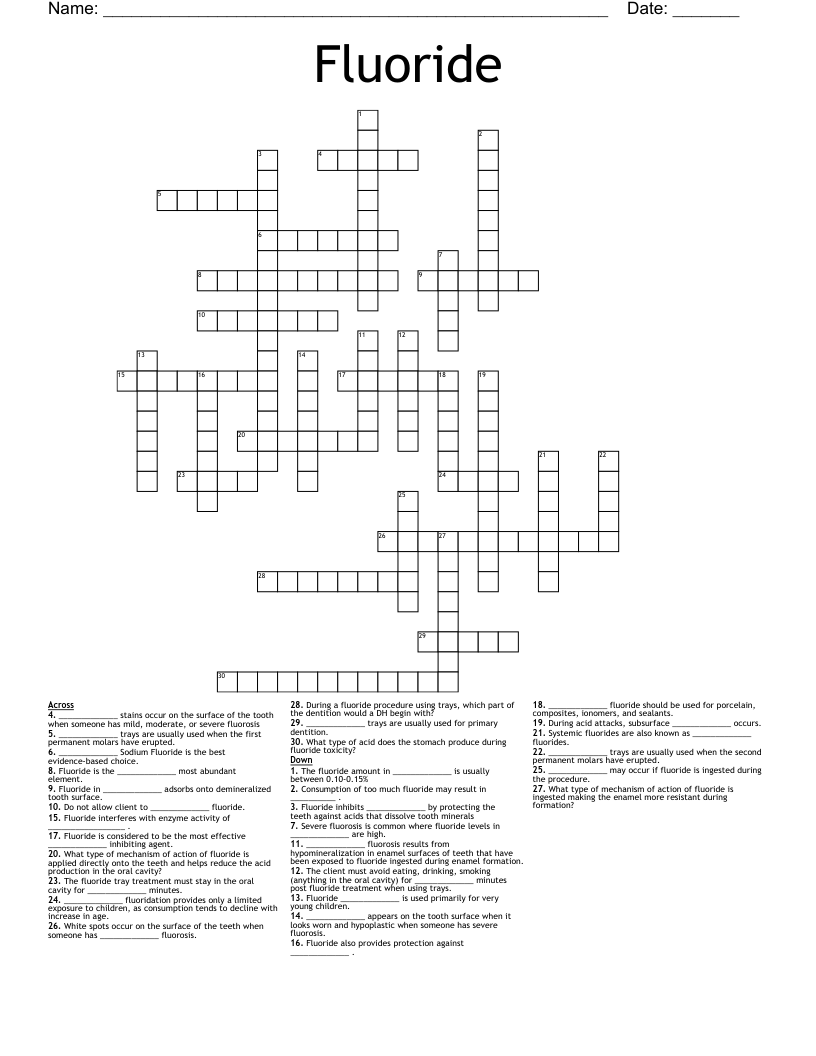
Fluoride Crossword
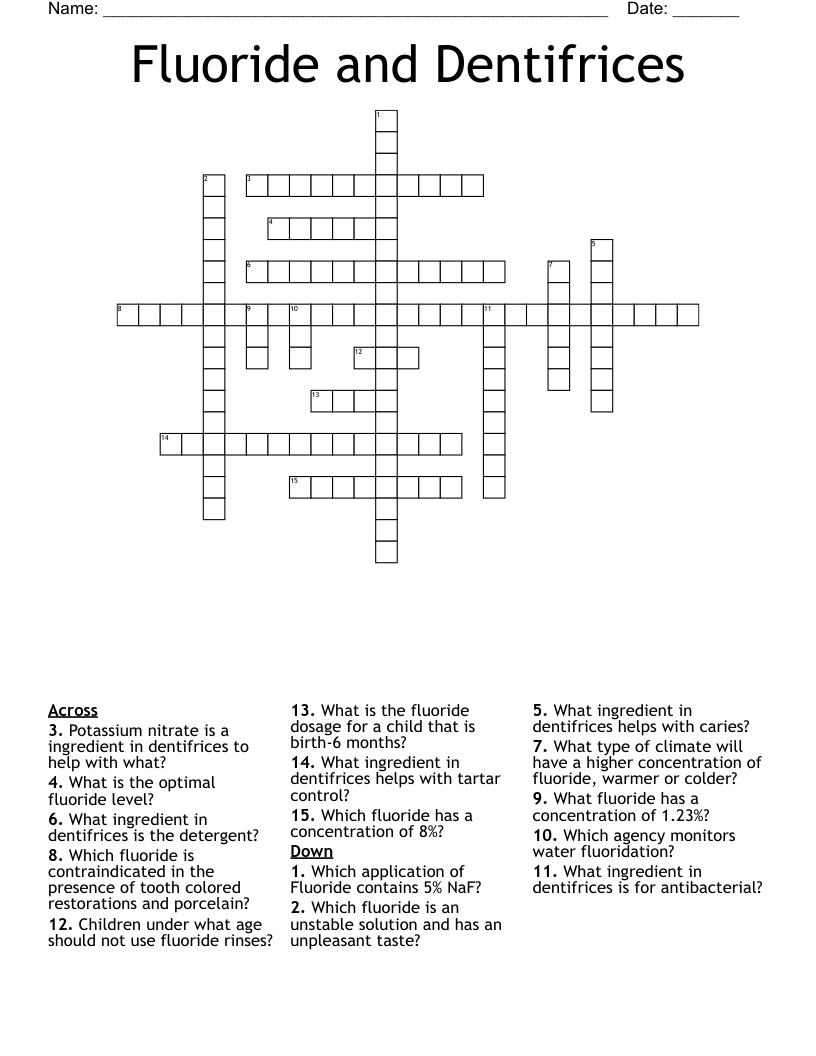
This printable crossword puzzle on the topic of Dental & Optometry has 30 clues. Answers range from 4 to 16 letters long. This crossword is also available to download as a Microsoft Word document or a PDF.
Description
Fluoride interferes with enzyme activity of _________________ .
Consumption of too much fluoride may result in __________ .
_____________ fluoride should be used for porcelain, composites, ionomers, and sealants.
_____________ may occur if fluoride is ingested during the procedure.
During acid attacks, subsurface _____________ occurs.
Fluoride also provides protection against _____________ .
Systemic fluorides are also known as _____________ fluorides.
Severe fluorosis is common where fluoride levels in _____________ are high.
Fluoride is the _____________ most abundant element.
White spots occur on the surface of the teeth when someone has _____________ fluorosis.
_____________ stains occur on the surface of the tooth when someone has mild, moderate, or severe fluorosis
_____________ appears on the tooth surface when it looks worn and hypoplastic when someone has severe fluorosis.
What type of mechanism of action of fluoride is ingested making the enamel more resistant during formation?
What type of mechanism of action of fluoride is applied directly onto the teeth and helps reduce the acid production in the oral cavity?
_____________ fluorosis results from hypomineralization in enamel surfaces of teeth that have been exposed to fluoride ingested during enamel formation.
_____________ fluoridation provides only a limited exposure to children, as consumption tends to decline with increase in age.
What type of acid does the stomach produce during fluoride toxicity?
Fluoride is considered to be the most effective _____________ inhibiting agent.
The fluoride amount in _____________ is usually between 0.10-0.15%
Fluoride inhibits _____________ by protecting the teeth against acids that dissolve tooth minerals
Fluoride in _____________ adsorbs onto demineralized tooth surface.
_____________ Sodium Fluoride is the best evidence-based choice.
_____________ trays are usually used for primary dentition.
_____________ trays are usually used when the first permanent molars have erupted.
_____________ trays are usually used when the second permanent molars have erupted.
During a fluoride procedure using trays, which part of the dentition would a DH begin with?
Fluoride _____________ is used primarily for very young children.
Do not allow client to _____________ fluoride.
The fluoride tray treatment must stay in the oral cavity for _____________ minutes.
The client must avoid eating, drinking, smoking (anything in the oral cavity) for _____________ minutes post fluoride treatment when using trays.