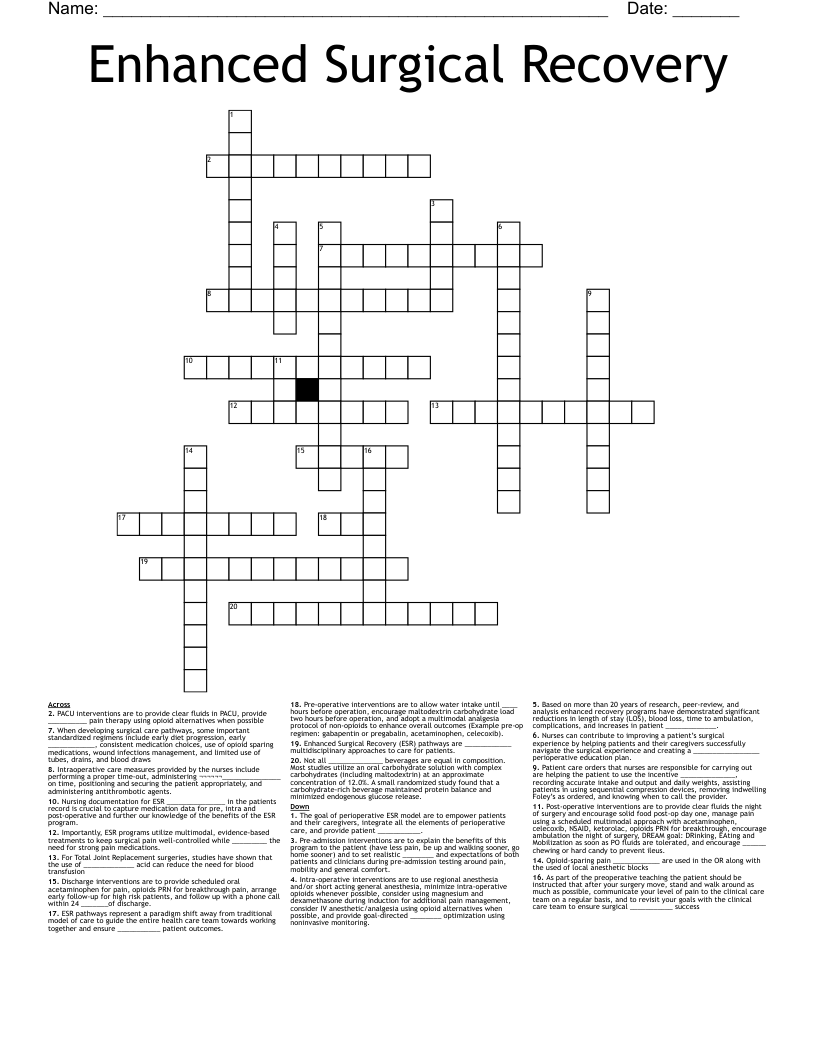
Enhanced Surgical Recovery Crossword
This printable crossword puzzle on the topic of Nursing & Healthcare Careers has 20 clues. Answers range from 3 to 13 letters long. This crossword is also available to download as a Microsoft Word document or a PDF.
Description
Based on more than 20 years of research, peer-review, and analysis enhanced recovery programs have demonstrated significant reductions in length of stay (LOS), blood loss, time to ambulation, complications, and increases in patient _____________.
Importantly, ESR programs utilize multimodal, evidence-based treatments to keep surgical pain well-controlled while _________ the need for strong pain medications.
Enhanced Surgical Recovery (ESR) pathways are ____________ multidisciplinary approaches to care for patients.
The goal of perioperative ESR model are to empower patients and their caregivers, integrate all the elements of perioperative care, and provide patient ___________.
ESR pathways represent a paradigm shift away from traditional model of care to guide the entire health care team towards working together and ensure ___________ patient outcomes.
When developing surgical care pathways, some important standardized regimens include early diet progression, early ____________, consistent medication choices, use of opioid sparing medications, wound infections management, and limited use of tubes, drains, and blood draws
Nurses can contribute to improving a patient’s surgical experience by helping patients and their caregivers successfully navigate the surgical experience and creating a _________________ perioperative education plan.
Intraoperative care measures provided by the nurses include performing a proper time-out, administering ¬¬¬¬¬¬_______________ on time, positioning and securing the patient appropriately, and administering antithrombotic agents.
Opioid-sparing pain ____________ are used in the OR along with the used of local anesthetic blocks
Patient care orders that nurses are responsible for carrying out are helping the patient to use the incentive ______________, recording accurate intake and output and daily weights, assisting patients in using sequential compression devices, removing indwelling Foley’s as ordered, and knowing when to call the provider.
Pre-admission interventions are to explain the benefits of this program to the patient (have less pain, be up and walking sooner, go home sooner) and to set realistic ________ and expectations of both patients and clinicians during pre-admission testing around pain, mobility and general comfort.
Pre-operative interventions are to allow water intake until ____ hours before operation, encourage maltodextrin carbohydrate load two hours before operation, and adopt a multimodal analgesia protocol of non-opioids to enhance overall outcomes (Example pre-op regimen: gabapentin or pregabalin, acetaminophen, celecoxib).
Intra-operative interventions are to use regional anesthesia and/or short acting general anesthesia, minimize intra-operative opioids whenever possible, consider using magnesium and dexamethasone during induction for additional pain management, consider IV anesthetic/analgesia using opioid alternatives when possible, and provide goal-directed ________ optimization using noninvasive monitoring.
PACU interventions are to provide clear fluids in PACU, provide __________ pain therapy using opioid alternatives when possible
Post-operative interventions are to provide clear fluids the night of surgery and encourage solid food post-op day one, manage pain using a scheduled multimodal approach with acetaminophen, celecoxib, NSAID, ketorolac, opioids PRN for breakthrough, encourage ambulation the night of surgery, DREAM goal: DRinking, EAting and Mobilization as soon as PO fluids are tolerated, and encourage ______ chewing or hard candy to prevent ileus.
Discharge interventions are to provide scheduled oral acetaminophen for pain, opioids PRN for breakthrough pain, arrange early follow-up for high risk patients, and follow up with a phone call within 24 _______of discharge.
For Total Joint Replacement surgeries, studies have shown that the use of _____________ acid can reduce the need for blood transfusion
As part of the preoperative teaching the patient should be instructed that after your surgery move, stand and walk around as much as possible, communicate your level of pain to the clinical care team on a regular basis, and to revisit your goals with the clinical care team to ensure surgical ___________ success
Not all ______________ beverages are equal in composition. Most studies utilize an oral carbohydrate solution with complex carbohydrates (including maltodextrin) at an approximate concentration of 12.0%. A small randomized study found that a carbohydrate-rich beverage maintained protein balance and minimized endogenous glucose release.
Nursing documentation for ESR _______________ in the patients record is crucial to capture medication data for pre, intra and post-operative and further our knowledge of the benefits of the ESR program.