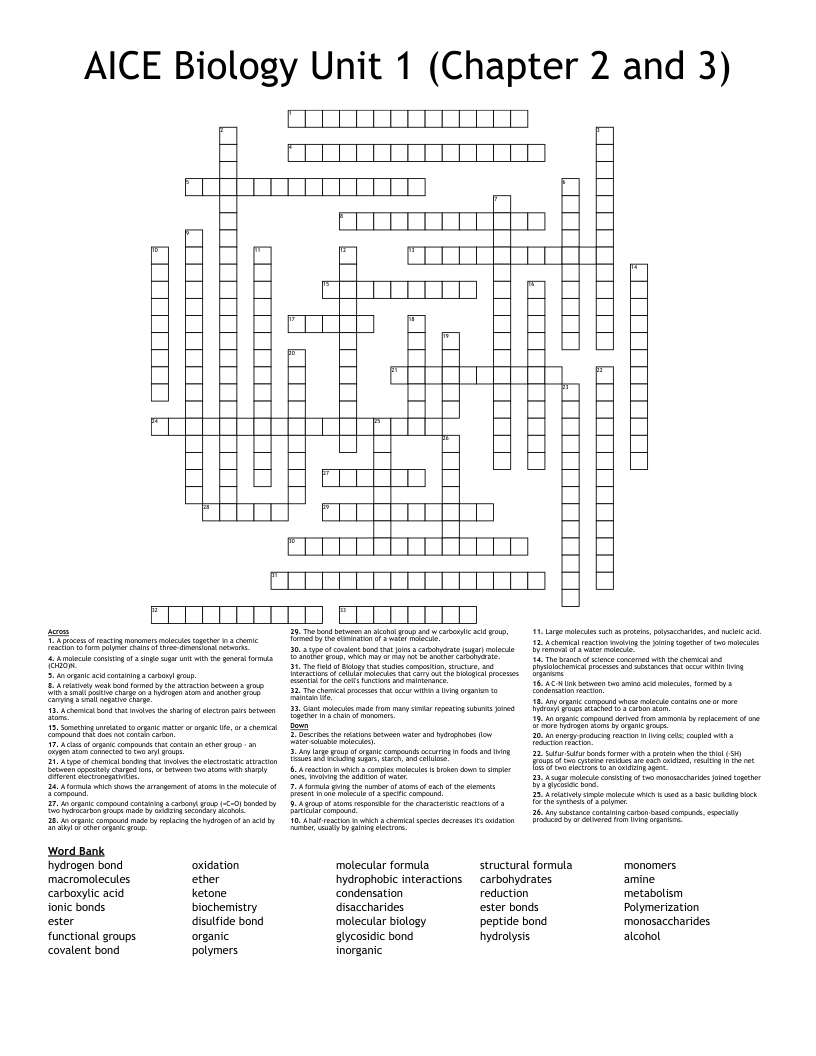
AICE Biology Unit 1 (Chapter 2 and 3) Crossword
This printable crossword puzzle on the topic of Organic Chemistry & Biochemistry has 33 clues. Answers range from 5 to 23 letters long. This crossword is also available to download as a Microsoft Word document or a PDF.
Description
The field of Biology that studies composition, structure, and interactions of cellular molecules that carry out the biological processes essential for the cell's functions and maintenance.
The branch of science concerned with the chemical and physiolochemical processes and substances that occur within living organisms
The chemical processes that occur within a living organism to maintain life.
Any substance containing carbon-based compunds, especially produced by or delivered from living organisms.
Something unrelated to organic matter or organic life, or a chemical compound that does not contain carbon.
A half-reaction in which a chemical species decreases it's oxidation number, usually by gaining electrons.
An energy-producing reaction in living cells; coupled with a reduction reaction.
A C-N link between two amino acid molecules, formed by a condensation reaction.
A type of chemical bonding that involves the electrostatic attraction between oppositely charged ions, or between two atoms with sharply different electronegativities.
A chemical bond that involves the sharing of electron pairs between atoms.
A relatively weak bond formed by the attraction between a group with a small positive charge on a hydrogen atom and another group carrying a small negative charge.
a type of covalent bond that joins a carbohydrate (sugar) molecule to another group, which may or may not be another carbohydrate.
The bond between an alcohol group and w carboxylic acid group, formed by the elimination of a water molecule.
Sulfur-Sulfur bonds former with a protein when the thiol (-SH) groups of two cysteine residues are each oxidized, resulting in the net loss of two electrons to an oxidizing agent.
Describes the relations between water and hydrophobes (low water-soluable molecules).
A process of reacting monomers molecules together in a chemic reaction to form polymer chains of three-dimensional networks.
A chemical reaction involving the joining together of two molecules by removal of a water molecule.
A reaction in which a complex molecules is broken down to simpler ones, involving the addition of water.
Large molecules such as proteins, polysaccharides, and nucleic acid.
A relatively simple molecule which is used as a basic building block for the synthesis of a polymer.
Giant molecules made from many similar repeating subunits joined together in a chain of monomers.
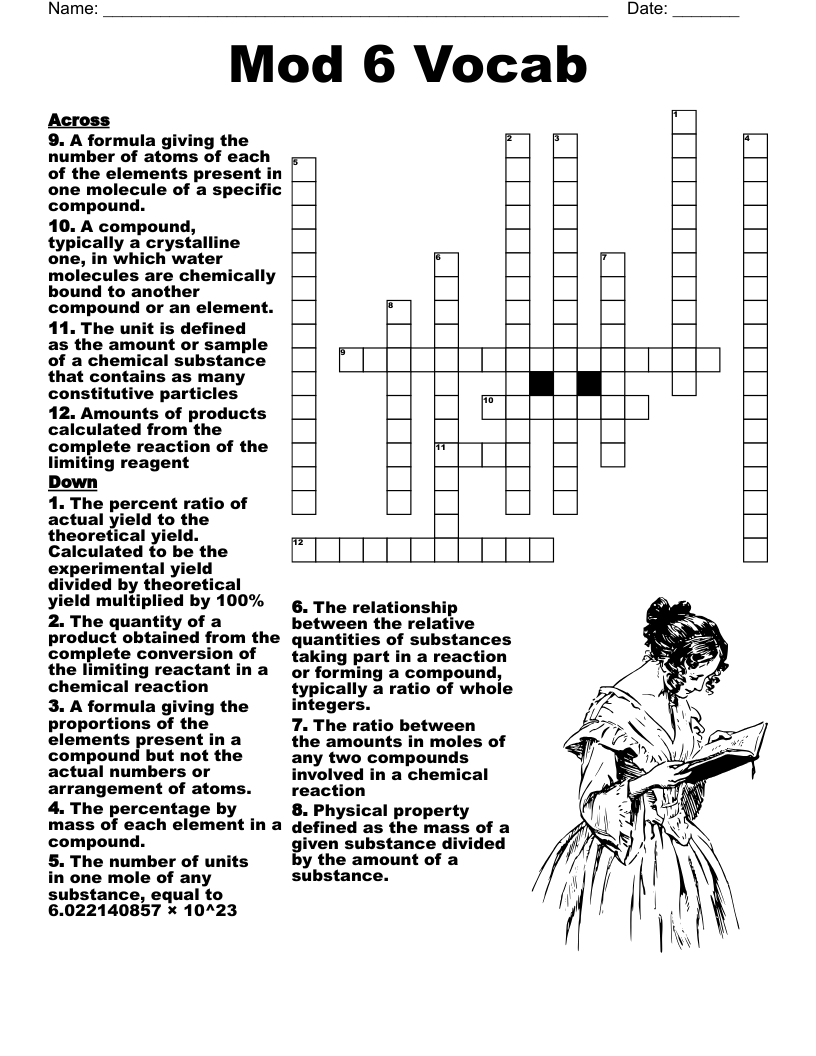
A formula giving the number of atoms of each of the elements present in one molecule of a specific compound.
A formula which shows the arrangement of atoms in the molecule of a compound.
A group of atoms responsible for the characteristic reactions of a particular compound.
An organic compound made by replacing the hydrogen of an acid by an alkyl or other organic group.
A class of organic compounds that contain an ether group - an oxygen atom connected to two aryl groups.
An organic acid containing a carboxyl group.
Any organic compound whose molecule contains one or more hydroxyl groups attached to a carbon atom.
An organic compound derived from ammonia by replacement of one or more hydrogen atoms by organic groups.
An organic compound containing a carbonyl group (=C=O) bonded by two hydrocarbon groups made by oxidizing secondary alcohols.
Any large group of organic compounds occurring in foods and living tissues and including sugars, starch, and cellulose.
A molecule consisting of a single sugar unit with the general formula (CH2O)N.
A sugar molecule consisting of two monosaccharides joined together by a glycosidic bond.