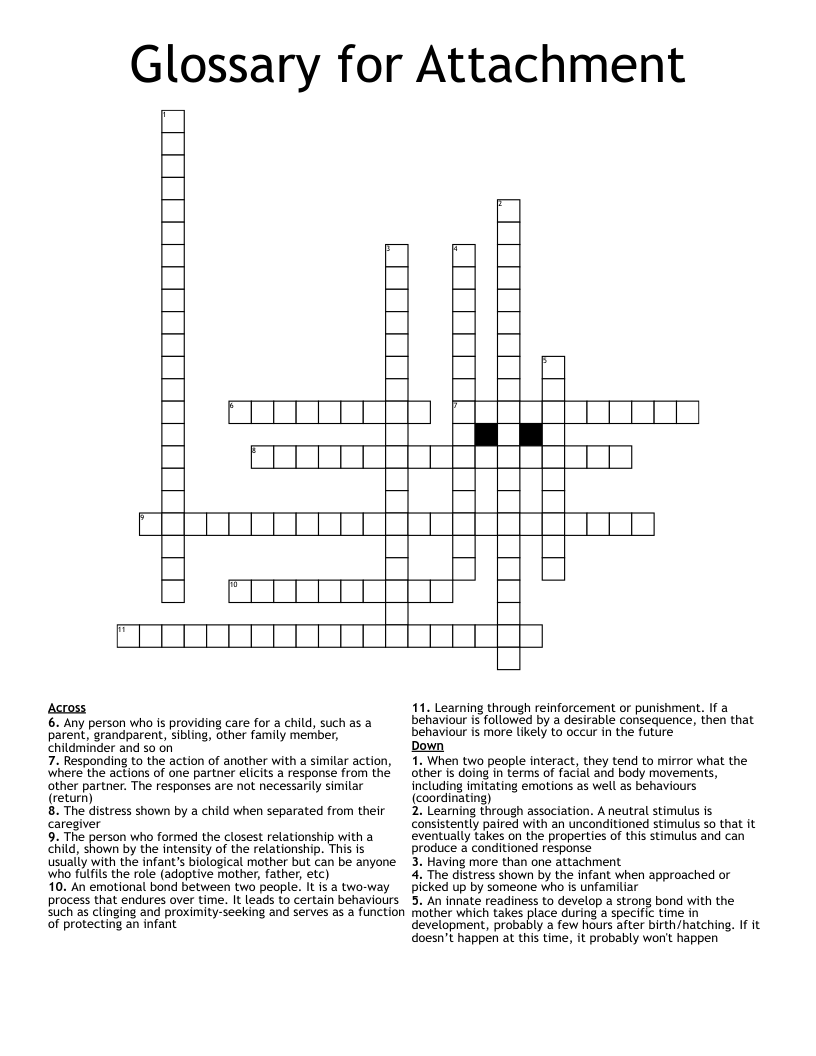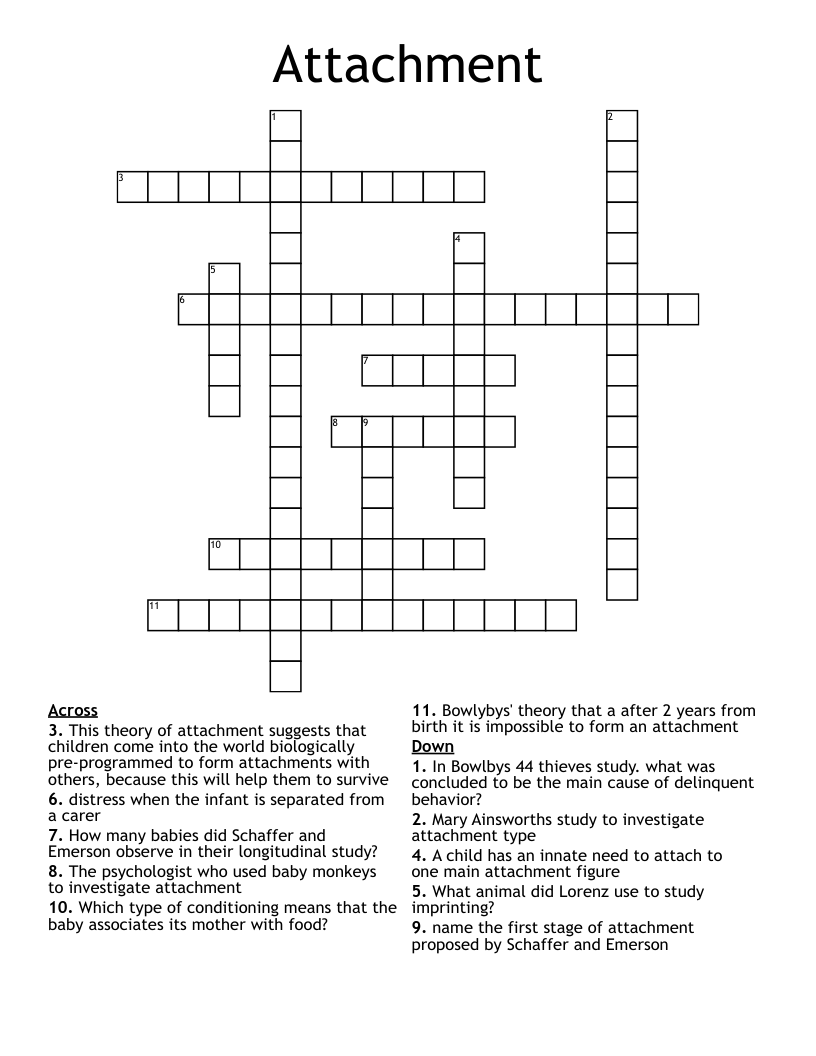
Attachment Unit Revision Crossword
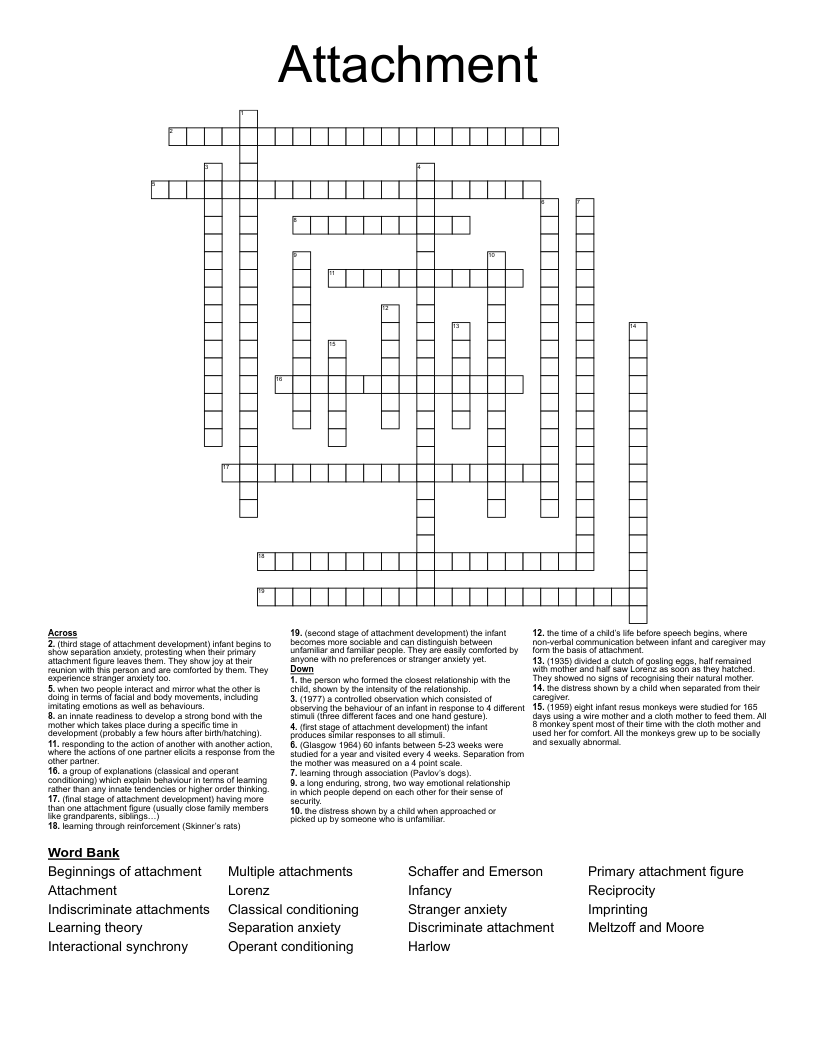
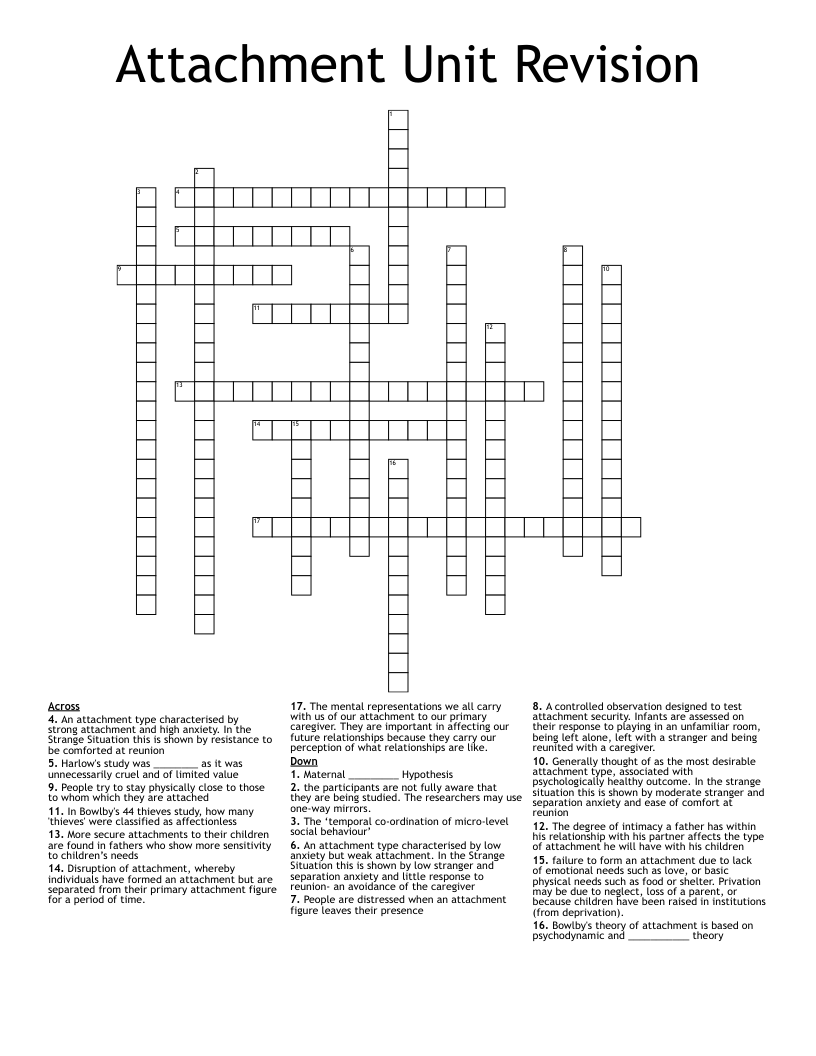
This printable crossword puzzle on the topic of Psychology & Sociology has 17 clues. Answers range from 8 to 24 letters long. This crossword is also available to download as a Microsoft Word document or a PDF.
Description
People try to stay physically close to those to whom which they are attached
Harlow's study was ________ as it was unnecessarily cruel and of limited value
Bowlby's theory of attachment is based on psychodynamic and ___________ theory
Disruption of attachment, whereby individuals have formed an attachment but are separated from their primary attachment figure for a period of time.
In Bowlby's 44 thieves study, how many 'thieves' were classified as affectionless
A controlled observation designed to test attachment security. Infants are assessed on their response to playing in an unfamiliar room, being left alone, left with a stranger and being reunited with a caregiver.
Generally thought of as the most desirable attachment type, associated with psychologically healthy outcome. In the strange situation this is shown by moderate stranger and separation anxiety and ease of comfort at reunion
An attachment type characterised by low anxiety but weak attachment. In the Strange Situation this is shown by low stranger and separation anxiety and little response to reunion- an avoidance of the caregiver
An attachment type characterised by strong attachment and high anxiety. In the Strange Situation this is shown by resistance to be comforted at reunion
People are distressed when an attachment figure leaves their presence
The mental representations we all carry with us of our attachment to our primary caregiver. They are important in affecting our future relationships because they carry our perception of what relationships are like.
Maternal _________ Hypothesis
The ‘temporal co-ordination of micro-level social behaviour’
failure to form an attachment due to lack of emotional needs such as love, or basic physical needs such as food or shelter. Privation may be due to neglect, loss of a parent, or because children have been raised in institutions (from deprivation).
The degree of intimacy a father has within his relationship with his partner affects the type of attachment he will have with his children
More secure attachments to their children are found in fathers who show more sensitivity to children’s needs
the participants are not fully aware that they are being studied. The researchers may use one-way mirrors.