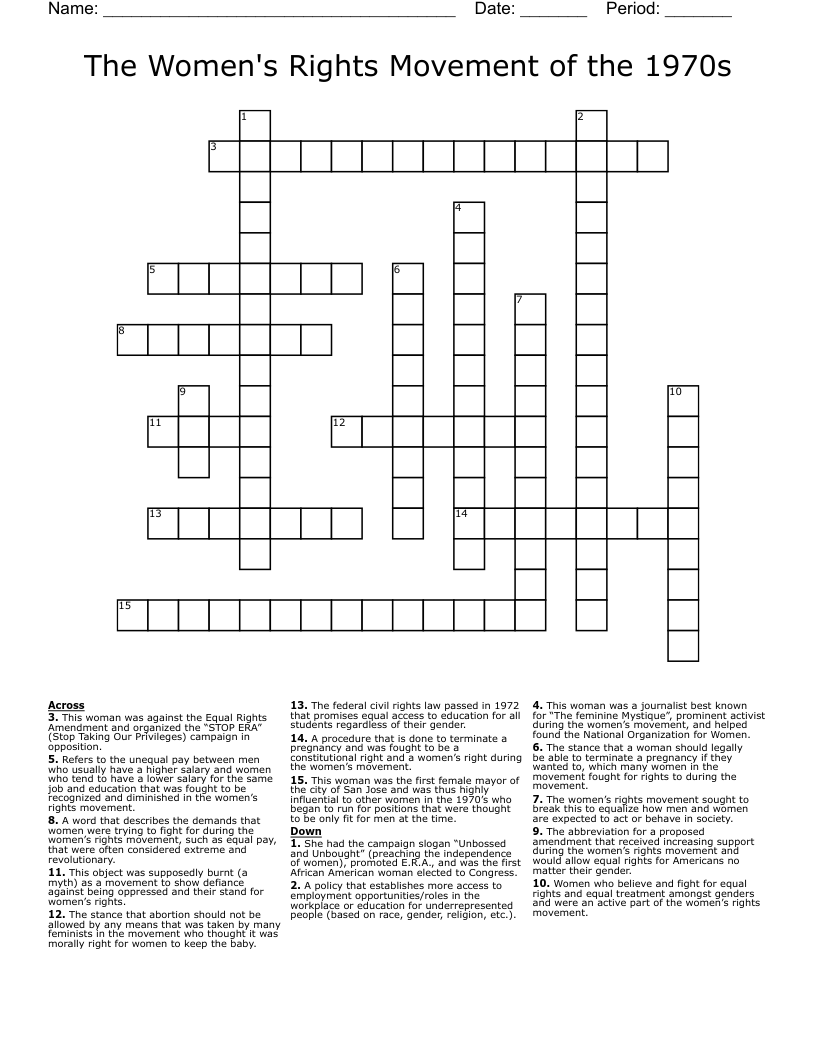
The Women's Rights Movement of the 1970s Crossword
This printable crossword puzzle on the topic of Civil Rights & Social Movements has 15 clues. Answers range from 3 to 17 letters long. This crossword is also available to download as a Microsoft Word document or a PDF.
Description
The women’s rights movement sought to break this to equalize how men and women are expected to act or behave in society.
This object was supposedly burnt (a myth) as a movement to show defiance against being oppressed and their stand for women’s rights.
A word that describes the demands that women were trying to fight for during the women’s rights movement, such as equal pay, that were often considered extreme and revolutionary.
Women who believe and fight for equal rights and equal treatment amongst genders and were an active part of the women’s rights movement.
This woman was a journalist best known for “The feminine Mystique”, prominent activist during the women’s movement, and helped found the National Organization for Women.
She had the campaign slogan “Unbossed and Unbought” (preaching the independence of women), promoted E.R.A., and was the first African American woman elected to Congress.
This woman was the first female mayor of the city of San Jose and was thus highly influential to other women in the 1970’s who began to run for positions that were thought to be only fit for men at the time.
This woman was against the Equal Rights Amendment and organized the “STOP ERA” (Stop Taking Our Privileges) campaign in opposition.
A procedure that is done to terminate a pregnancy and was fought to be a constitutional right and a women’s right during the women’s movement.
The stance that abortion should not be allowed by any means that was taken by many feminists in the movement who thought it was morally right for women to keep the baby.
The stance that a woman should legally be able to terminate a pregnancy if they wanted to, which many women in the movement fought for rights to during the movement.
The abbreviation for a proposed amendment that received increasing support during the women’s rights movement and would allow equal rights for Americans no matter their gender.
The federal civil rights law passed in 1972 that promises equal access to education for all students regardless of their gender.
Refers to the unequal pay between men who usually have a higher salary and women who tend to have a lower salary for the same job and education that was fought to be recognized and diminished in the women’s rights movement.
A policy that establishes more access to employment opportunities/roles in the workplace or education for underrepresented people (based on race, gender, religion, etc.).