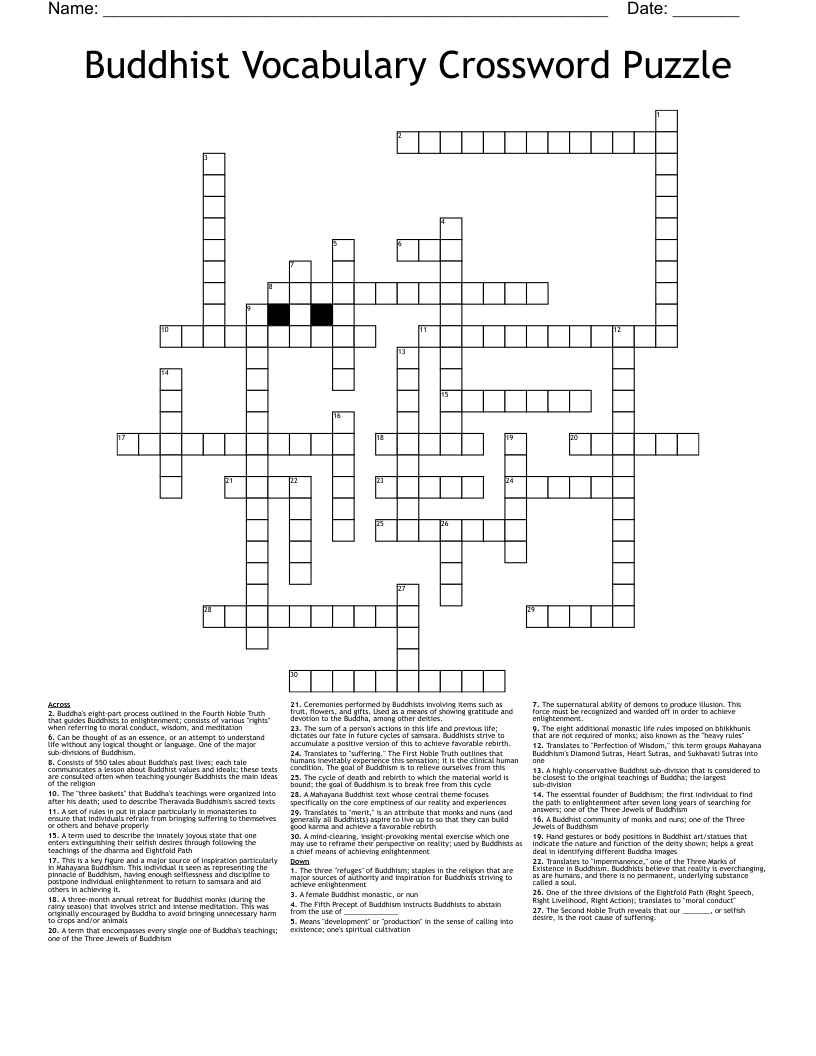
Buddhist Vocabulary Crossword Puzzle
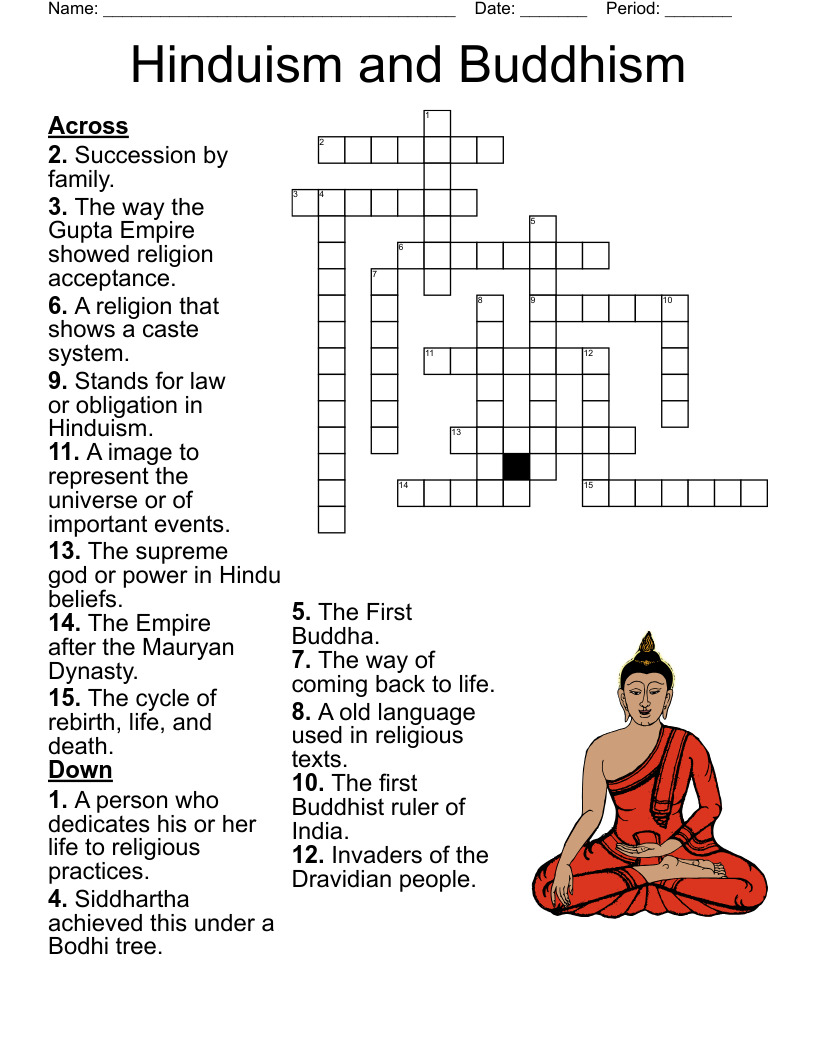
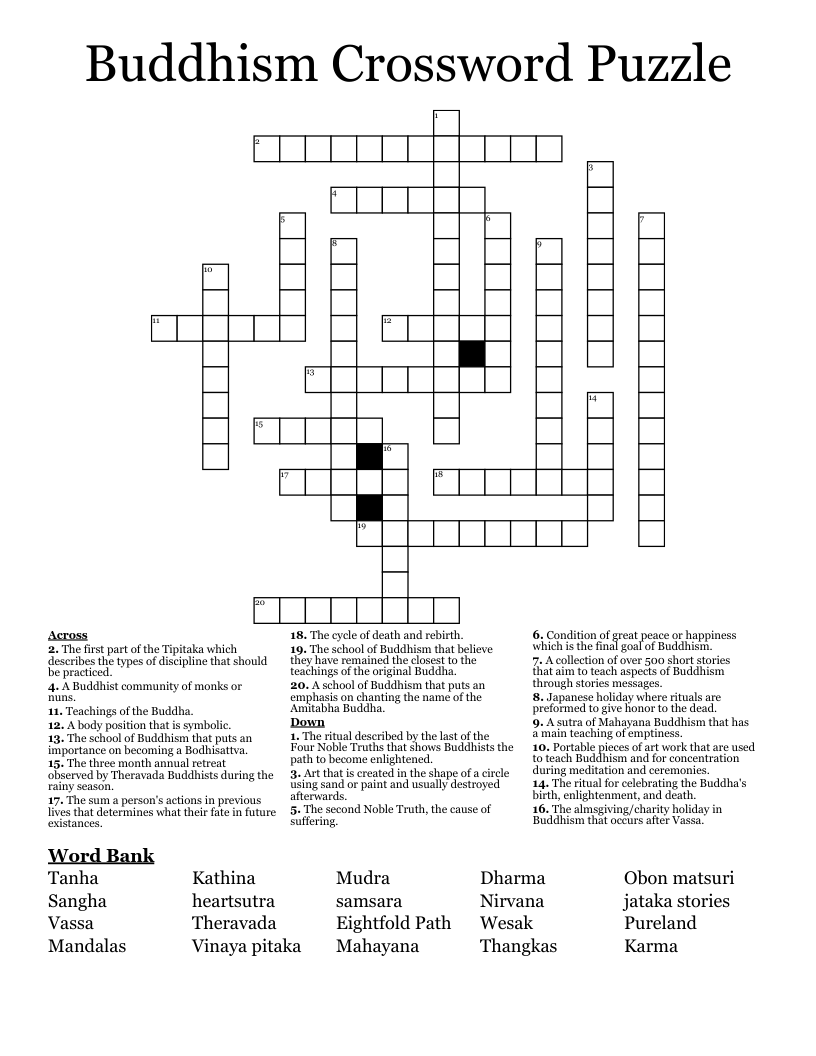
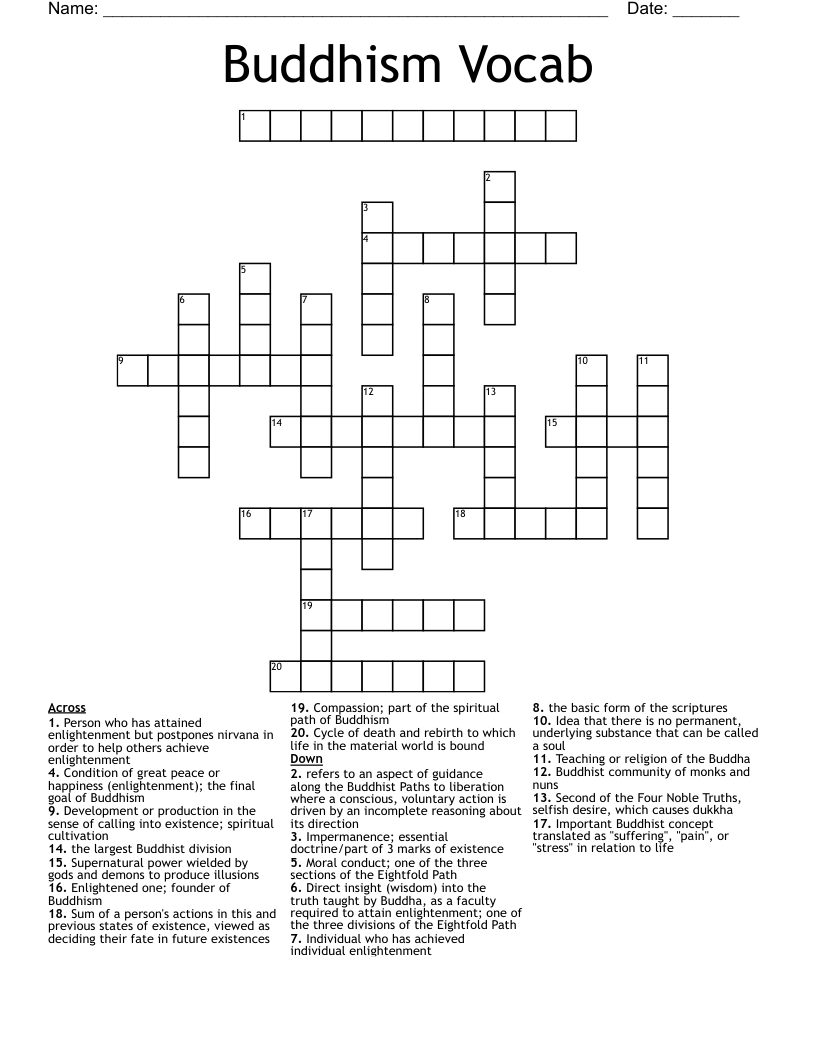
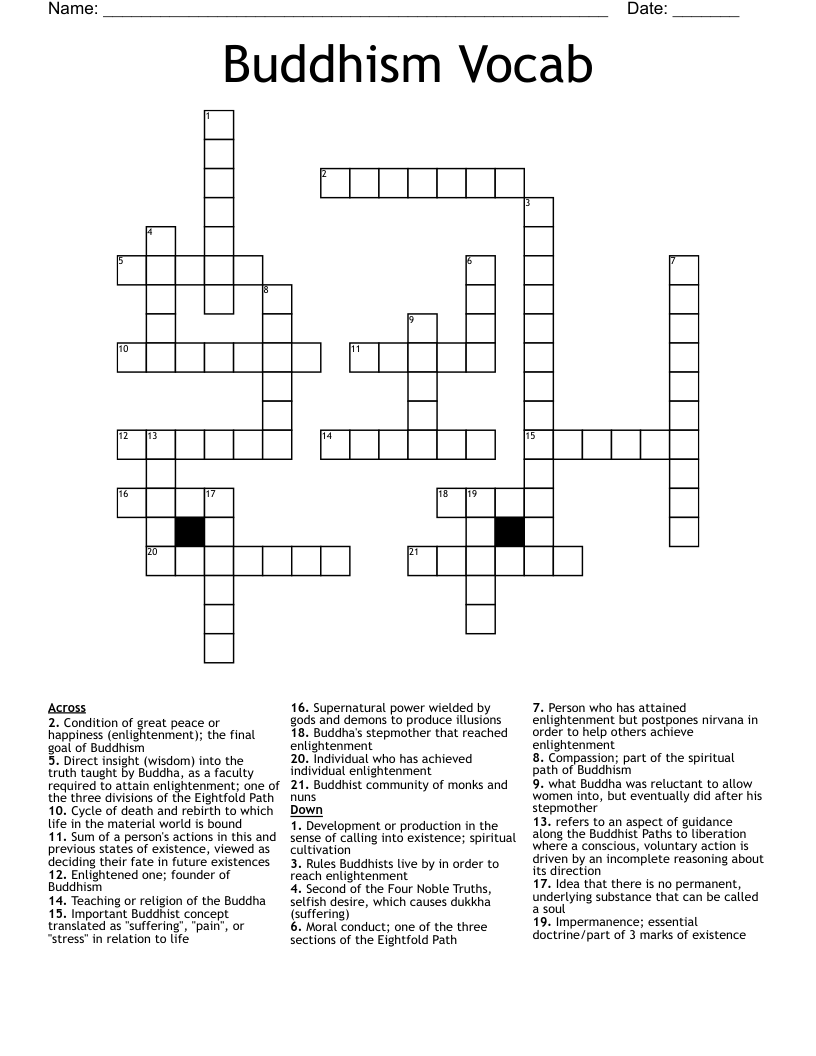
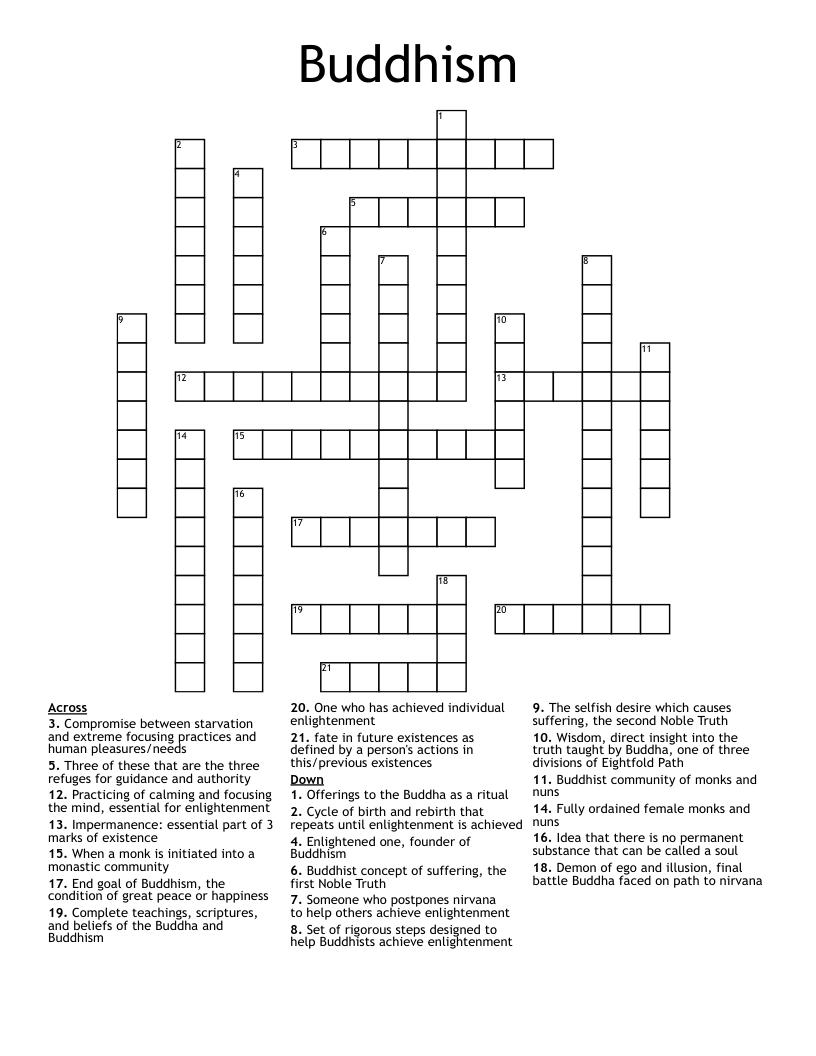
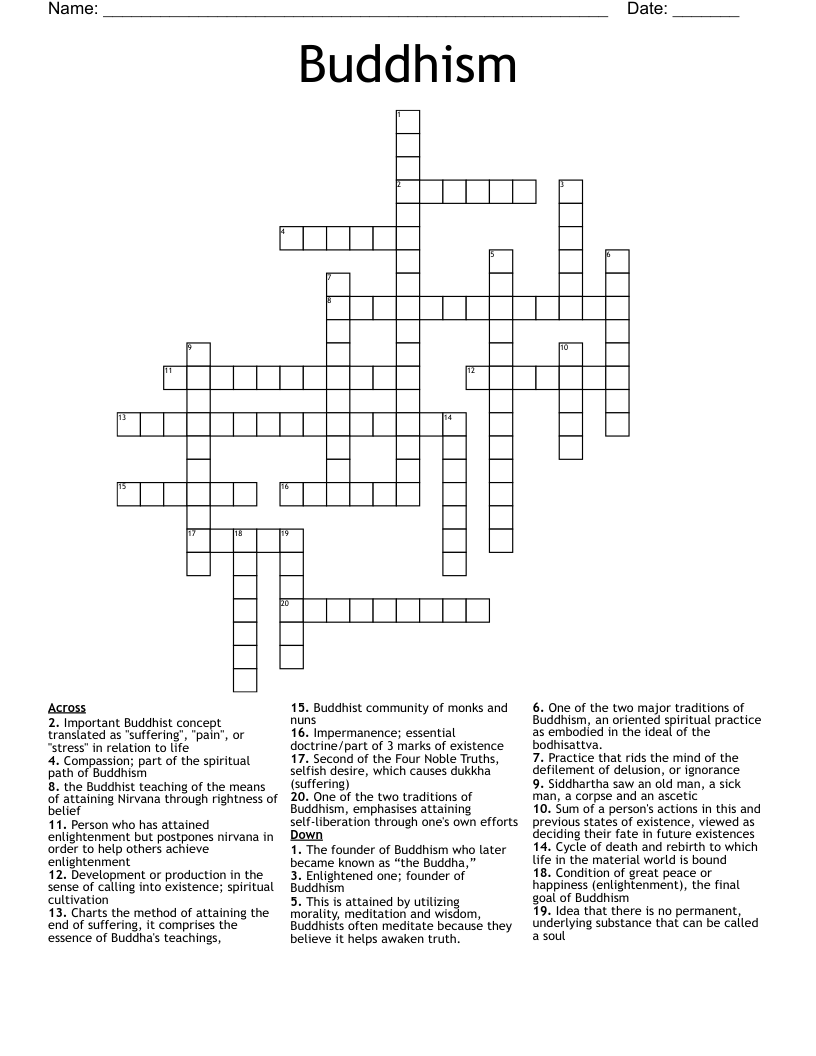
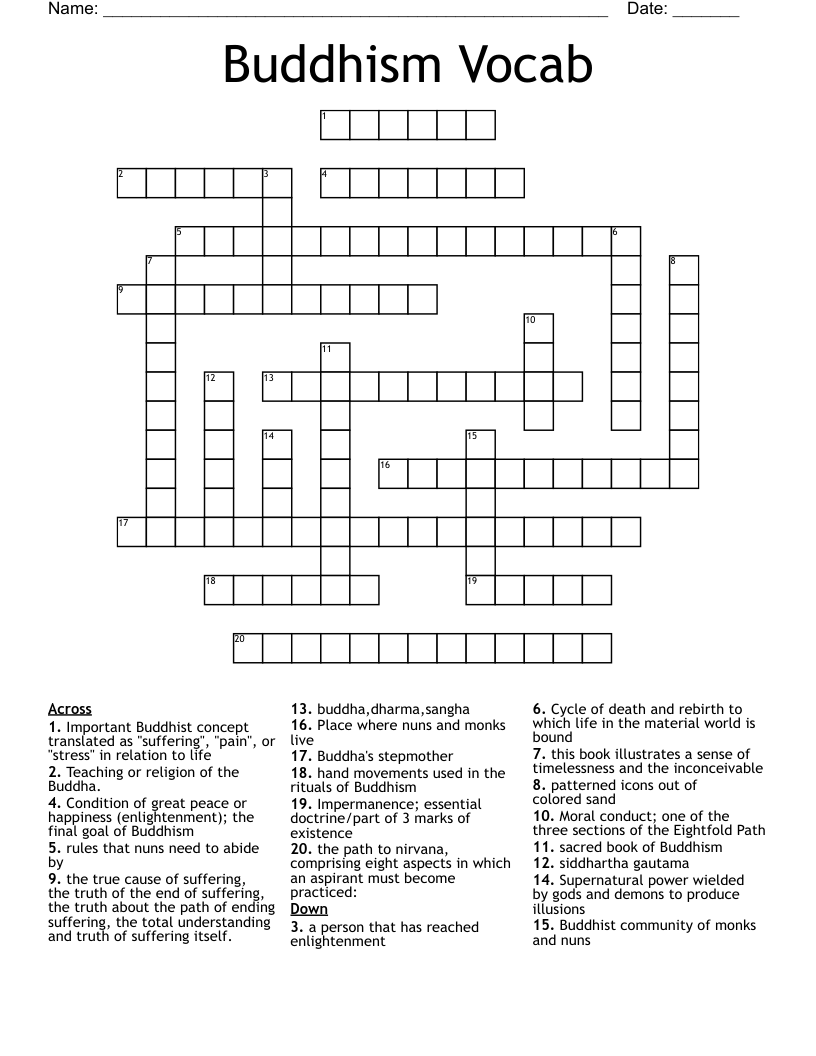
This printable crossword puzzle on the topic of Hinduism, Sikhism & Buddhism has 30 clues. Answers range from 3 to 16 letters long. This crossword is also available to download as a Microsoft Word document or a PDF.
Description
Translates to "Perfection of Wisdom," this term groups Mahayana Buddhism's Diamond Sutras, Heart Sutras, and Sukhavati Sutras into one
The "three baskets" that Buddha's teachings were organized into after his death; used to describe Theravada Buddhism's sacred texts
The supernatural ability of demons to produce illusion. This force must be recognized and warded off in order to achieve enlightenment.
The Fifth Precept of Buddhism instructs Buddhists to abstain from the use of ______________
A term used to describe the innately joyous state that one enters extinguishing their selfish desires through following the teachings of the dharma and Eightfold Path
The Second Noble Truth reveals that our _______, or selfish desire, is the root cause of suffering.
A term that encompasses every single one of Buddha's teachings; one of the Three Jewels of Buddhism
A Buddhist community of monks and nuns; one of the Three Jewels of Buddhism
A female Buddhist monastic, or nun
The eight additional monastic life rules imposed on bhikkhunis that are not required of monks; also known as the "heavy rules"
Translates to "impermanence," one of the Three Marks of Existence in Buddhism. Buddhists believe that reality is everchanging, as are humans, and there is no permanent, underlying substance called a soul.
The cycle of death and rebirth to which the material world is bound; the goal of Buddhism is to break free from this cycle
Translates to "suffering." The First Noble Truth outlines that humans inevitably experience this sensation; it is the clinical human condition. The goal of Buddhism is to relieve ourselves from this
This is a key figure and a major source of inspiration particularly in Mahayana Buddhism. This individual is seen as representing the pinnacle of Buddhism, having enough selflessness and discipline to postpone individual enlightenment to return to samsara and aid others in achieving it.
The sum of a person's actions in this life and previous life; dictates our fate in future cycles of samsara. Buddhists strive to accumulate a positive version of this to achieve favorable rebirth.
Buddha's eight-part process outlined in the Fourth Noble Truth that guides Buddhists to enlightenment; consists of various "rights" when referring to moral conduct, wisdom, and meditation
A mind-clearing, insight-provoking mental exercise which one may use to reframe their perspective on reality; used by Buddhists as a chief means of achieving enlightenment
Ceremonies performed by Buddhists involving items such as fruit, flowers, and gifts. Used as a means of showing gratitude and devotion to the Buddha, among other deities.
The essential founder of Buddhism; the first individual to find the path to enlightenment after seven long years of searching for answers; one of the Three Jewels of Buddhism
A set of rules in put in place particularly in monasteries to ensure that individuals refrain from bringing suffering to themselves or others and behave properly
Translates to "merit," is an attribute that monks and nuns (and generally all Buddhists) aspire to live up to so that they can build good karma and achieve a favorable rebirth
Hand gestures or body positions in Buddhist art/statues that indicate the nature and function of the deity shown; helps a great deal in identifying different Buddha images
The three "refuges" of Buddhism; staples in the religion that are major sources of authority and inspiration for Buddhists striving to achieve enlightenment
Can be thought of as an essence, or an attempt to understand life without any logical thought or language. One of the major sub-divisions of Buddhism.
A three-month annual retreat for Buddhist monks (during the rainy season) that involves strict and intense meditation. This was originally encouraged by Buddha to avoid bringing unnecessary harm to crops and/or animals
A Mahayana Buddhist text whose central theme focuses specifically on the core emptiness of our reality and experiences
One of the three divisions of the Eightfold Path (Right Speech, Right Livelihood, Right Action); translates to "moral conduct"
Consists of 550 tales about Buddha's past lives; each tale communicates a lesson about Buddhist values and ideals; these texts are consulted often when teaching younger Buddhists the main ideas of the religion
Means "development" or "production" in the sense of calling into existence; one's spiritual cultivation
A highly-conservative Buddhist sub-division that is considered to be closest to the original teachings of Buddha; the largest sub-division