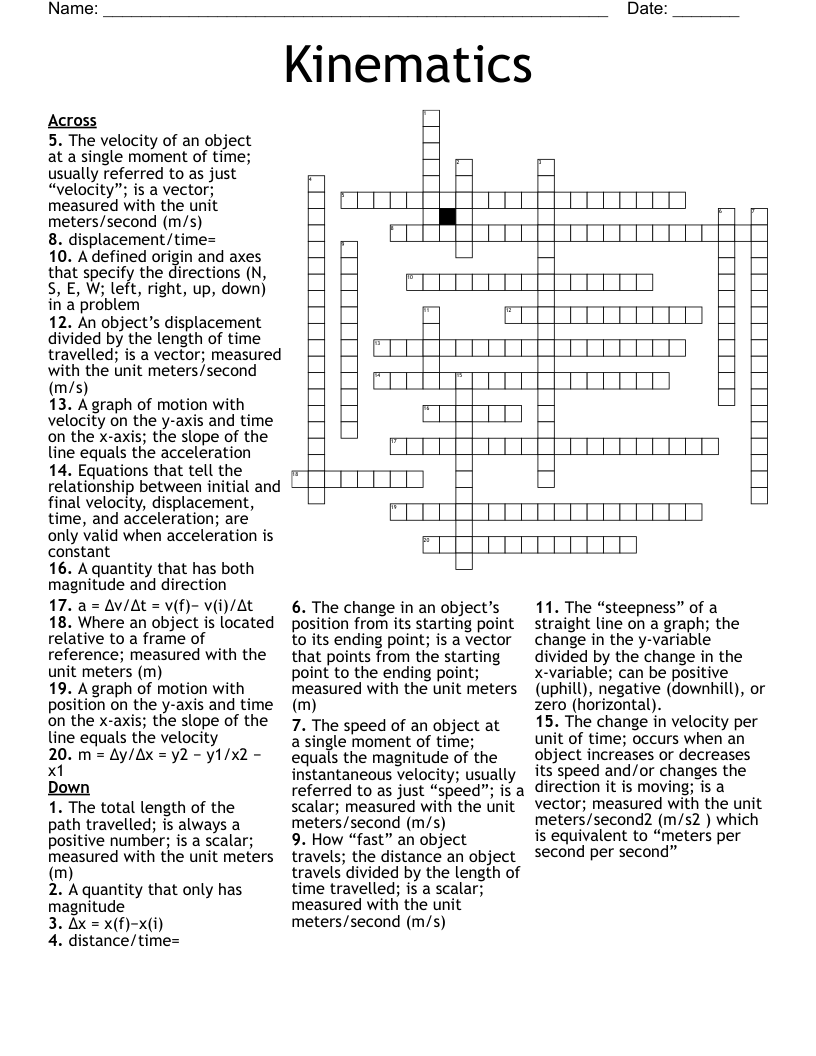
Kinematics Crossword
This printable crossword puzzle on the topic of Physics has 20 clues. Answers range from 5 to 23 letters long. This crossword is also available to download as a Microsoft Word document or a PDF.
Description
A quantity that only has magnitude
A quantity that has both magnitude and direction
A defined origin and axes that specify the directions (N, S, E, W; left, right, up, down) in a problem
Where an object is located relative to a frame of reference; measured with the unit meters (m)
The total length of the path travelled; is always a positive number; is a scalar; measured with the unit meters (m)
The change in an object’s position from its starting point to its ending point; is a vector that points from the starting point to the ending point; measured with the unit meters (m)
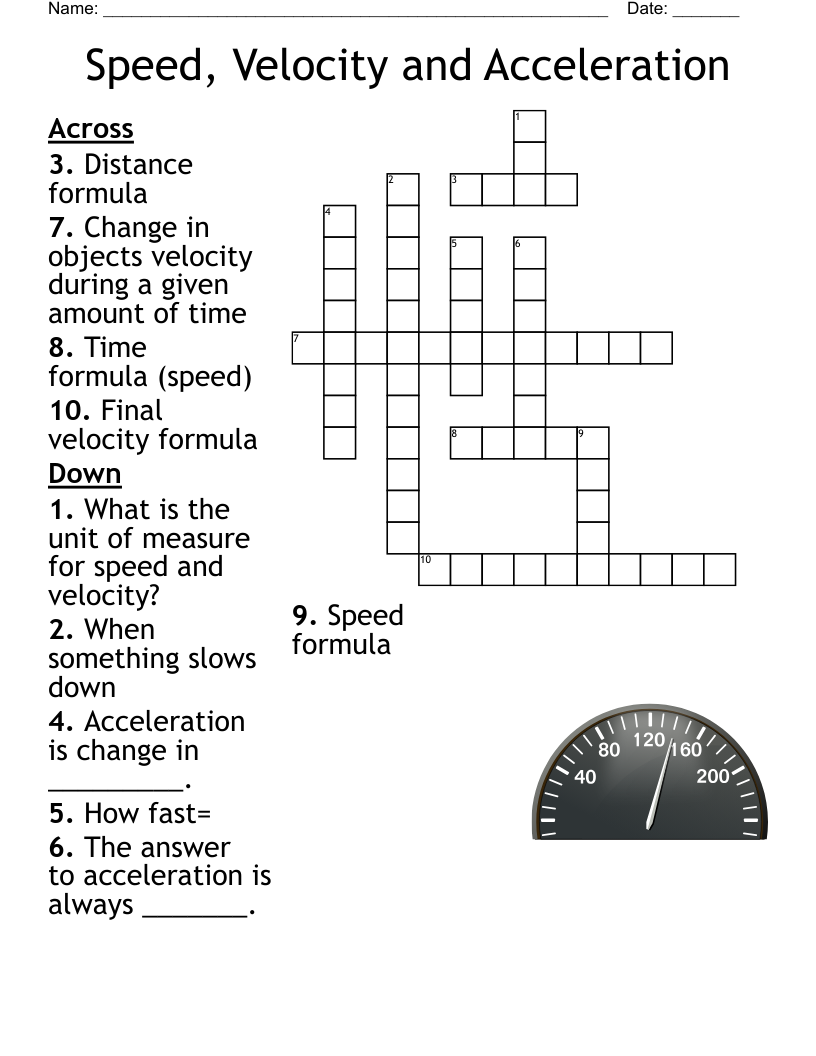
How “fast” an object travels; the distance an object travels divided by the length of time travelled; is a scalar; measured with the unit meters/second (m/s)
An object’s displacement divided by the length of time travelled; is a vector; measured with the unit meters/second (m/s)
The speed of an object at a single moment of time; equals the magnitude of the instantaneous velocity; usually referred to as just “speed”; is a scalar; measured with the unit meters/second (m/s)
The velocity of an object at a single moment of time; usually referred to as just “velocity”; is a vector; measured with the unit meters/second (m/s)
The change in velocity per unit of time; occurs when an object increases or decreases its speed and/or changes the direction it is moving; is a vector; measured with the unit meters/second2 (m/s2 ) which is equivalent to “meters per second per second”
Equations that tell the relationship between initial and final velocity, displacement, time, and acceleration; are only valid when acceleration is constant
The “steepness” of a straight line on a graph; the change in the y-variable divided by the change in the x-variable; can be positive (uphill), negative (downhill), or zero (horizontal).
A graph of motion with position on the y-axis and time on the x-axis; the slope of the line equals the velocity
A graph of motion with velocity on the y-axis and time on the x-axis; the slope of the line equals the acceleration
a = ∆v/∆t = v(f)− v(i)/∆t
m = ∆y/∆x = y2 − y1/x2 − x1
∆x = x(f)−x(i)
distance/time=
displacement/time=