MEDIEVAL VOCABULARY Crossword
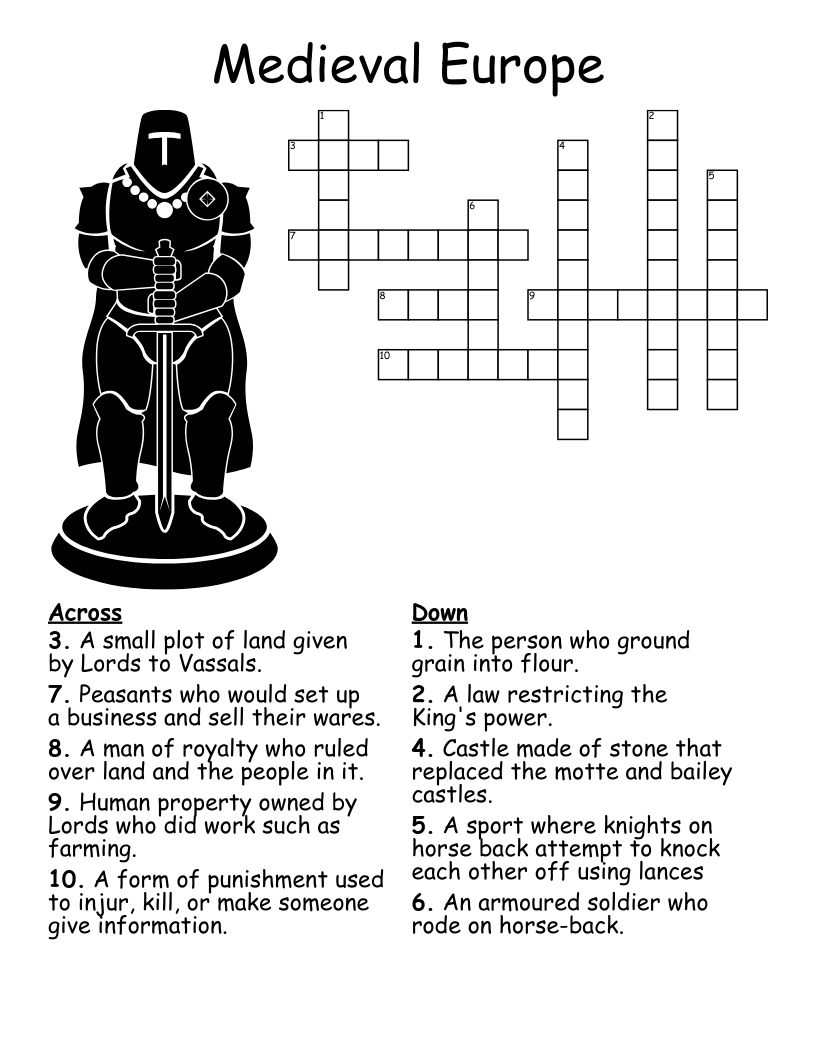
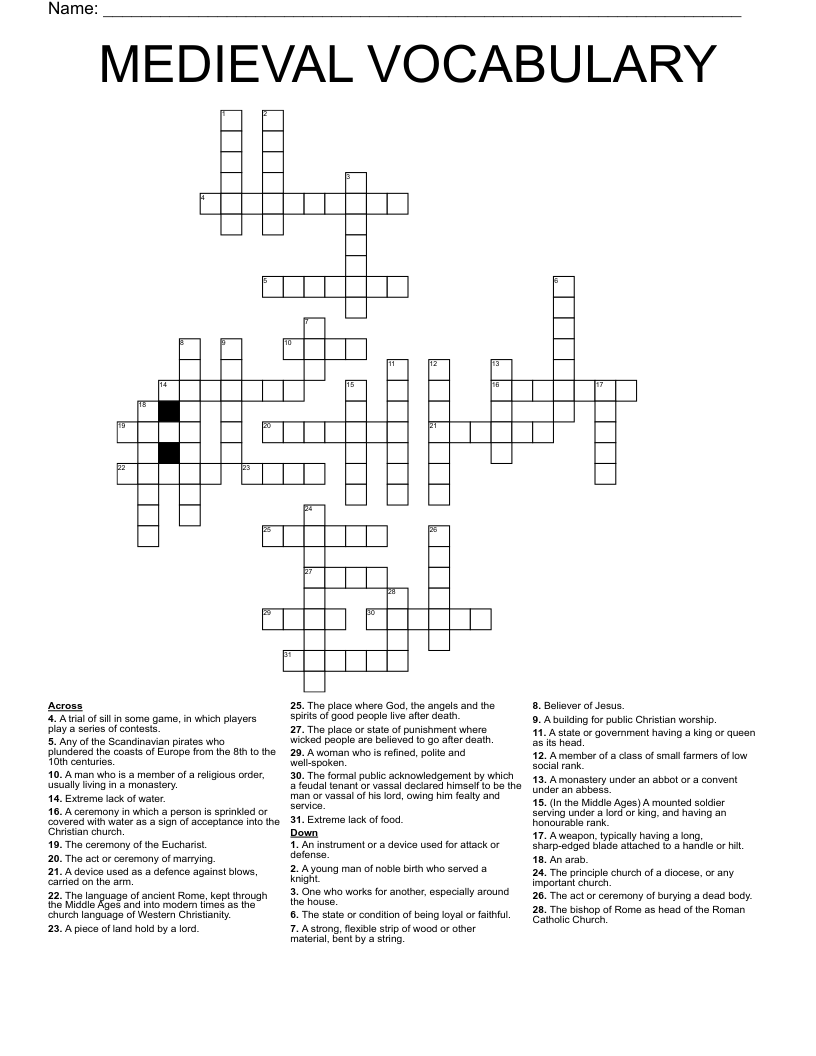
This printable crossword puzzle on the topic of Medieval History has 31 clues. Answers range from 3 to 10 letters long. This crossword is also available to download as a Microsoft Word document or a PDF.
Description
The place or state of punishment where wicked people are believed to go after death.
Believer of Jesus.
Any of the Scandinavian pirates who plundered the coasts of Europe from the 8th to the 10th centuries.
The formal public acknowledgement by which a feudal tenant or vassal declared himself to be the man or vassal of his lord, owing him fealty and service.
A device used as a defence against blows, carried on the arm.
Extreme lack of food.
The place where God, the angels and the spirits of good people live after death.
A piece of land hold by a lord.
A man who is a member of a religious order, usually living in a monastery.
The ceremony of the Eucharist.
A member of a class of small farmers of low social rank.
A trial of sill in some game, in which players play a series of contests.
A monastery under an abbot or a convent under an abbess.
An instrument or a device used for attack or defense.
The state or condition of being loyal or faithful.
The act or ceremony of burying a dead body.
One who works for another, especially around the house.
A building for public Christian worship.
A weapon, typically having a long, sharp-edged blade attached to a handle or hilt.
A young man of noble birth who served a knight.
(In the Middle Ages) A mounted soldier serving under a lord or king, and having an honourable rank.
An arab.
A state or government having a king or queen as its head.
A strong, flexible strip of wood or other material, bent by a string.
A ceremony in which a person is sprinkled or covered with water as a sign of acceptance into the Christian church.
The language of ancient Rome, kept through the Middle Ages and into modern times as the church language of Western Christianity.
The principle church of a diocese, or any important church.
Extreme lack of water.
The act or ceremony of marrying.
The bishop of Rome as head of the Roman Catholic Church.
A woman who is refined, polite and well-spoken.