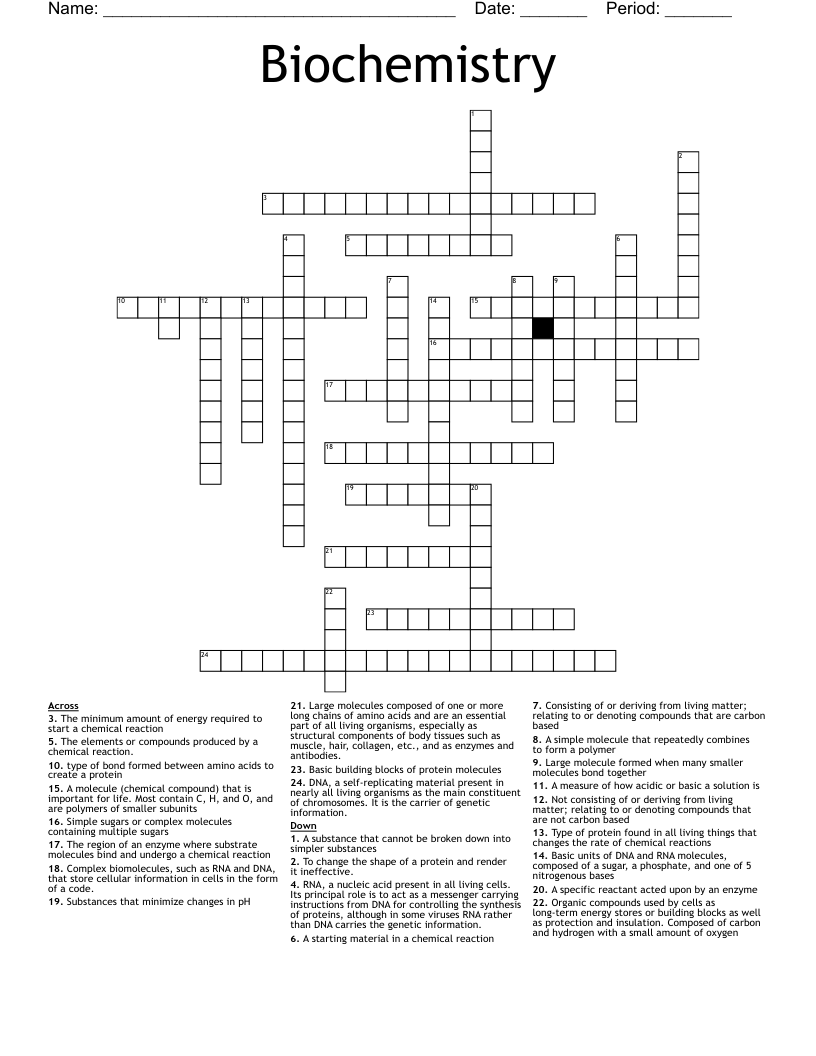
Biochemistry Crossword
This printable crossword puzzle on the topic of Organic Chemistry & Biochemistry has 24 clues. Answers range from 2 to 20 letters long. This crossword is also available to download as a Microsoft Word document or a PDF.
Description
Basic building blocks of protein molecules
Large molecules composed of one or more long chains of amino acids and are an essential part of all living organisms, especially as structural components of body tissues such as muscle, hair, collagen, etc., and as enzymes and antibodies.
Type of protein found in all living things that changes the rate of chemical reactions
type of bond formed between amino acids to create a protein
Simple sugars or complex molecules containing multiple sugars
Basic units of DNA and RNA molecules, composed of a sugar, a phosphate, and one of 5 nitrogenous bases
A specific reactant acted upon by an enzyme
Substances that minimize changes in pH
A measure of how acidic or basic a solution is
The minimum amount of energy required to start a chemical reaction
A substance that cannot be broken down into simpler substances
A molecule (chemical compound) that is important for life. Most contain C, H, and O, and are polymers of smaller subunits
RNA, a nucleic acid present in all living cells. Its principal role is to act as a messenger carrying instructions from DNA for controlling the synthesis of proteins, although in some viruses RNA rather than DNA carries the genetic information.
Organic compounds used by cells as long-term energy stores or building blocks as well as protection and insulation. Composed of carbon and hydrogen with a small amount of oxygen
DNA, a self-replicating material present in nearly all living organisms as the main constituent of chromosomes. It is the carrier of genetic information.
Complex biomolecules, such as RNA and DNA, that store cellular information in cells in the form of a code.
A starting material in a chemical reaction
To change the shape of a protein and render it ineffective.
The elements or compounds produced by a chemical reaction.
Large molecule formed when many smaller molecules bond together
A simple molecule that repeatedly combines to form a polymer
The region of an enzyme where substrate molecules bind and undergo a chemical reaction
Consisting of or deriving from living matter; relating to or denoting compounds that are carbon based
Not consisting of or deriving from living matter; relating to or denoting compounds that are not carbon based