Biochemistry Crossword
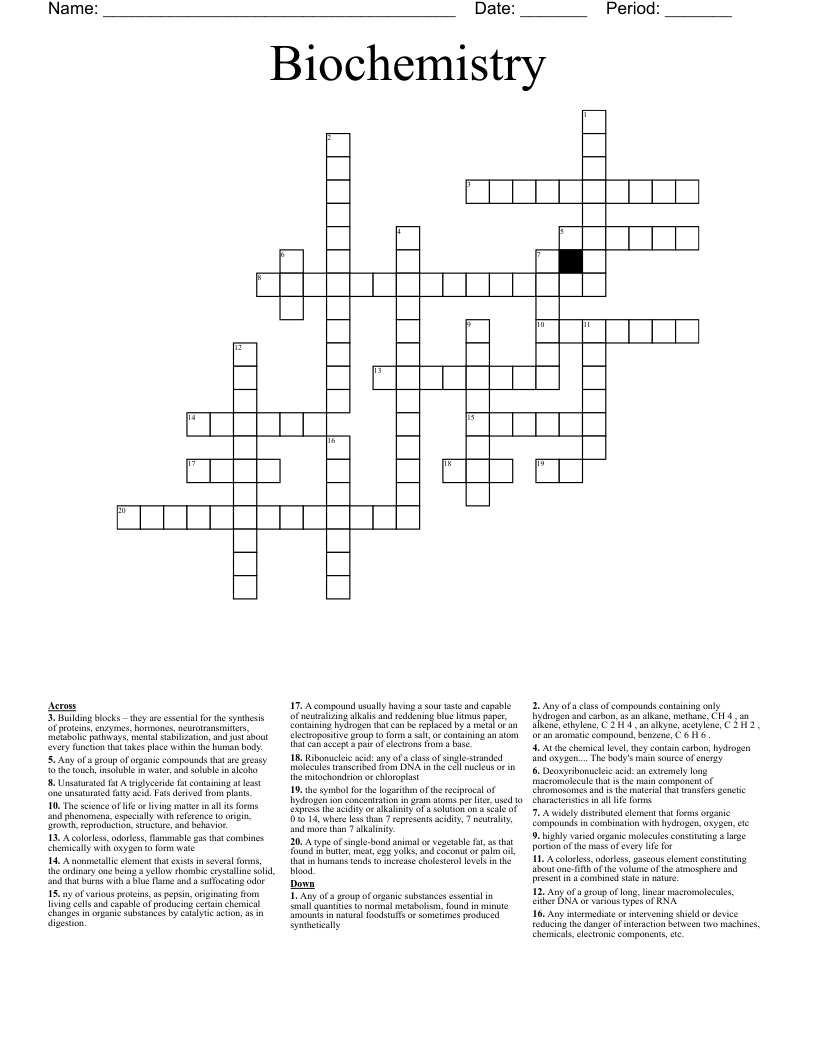
This printable crossword puzzle on the topic of Organic Chemistry & Biochemistry has 20 clues. Answers range from 2 to 15 letters long. This crossword is also available to download as a Microsoft Word document or a PDF.
Description
Building blocks – they are essential for the synthesis of proteins, enzymes, hormones, neurotransmitters, metabolic pathways, mental stabilization, and just about every function that takes place within the human body.
At the chemical level, they contain carbon, hydrogen and oxygen.... The body's main source of energy
highly varied organic molecules constituting a large portion of the mass of every life for
Any of a group of organic compounds that are greasy to the touch, insoluble in water, and soluble in alcoho
Any of a group of long, linear macromolecules, either DNA or various types of RNA
A widely distributed element that forms organic compounds in combination with hydrogen, oxygen, etc
A type of single-bond animal or vegetable fat, as that found in butter, meat, egg yolks, and coconut or palm oil, that in humans tends to increase cholesterol levels in the blood.
Unsaturated fat A triglyceride fat containing at least one unsaturated fatty acid. Fats derived from plants.
Any of a group of organic substances essential in small quantities to normal metabolism, found in minute amounts in natural foodstuffs or sometimes produced synthetically
Deoxyribonucleic acid: an extremely long macromolecule that is the main component of chromosomes and is the material that transfers genetic characteristics in all life forms
Ribonucleic acid: any of a class of single-stranded molecules transcribed from DNA in the cell nucleus or in the mitochondrion or chloroplast
A compound usually having a sour taste and capable of neutralizing alkalis and reddening blue litmus paper, containing hydrogen that can be replaced by a metal or an electropositive group to form a salt, or containing an atom that can accept a pair of electrons from a base.
A colorless, odorless, flammable gas that combines chemically with oxygen to form wate
The science of life or living matter in all its forms and phenomena, especially with reference to origin, growth, reproduction, structure, and behavior.
Any intermediate or intervening shield or device reducing the danger of interaction between two machines, chemicals, electronic components, etc.
the symbol for the logarithm of the reciprocal of hydrogen ion concentration in gram atoms per liter, used to express the acidity or alkalinity of a solution on a scale of 0 to 14, where less than 7 represents acidity, 7 neutrality, and more than 7 alkalinity.
A colorless, odorless, gaseous element constituting about one-fifth of the volume of the atmosphere and present in a combined state in nature.
Any of a class of compounds containing only hydrogen and carbon, as an alkane, methane, CH 4 , an alkene, ethylene, C 2 H 4 , an alkyne, acetylene, C 2 H 2 , or an aromatic compound, benzene, C 6 H 6 .
A nonmetallic element that exists in several forms, the ordinary one being a yellow rhombic crystalline solid, and that burns with a blue flame and a suffocating odor
ny of various proteins, as pepsin, originating from living cells and capable of producing certain chemical changes in organic substances by catalytic action, as in digestion.