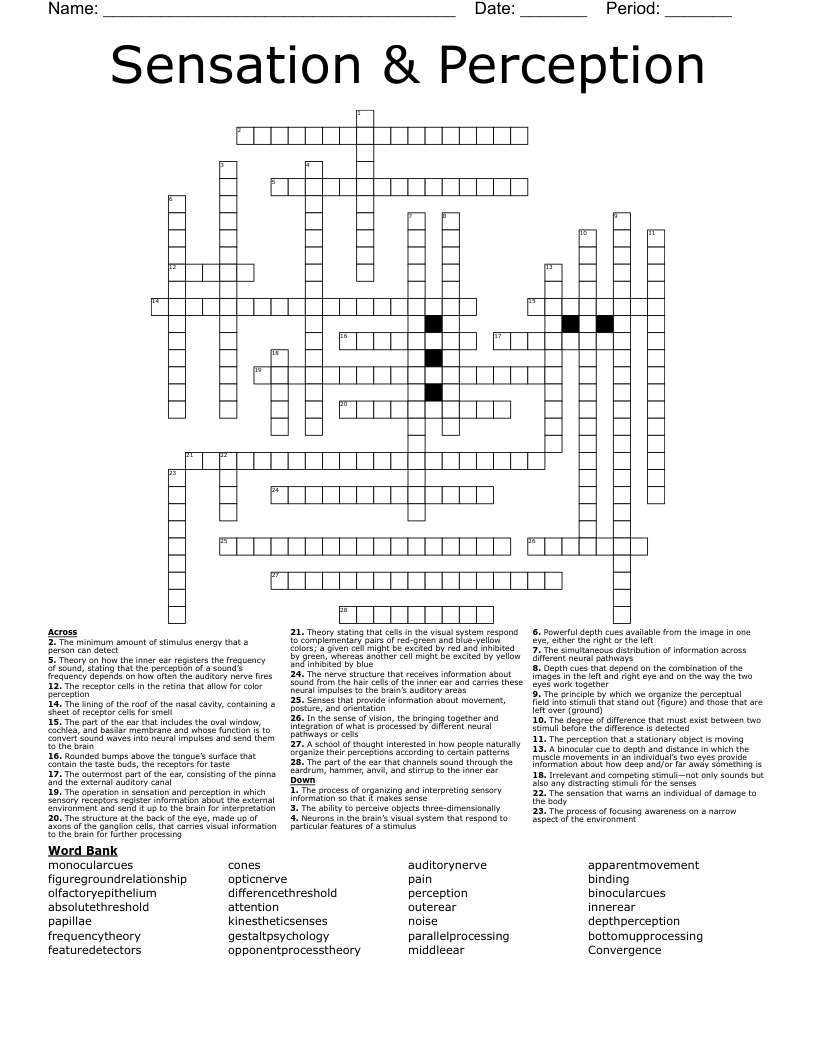
Sensation & Perception Crossword
This printable crossword puzzle on the topic of Psychology & Sociology has 28 clues. Answers range from 4 to 24 letters long. This crossword is also available to download as a Microsoft Word document or a PDF.
Description
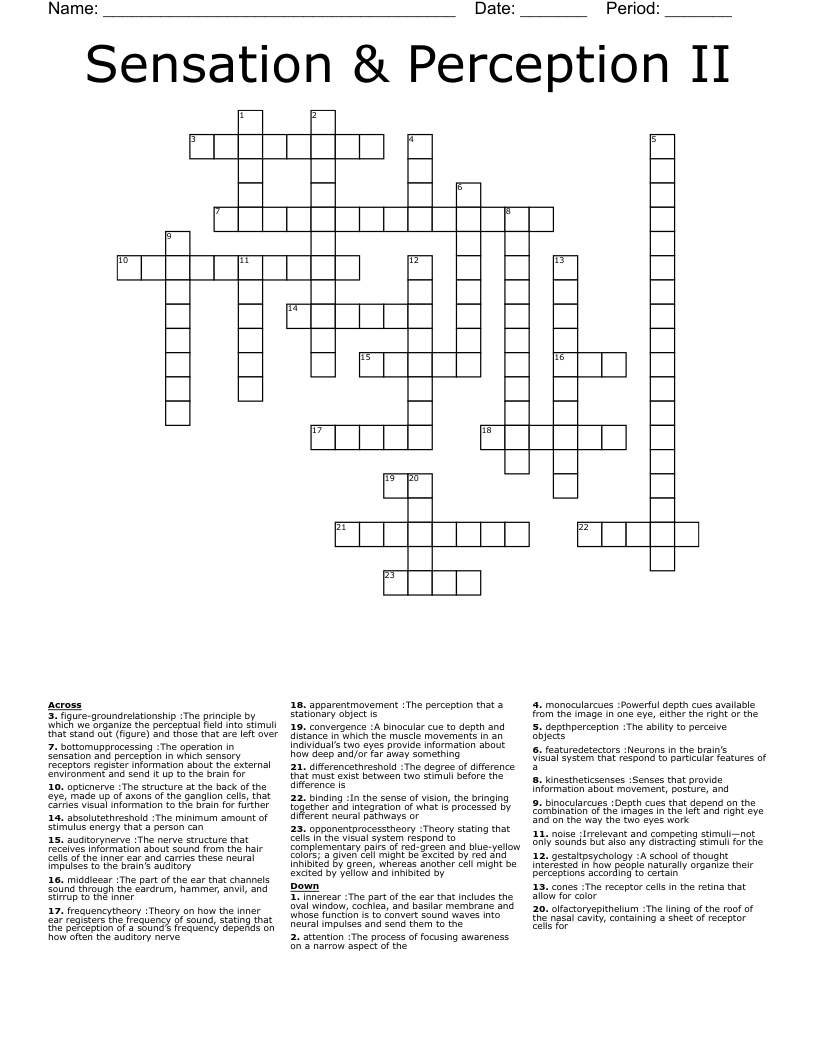
The minimum amount of stimulus energy that a person can detect
The perception that a stationary object is moving
The process of focusing awareness on a narrow aspect of the environment
The nerve structure that receives information about sound from the hair cells of the inner ear and carries these neural impulses to the brain’s auditory areas
In the sense of vision, the bringing together and integration of what is processed by different neural pathways or cells
Depth cues that depend on the combination of the images in the left and right eye and on the way the two eyes work together
The operation in sensation and perception in which sensory receptors register information about the external environment and send it up to the brain for interpretation
The receptor cells in the retina that allow for color perception
A binocular cue to depth and distance in which the muscle movements in an individual’s two eyes provide information about how deep and/or far away something is
The ability to perceive objects three-dimensionally
The degree of difference that must exist between two stimuli before the difference is detected
Neurons in the brain’s visual system that respond to particular features of a stimulus
The principle by which we organize the perceptual field into stimuli that stand out (figure) and those that are left over (ground)
Theory on how the inner ear registers the frequency of sound, stating that the perception of a sound’s frequency depends on how often the auditory nerve fires
A school of thought interested in how people naturally organize their perceptions according to certain patterns
The part of the ear that includes the oval window, cochlea, and basilar membrane and whose function is to convert sound waves into neural impulses and send them to the brain
Senses that provide information about movement, posture, and orientation
The part of the ear that channels sound through the eardrum, hammer, anvil, and stirrup to the inner ear
Powerful depth cues available from the image in one eye, either the right or the left
Irrelevant and competing stimuli—not only sounds but also any distracting stimuli for the senses
The lining of the roof of the nasal cavity, containing a sheet of receptor cells for smell
Theory stating that cells in the visual system respond to complementary pairs of red-green and blue-yellow colors; a given cell might be excited by red and inhibited by green, whereas another cell might be excited by yellow and inhibited by blue
The structure at the back of the eye, made up of axons of the ganglion cells, that carries visual information to the brain for further processing
The outermost part of the ear, consisting of the pinna and the external auditory canal
The sensation that warns an individual of damage to the body
Rounded bumps above the tongue’s surface that contain the taste buds, the receptors for taste
The simultaneous distribution of information across different neural pathways
The process of organizing and interpreting sensory information so that it makes sense