Literary Terms Word Matching Activity Worksheet
This printable matching worksheet on the topic of Figurative Language & Literary Devices has 25 questions and answers to match. This matching worksheet is also available to download as a Microsoft Word document or a PDF.
Description
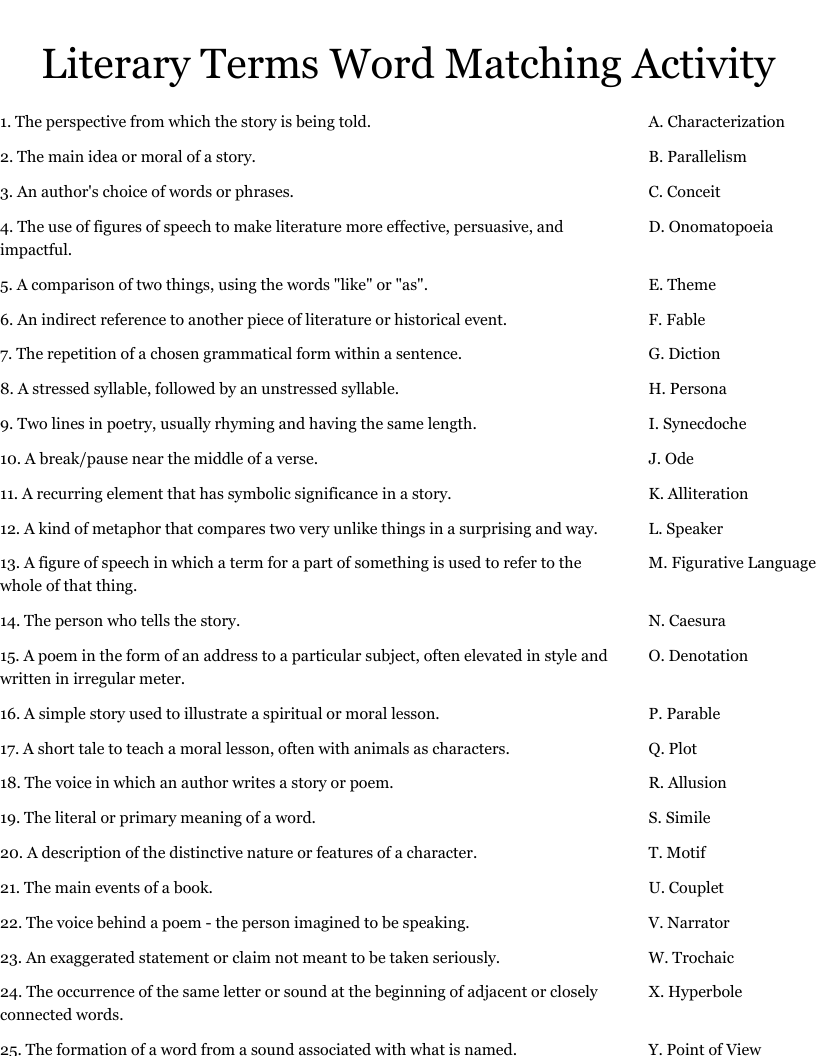
The perspective from which the story is being told.
The main idea or moral of a story.
An author's choice of words or phrases.
The use of figures of speech to make literature more effective, persuasive, and impactful.
A comparison of two things, using the words "like" or "as".
An indirect reference to another piece of literature or historical event.
The repetition of a chosen grammatical form within a sentence.
A stressed syllable, followed by an unstressed syllable.
Two lines in poetry, usually rhyming and having the same length.
A break/pause near the middle of a verse.
A recurring element that has symbolic significance in a story.
A kind of metaphor that compares two very unlike things in a surprising and way.
A figure of speech in which a term for a part of something is used to refer to the whole of that thing.
The person who tells the story.
A poem in the form of an address to a particular subject, often elevated in style and written in irregular meter.
A simple story used to illustrate a spiritual or moral lesson.
A short tale to teach a moral lesson, often with animals as characters.
The voice in which an author writes a story or poem.
The literal or primary meaning of a word.
A description of the distinctive nature or features of a character.
The main events of a book.
The voice behind a poem - the person imagined to be speaking.
An exaggerated statement or claim not meant to be taken seriously.
The occurrence of the same letter or sound at the beginning of adjacent or closely connected words.
The formation of a word from a sound associated with what is named.