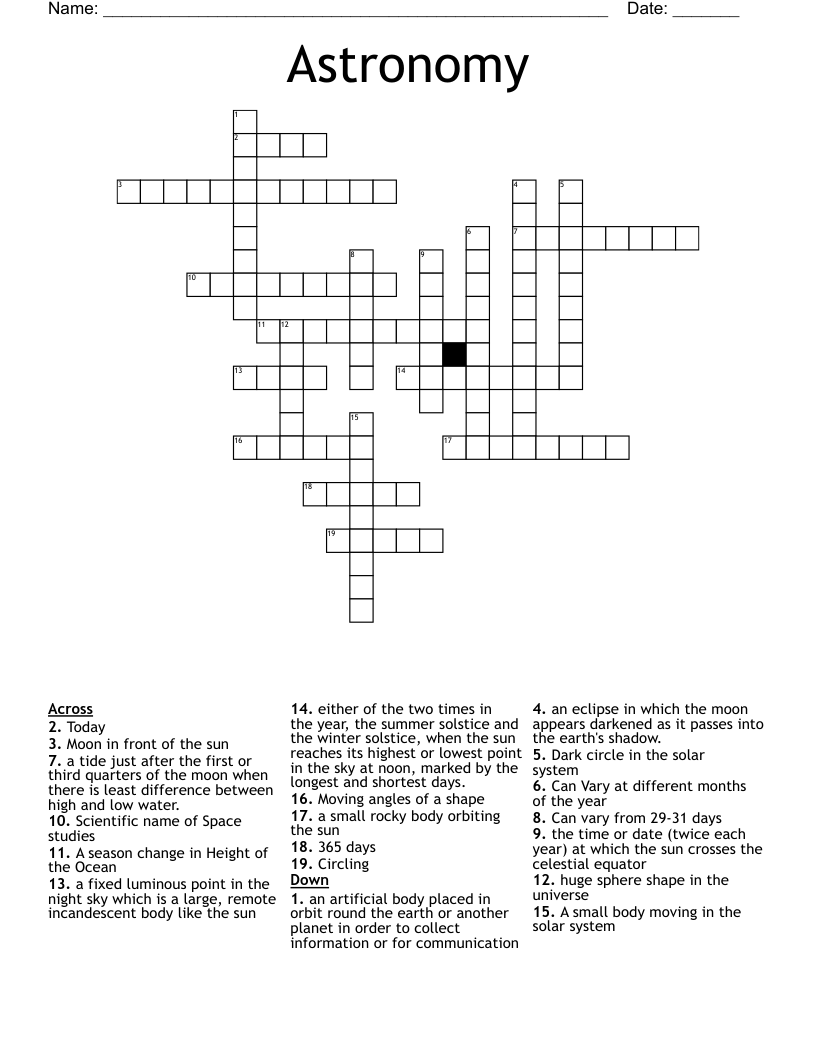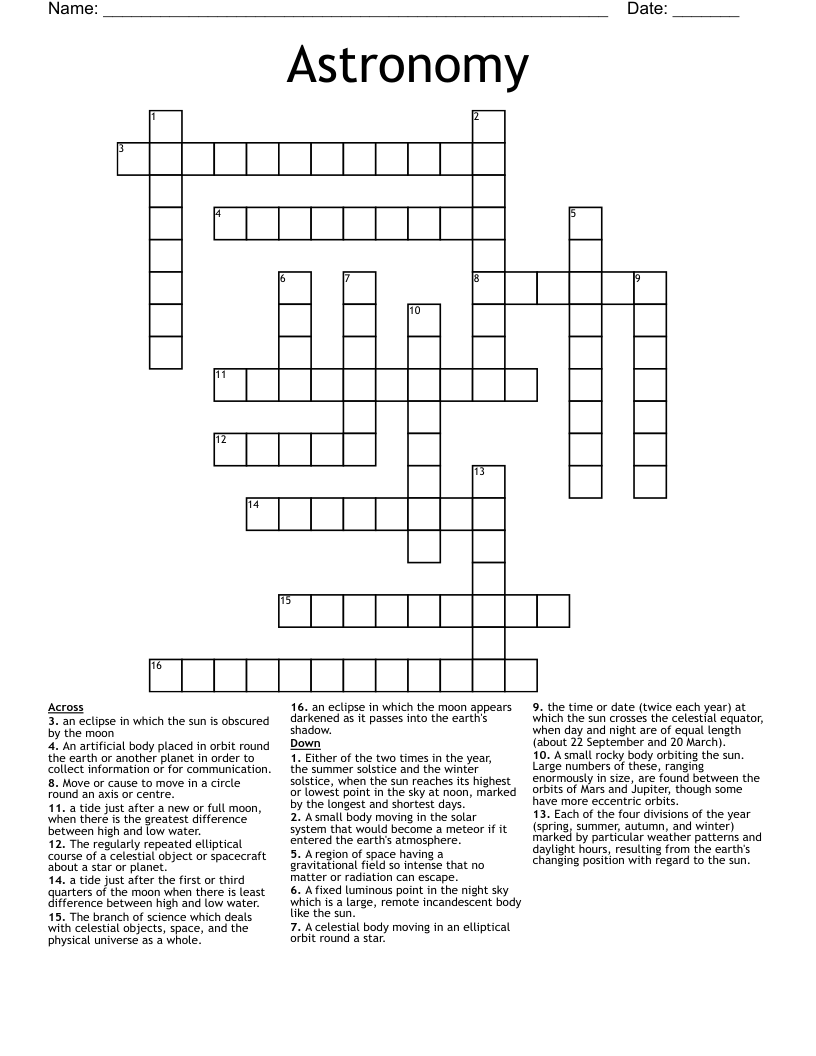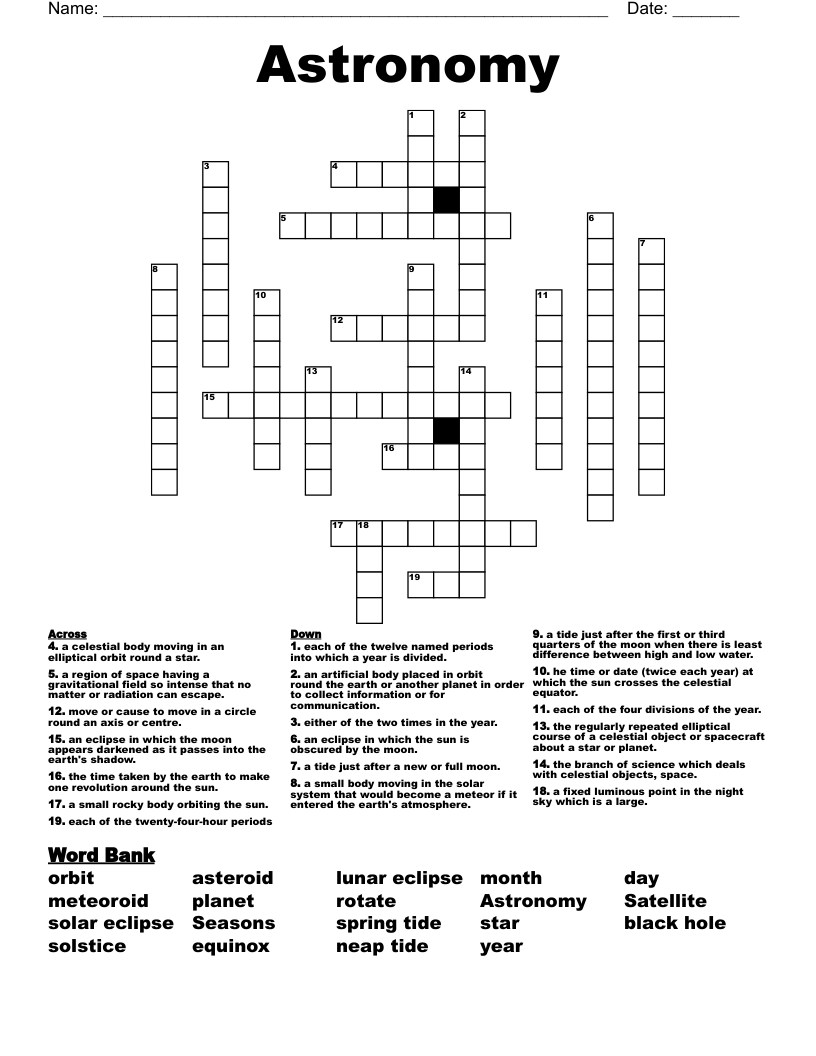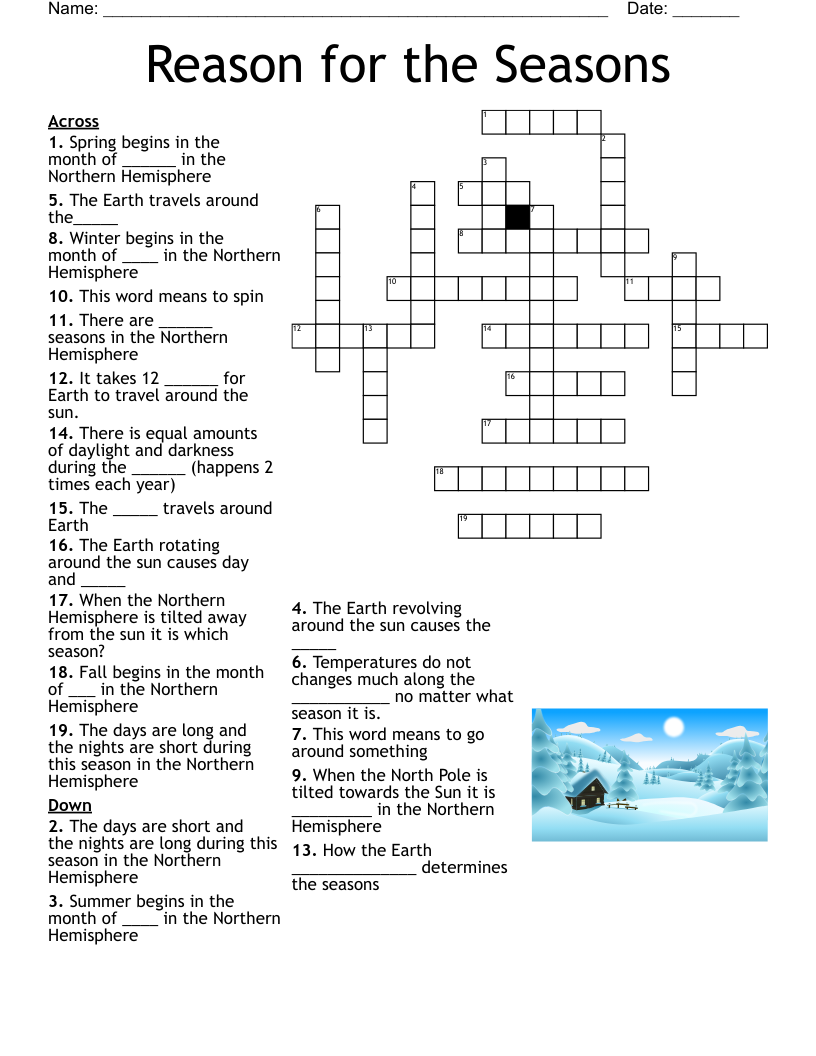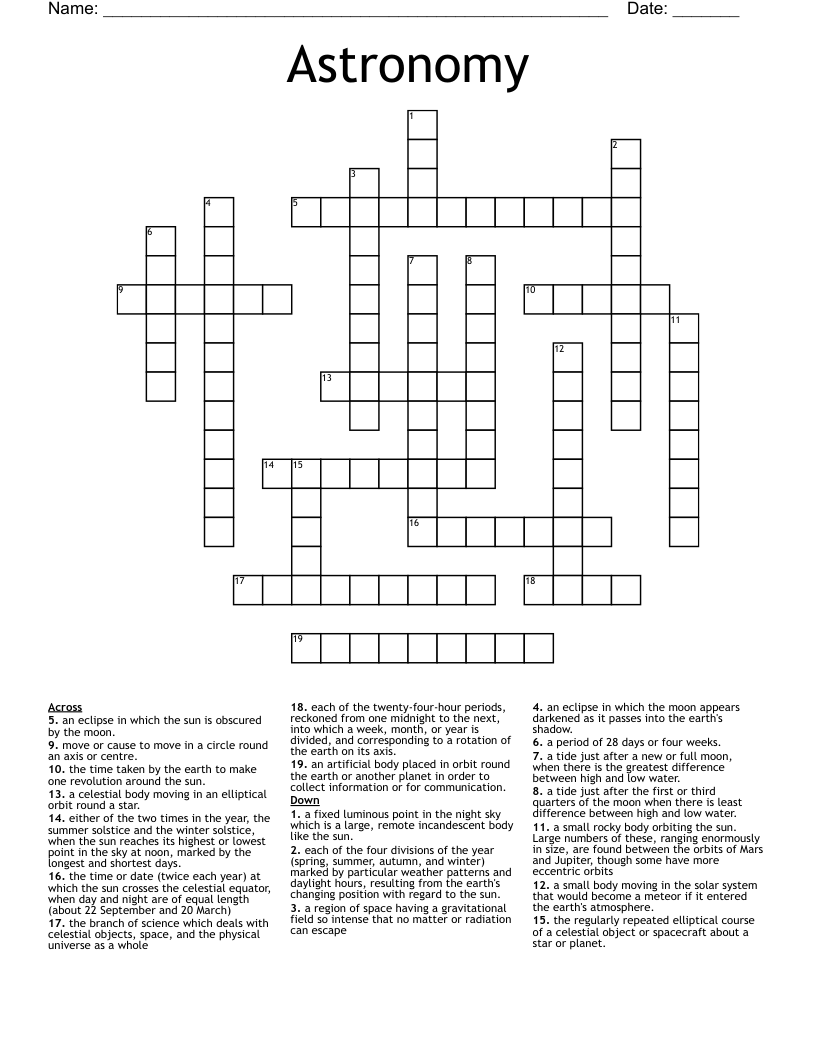
Astronomy Crossword
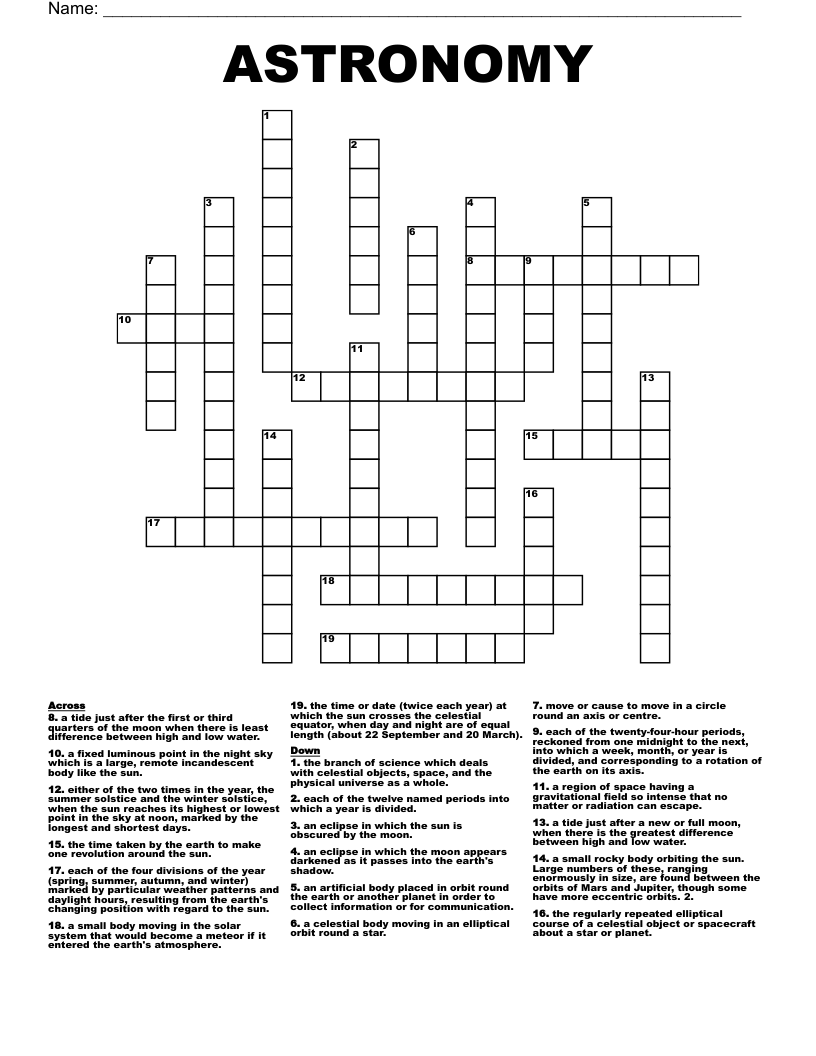
This printable crossword puzzle on the topic of Astronomy & Space has 19 clues. Answers range from 4 to 12 letters long. This crossword is also available to download as a Microsoft Word document or a PDF.
Description
the branch of science which deals with celestial objects, space, and the physical universe as a whole
each of the twenty-four-hour periods, reckoned from one midnight to the next, into which a week, month, or year is divided, and corresponding to a rotation of the earth on its axis.
a period of 28 days or four weeks.
the time taken by the earth to make one revolution around the sun.
each of the four divisions of the year (spring, summer, autumn, and winter) marked by particular weather patterns and daylight hours, resulting from the earth's changing position with regard to the sun.
the regularly repeated elliptical course of a celestial object or spacecraft about a star or planet.
move or cause to move in a circle round an axis or centre.
an artificial body placed in orbit round the earth or another planet in order to collect information or for communication.
a celestial body moving in an elliptical orbit round a star.
a small body moving in the solar system that would become a meteor if it entered the earth's atmosphere.
a small rocky body orbiting the sun. Large numbers of these, ranging enormously in size, are found between the orbits of Mars and Jupiter, though some have more eccentric orbits
a fixed luminous point in the night sky which is a large, remote incandescent body like the sun.
a region of space having a gravitational field so intense that no matter or radiation can escape
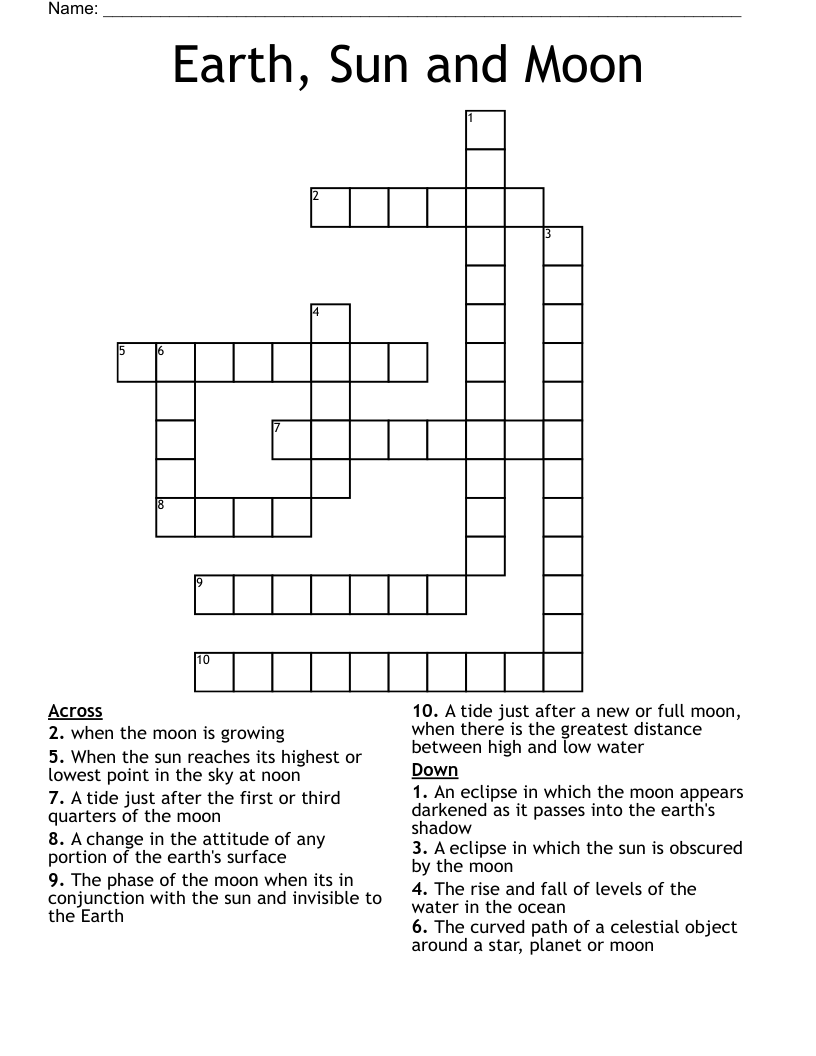
either of the two times in the year, the summer solstice and the winter solstice, when the sun reaches its highest or lowest point in the sky at noon, marked by the longest and shortest days.
the time or date (twice each year) at which the sun crosses the celestial equator, when day and night are of equal length (about 22 September and 20 March)
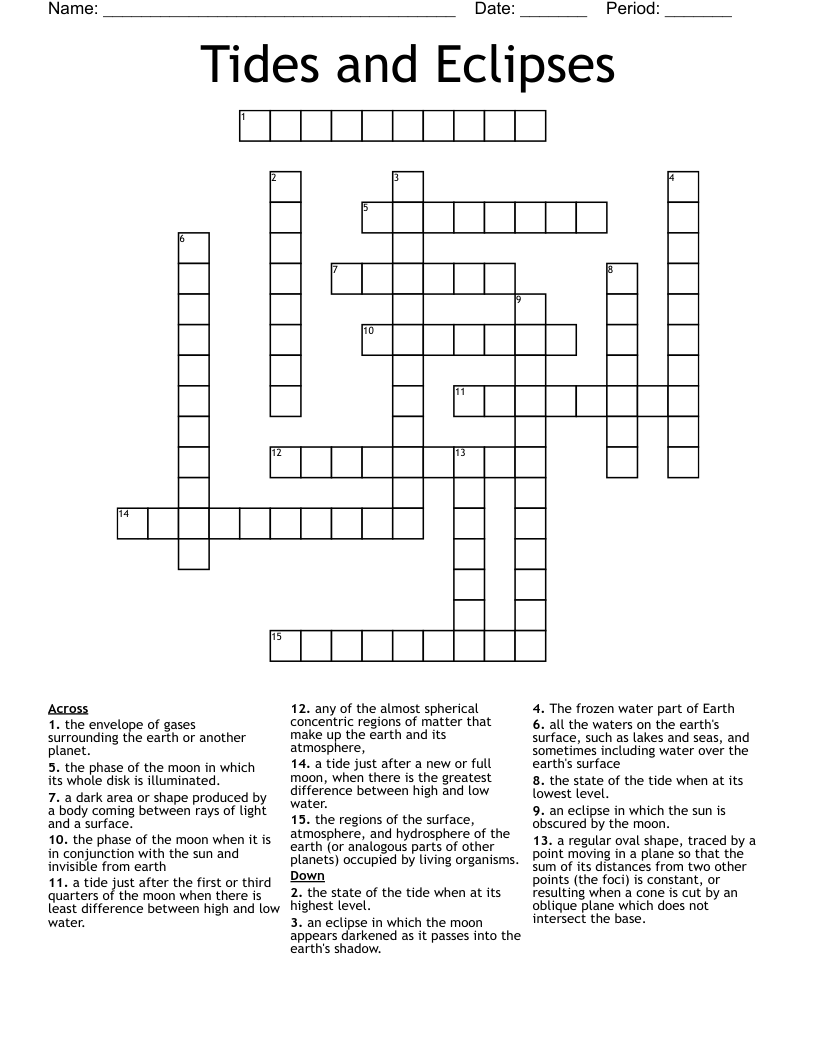
a tide just after a new or full moon, when there is the greatest difference between high and low water.
a tide just after the first or third quarters of the moon when there is least difference between high and low water.
an eclipse in which the sun is obscured by the moon.
an eclipse in which the moon appears darkened as it passes into the earth's shadow.