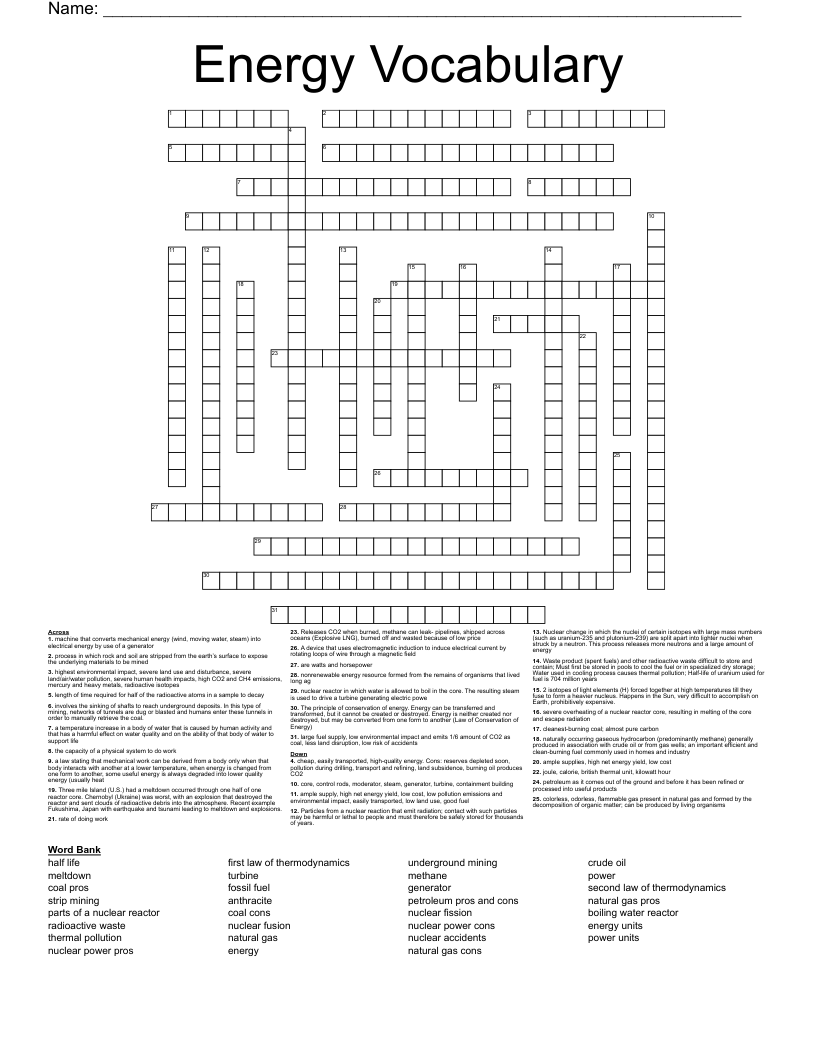
Energy Vocabulary Crossword
This printable crossword puzzle on the topic of Physics has 31 clues. Answers range from 5 to 25 letters long. This crossword is also available to download as a Microsoft Word document or a PDF.
Description
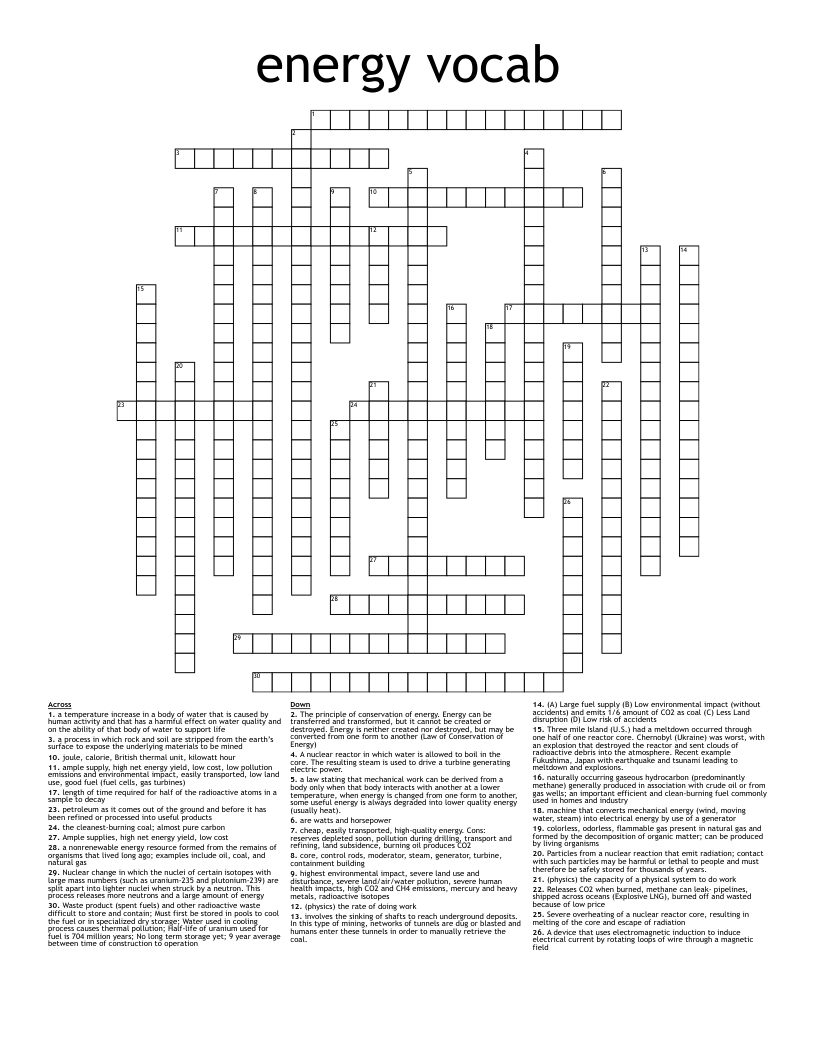
the capacity of a physical system to do work
rate of doing work
joule, calorie, british thermal unit, kilowatt hour
are watts and horsepower
machine that converts mechanical energy (wind, moving water, steam) into electrical energy by use of a generator
A device that uses electromagnetic induction to induce electrical current by rotating loops of wire through a magnetic field
The principle of conservation of energy. Energy can be transferred and transformed, but it cannot be created or destroyed. Energy is neither created nor destroyed, but may be converted from one form to another (Law of Conservation of Energy)
a law stating that mechanical work can be derived from a body only when that body interacts with another at a lower temperature, when energy is changed from one form to another, some useful energy is always degraded into lower quality energy (usually heat
nonrenewable energy resource formed from the remains of organisms that lived long ag
naturally occurring gaseous hydrocarbon (predominantly methane) generally produced in association with crude oil or from gas wells; an important efficient and clean-burning fuel commonly used in homes and industry
colorless, odorless, flammable gas present in natural gas and formed by the decomposition of organic matter; can be produced by living organisms
petroleum as it comes out of the ground and before it has been refined or processed into useful products
cleanest-burning coal; almost pure carbon
involves the sinking of shafts to reach underground deposits. In this type of mining, networks of tunnels are dug or blasted and humans enter these tunnels in order to manually retrieve the coal.
process in which rock and soil are stripped from the earth’s surface to expose the underlying materials to be mined
ample supply, high net energy yield, low cost, low pollution emissions and environmental impact, easily transported, low land use, good fuel
Releases CO2 when burned, methane can leak- pipelines, shipped across oceans (Explosive LNG), burned off and wasted because of low price
ample supplies, high net energy yield, low cost
highest environmental impact, severe land use and disturbance, severe land/air/water pollution, severe human health impacts, high CO2 and CH4 emissions, mercury and heavy metals, radioactive isotopes
cheap, easily transported, high-quality energy. Cons: reserves depleted soon, pollution during drilling, transport and refining, land subsidence, burning oil produces CO2
Nuclear change in which the nuclei of certain isotopes with large mass numbers (such as uranium-235 and plutonium-239) are split apart into lighter nuclei when struck by a neutron. This process releases more neutrons and a large amount of energy
core, control rods, moderator, steam, generator, turbine, containment building
nuclear reactor in which water is allowed to boil in the core. The resulting steam is used to drive a turbine generating electric powe
large fuel supply, low environmental impact and emits 1/6 amount of CO2 as coal, less land disruption, low risk of accidents
Waste product (spent fuels) and other radioactive waste difficult to store and contain; Must first be stored in pools to cool the fuel or in specialized dry storage; Water used in cooling process causes thermal pollution; Half-life of uranium used for fuel is 704 million years
length of time required for half of the radioactive atoms in a sample to decay
severe overheating of a nuclear reactor core, resulting in melting of the core and escape radiation
a temperature increase in a body of water that is caused by human activity and that has a harmful effect on water quality and on the ability of that body of water to support life
Three mile Island (U.S.) had a meltdown occurred through one half of one reactor core. Chernobyl (Ukraine) was worst, with an explosion that destroyed the reactor and sent clouds of radioactive debris into the atmosphere. Recent example Fukushima, Japan with earthquake and tsunami leading to meltdown and explosions.
Particles from a nuclear reaction that emit radiation; contact with such particles may be harmful or lethal to people and must therefore be safely stored for thousands of years.
2 isotopes of light elements (H) forced together at high temperatures till they fuse to form a heavier nucleus. Happens in the Sun, very difficult to accomplish on Earth, prohibitively expensive.