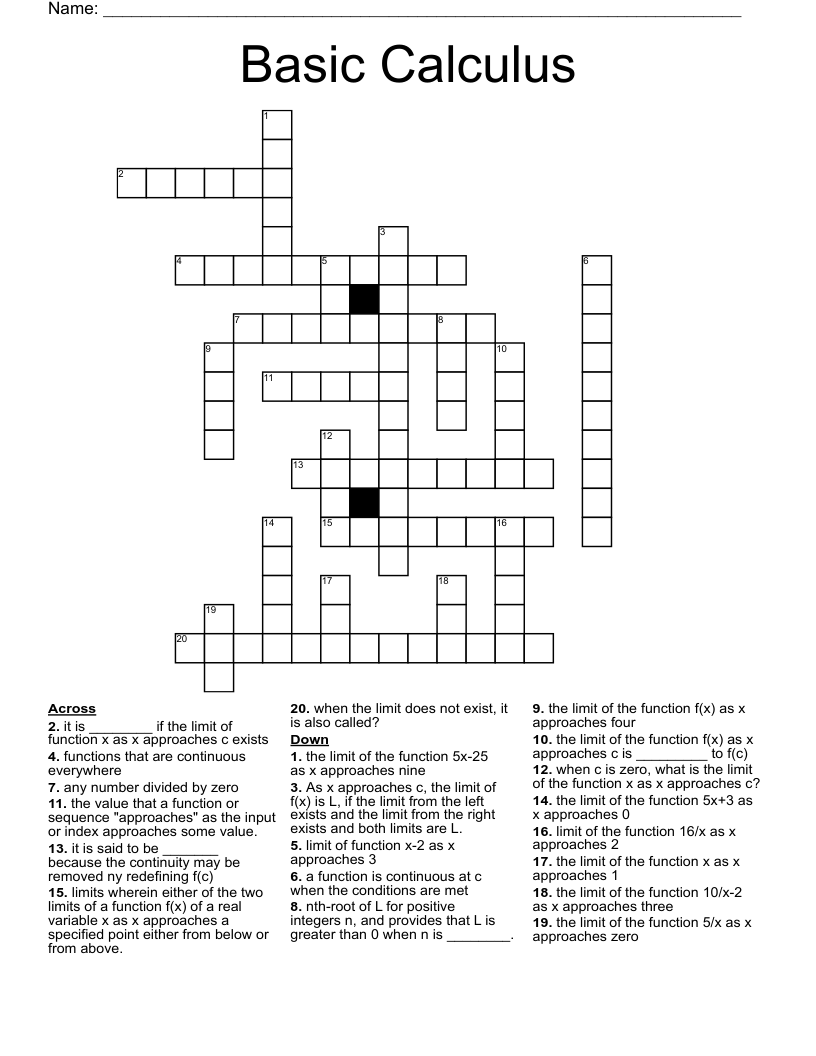
BASIC CALCULUS Crossword
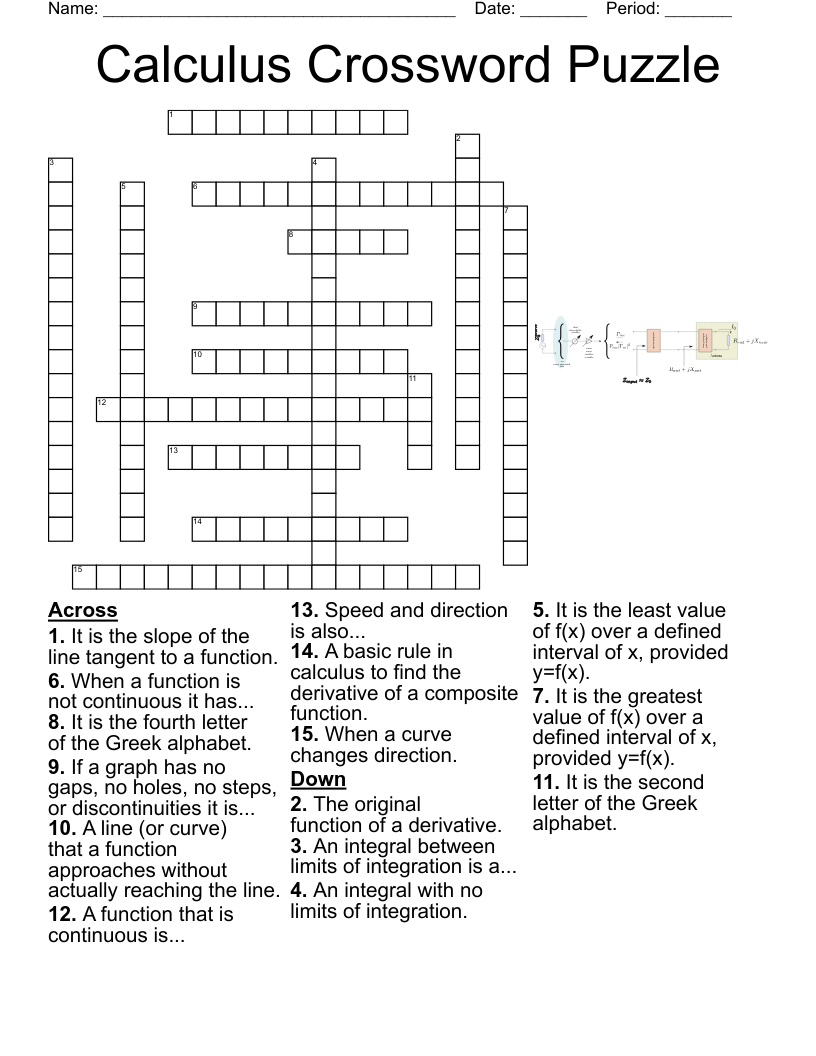
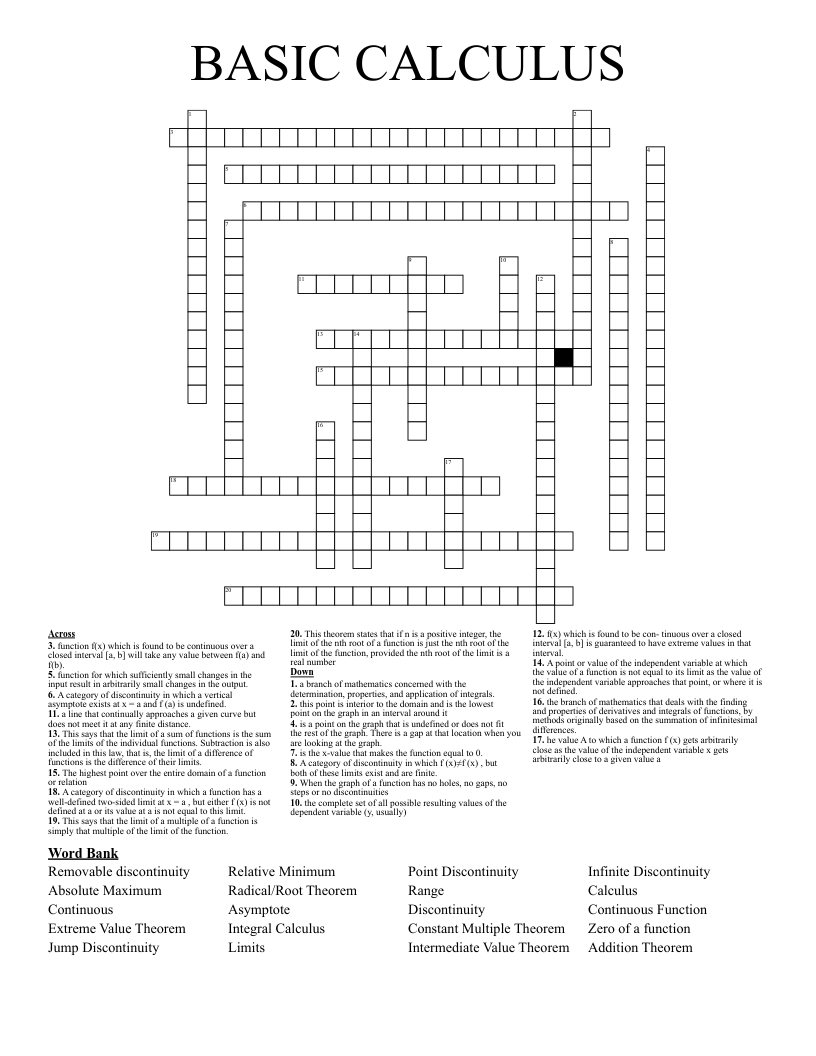
This printable crossword puzzle on the topic of Calculus & Pre-Calculus has 20 clues. Answers range from 5 to 24 letters long. This crossword is also available to download as a Microsoft Word document or a PDF.
Description
When the graph of a function has no holes, no gaps, no steps or no discontinuities
A point or value of the independent variable at which the value of a function is not equal to its limit as the value of the independent variable approaches that point, or where it is not defined.
he value A to which a function f (x) gets arbitrarily close as the value of the independent variable x gets arbitrarily close to a given value a
A category of discontinuity in which f (x)≠f (x) , but both of these limits exist and are finite.
A category of discontinuity in which a vertical asymptote exists at x = a and f (a) is undefined.
A category of discontinuity in which a function has a well-defined two-sided limit at x = a , but either f (x) is not defined at a or its value at a is not equal to this limit.
is a point on the graph that is undefined or does not fit the rest of the graph. There is a gap at that location when you are looking at the graph.
is the x-value that makes the function equal to 0.
The highest point over the entire domain of a function or relation
this point is interior to the domain and is the lowest point on the graph in an interval around it
function for which sufficiently small changes in the input result in arbitrarily small changes in the output.
the branch of mathematics that deals with the finding and properties of derivatives and integrals of functions, by methods originally based on the summation of infinitesimal differences.
a branch of mathematics concerned with the determination, properties, and application of integrals.
This says that the limit of a multiple of a function is simply that multiple of the limit of the function.
This says that the limit of a sum of functions is the sum of the limits of the individual functions. Subtraction is also included in this law, that is, the limit of a difference of functions is the difference of their limits.
This theorem states that if n is a positive integer, the limit of the nth root of a function is just the nth root of the limit of the function, provided the nth root of the limit is a real number
function f(x) which is found to be continuous over a closed interval [a, b] will take any value between f(a) and f(b).
f(x) which is found to be con- tinuous over a closed interval [a, b] is guaranteed to have extreme values in that interval.
the complete set of all possible resulting values of the dependent variable (y, usually)
a line that continually approaches a given curve but does not meet it at any finite distance.