APES Unit 4 Vocabulary Crossword
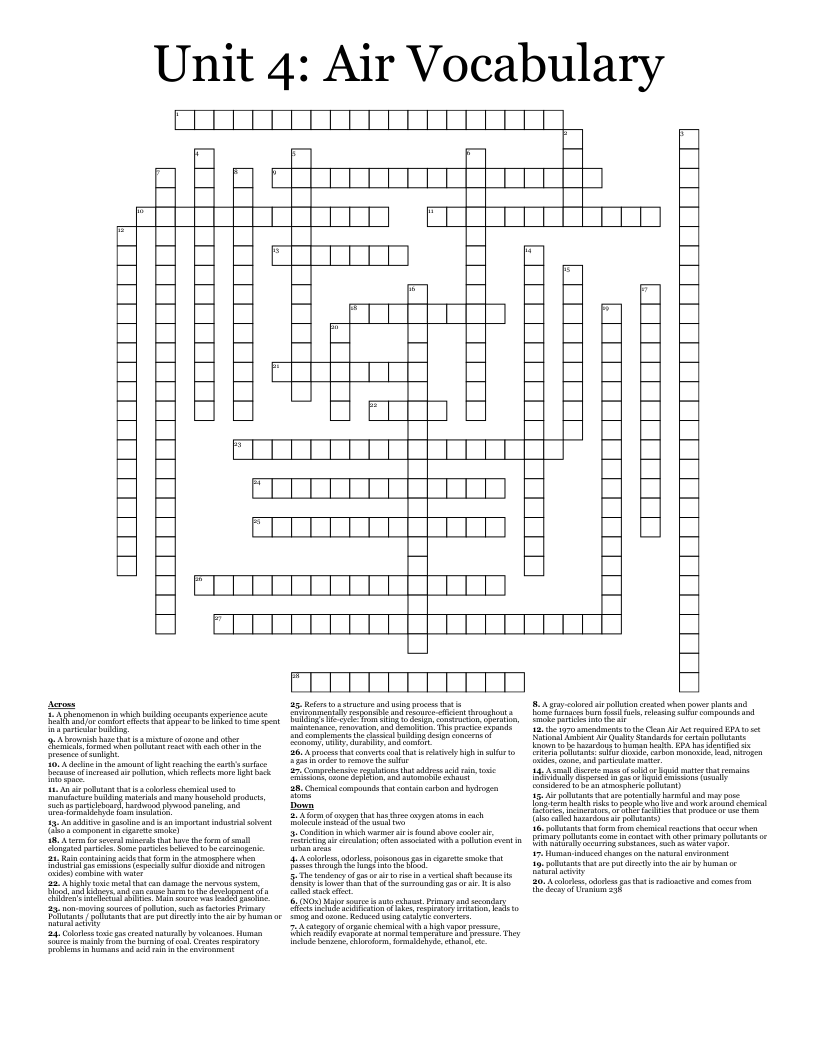
This printable crossword puzzle on the topic of Environmental Science has 28 clues. Answers range from 4 to 24 letters long. This crossword is also available to download as a Microsoft Word document or a PDF.
Description
non-moving sources of pollution, such as factories.
pollutants that are put directly into the air by human or natural activity.
pollutants that form from chemical reactions that occur when primary pollutants come in contact with other primary pollutants or with naturally occurring substances, such as water vapor.
the 1970 amendments to the Clean Air Act required EPA to set National Ambient Air Quality Standards for certain pollutants known to be hazardous to human health. EPA has identified six criteria pollutants: sulfur dioxide, carbon monoxide, lead, nitrogen oxides, ozone, and particulate matter.
Air pollutants that are potentially harmful and may pose long-term health risks to people who live and work around chemical factories, incinerators, or other facilities that produce or use them (also called hazardous air pollutants).
A form of oxygen that has three oxygen atoms in each molecule instead of the usual two.
Colorless toxic gas created naturally by volcanoes. Human source is mainly from the burning of coal. Creates respiratory problems in humans and acid rain in the environment
(NOx) Major source is auto exhaust. Primary and secondary effects include acidification of lakes, respiratory irritation, leads to smog and ozone. Reduced using catalytic converters.
A colorless, odorless, poisonous gas in cigarette smoke that passes through the lungs into the blood.
A small discrete mass of solid or liquid matter that remains individually dispersed in gas or liquid emissions (usually considered to be an atmospheric pollutant)
A highly toxic metal that can damage the nervous system, blood, and kidneys, and can cause harm to the development of a children's intellectual abilities. Main source was leaded gasoline.
A category of organic chemical with a high vapor pressure, which readily evaporate at normal temperature and pressure. They include benzene, chloroform, formaldehyde, ethanol, etc.
Chemical compounds that contain carbon and hydrogen atoms.
Rain containing acids that form in the atmosphere when industrial gas emissions (especially sulfur dioxide and nitrogen oxides) combine with water.
A decline in the amount of light reaching the earth's surface because of increased air pollution, which reflects more light back into space.
A process that converts coal that is relatively high in sulfur to a gas in order to remove the sulfur
An additive in gasoline and is an important industrial solvent (also a component in cigarette smoke)
Condition in which warmer air is found above cooler air, restricting air circulation; often associated with a pollution event in urban areas
A brownish haze that is a mixture of ozone and other chemicals, formed when pollutants react with each other in the presence of sunlight
A gray-colored air pollution created when power plants and home furnaces burn fossil fuels, releasing sulfur compounds and smoke particles into the air
Comprehensive regulations that address acid rain, toxic emissions, ozone depletion, and automobile exhaust
Human-induced changes on the natural environment
A term for several minerals that have the form of small elongated particles. Some particles believed to be carcinogenic
A colorless, odorless gas that is radioactiveand comes from the decay of Uranium 238
The tendency of gas or air to rise in a vertical shaft because its density is lower than that of the surrounding gas or air. It is also called stack effect.
A phenomenon in which building occupants experience acute health and/or comfort effects that appear to be linked to time spent in a particular building.
Refers to a structure and using process that is environmentally responsible and resource-efficient throughout a building's life-cycle: from siting to design, construction, operation, maintenance, renovation, and demolition. This practice expands and complements the classical building design concerns of economy, utility, durability, and comfort.
An air pollutant that is a colorless chemical used to manufacture building materials and many household products, such as particleboard, hardwood plywood paneling, and urea-formaldehyde foam insulation.