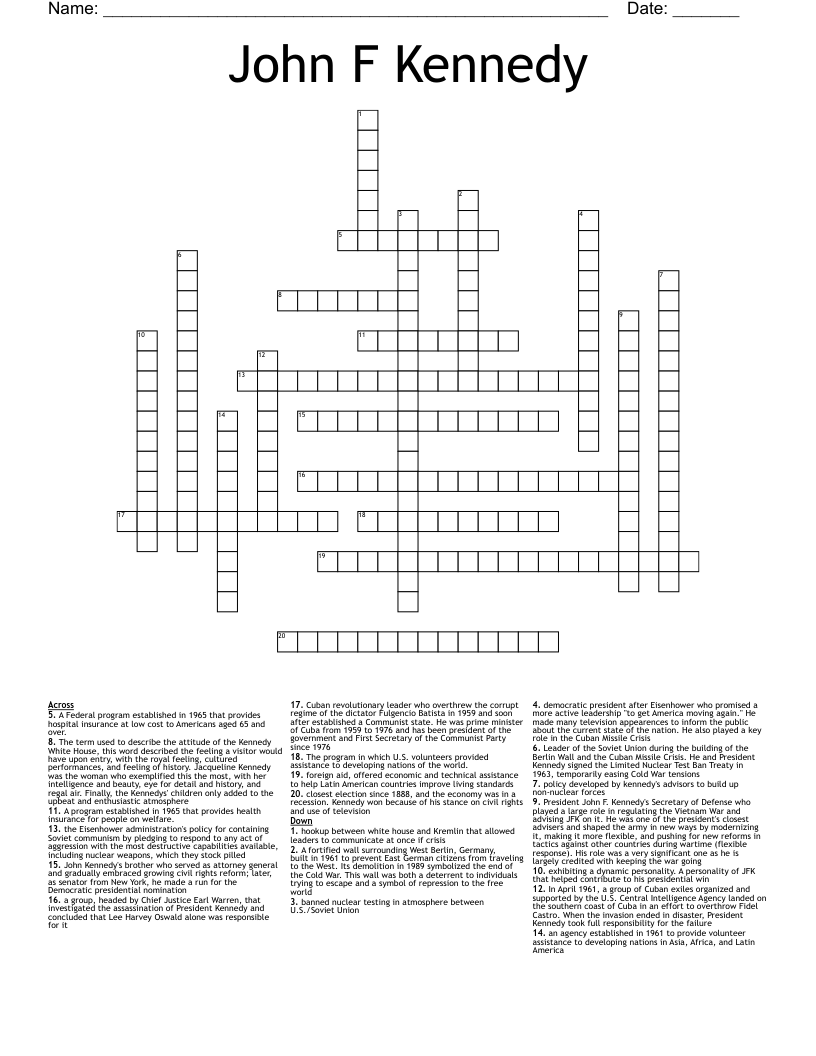
John F Kennedy Crossword
This printable crossword puzzle on the topic of US History (General) has 20 clues. Answers range from 7 to 20 letters long. This crossword is also available to download as a Microsoft Word document or a PDF.
Description
policy developed by kennedy's advisors to build up non-nuclear forces
hookup between white house and Kremlin that allowed leaders to communicate at once if crisis
banned nuclear testing in atmosphere between U.S./Soviet Union
foreign aid, offered economic and technical assistance to help Latin American countries improve living standards
closest election since 1888, and the economy was in a recession. Kennedy won because of his stance on civil rights and use of television
democratic president after Eisenhower who promised a more active leadership "to get America moving again." He made many television appearences to inform the public about the current state of the nation. He also played a key role in the Cuban Missile Crisis
exhibiting a dynamic personality. A personality of JFK that helped contribute to his presidential win
John Kennedy's brother who served as attorney general and gradually embraced growing civil rights reform; later, as senator from New York, he made a run for the Democratic presidential nomination
The term used to describe the attitude of the Kennedy White House, this word described the feeling a visitor would have upon entry, with the royal feeling, cultured performances, and feeling of history. Jacqueline Kennedy was the woman who exemplified this the most, with her intelligence and beauty, eye for detail and history, and regal air. Finally, the Kennedys' children only added to the upbeat and enthusiastic atmosphere
President John F. Kennedy's Secretary of Defense who played a large role in regulating the Vietnam War and advising JFK on it. He was one of the president's closest advisers and shaped the army in new ways by modernizing it, making it more flexible, and pushing for new reforms in tactics against other countries during wartime (flexible response). His role was a very significant one as he is largely credited with keeping the war going
the Eisenhower administration's policy for containing Soviet communism by pledging to respond to any act of aggression with the most destructive capabilities available, including nuclear weapons, which they stock pilled
Cuban revolutionary leader who overthrew the corrupt regime of the dictator Fulgencio Batista in 1959 and soon after established a Communist state. He was prime minister of Cuba from 1959 to 1976 and has been president of the government and First Secretary of the Communist Party since 1976
In April 1961, a group of Cuban exiles organized and supported by the U.S. Central Intelligence Agency landed on the southern coast of Cuba in an effort to overthrow Fidel Castro. When the invasion ended in disaster, President Kennedy took full responsibility for the failure
Leader of the Soviet Union during the building of the Berlin Wall and the Cuban Missile Crisis. He and President Kennedy signed the Limited Nuclear Test Ban Treaty in 1963, temporarily easing Cold War tensions
A fortified wall surrounding West Berlin, Germany, built in 1961 to prevent East German citizens from traveling to the West. Its demolition in 1989 symbolized the end of the Cold War. This wall was both a deterrent to individuals trying to escape and a symbol of repression to the free world
an agency established in 1961 to provide volunteer assistance to developing nations in Asia, Africa, and Latin America
a group, headed by Chief Justice Earl Warren, that investigated the assassination of President Kennedy and concluded that Lee Harvey Oswald alone was responsible for it
The program in which U.S. volunteers provided assistance to developing nations of the world.
A Federal program established in 1965 that provides hospital insurance at low cost to Americans aged 65 and over.
A program established in 1965 that provides health insurance for people on welfare.