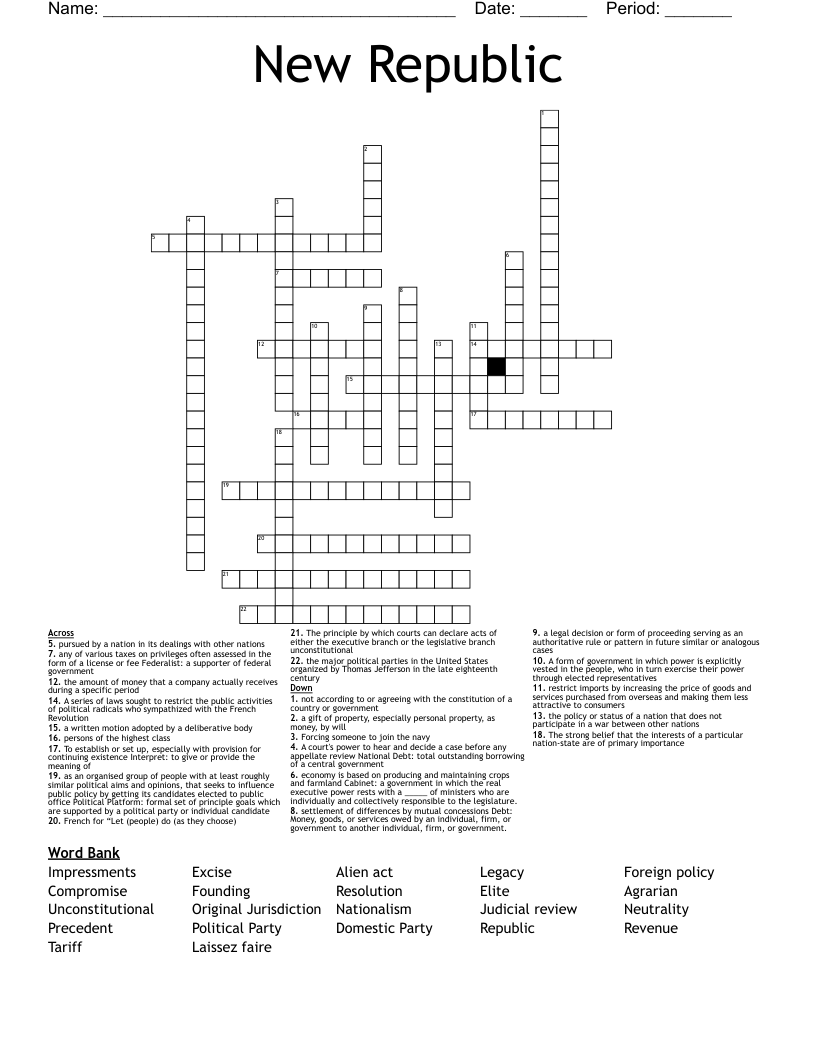
New Republic Crossword
This printable crossword puzzle on the topic of US History (General) has 22 clues. Answers range from 5 to 20 letters long. This crossword is also available to download as a Microsoft Word document or a PDF.
Description
A series of laws sought to restrict the public activities of political radicals who sympathized with the French Revolution
economy is based on producing and maintaining crops and farmland Cabinet: a government in which the real executive power rests with a _____ of ministers who are individually and collectively responsible to the legislature.
settlement of differences by mutual concessions Debt: Money, goods, or services owed by an individual, firm, or government to another individual, firm, or government.
persons of the highest class
any of various taxes on privileges often assessed in the form of a license or fee Federalist: a supporter of federal government
To establish or set up, especially with provision for continuing existence Interpret: to give or provide the meaning of
Forcing someone to join the navy
a gift of property, especially personal property, as money, by will
French for “Let (people) do (as they choose)
A court's power to hear and decide a case before any appellate review National Debt: total outstanding borrowing of a central government
The strong belief that the interests of a particular nation-state are of primary importance
the policy or status of a nation that does not participate in a war between other nations
as an organised group of people with at least roughly similar political aims and opinions, that seeks to influence public policy by getting its candidates elected to public office Political Platform: formal set of principle goals which are supported by a political party or individual candidate
a legal decision or form of proceeding serving as an authoritative rule or pattern in future similar or analogous cases
A form of government in which power is explicitly vested in the people, who in turn exercise their power through elected representatives
a written motion adopted by a deliberative body
the amount of money that a company actually receives during a specific period
restrict imports by increasing the price of goods and services purchased from overseas and making them less attractive to consumers
not according to or agreeing with the constitution of a country or government
the major political parties in the United States organized by Thomas Jefferson in the late eighteenth century
pursued by a nation in its dealings with other nations
The principle by which courts can declare acts of either the executive branch or the legislative branch unconstitutional