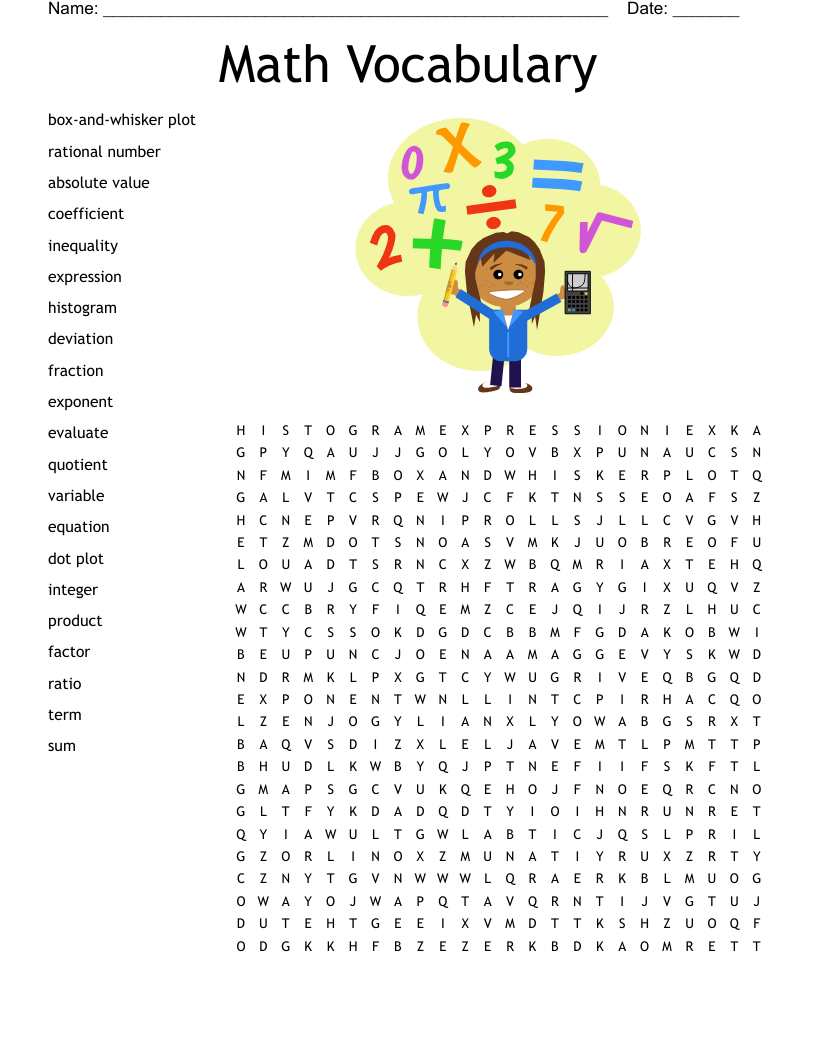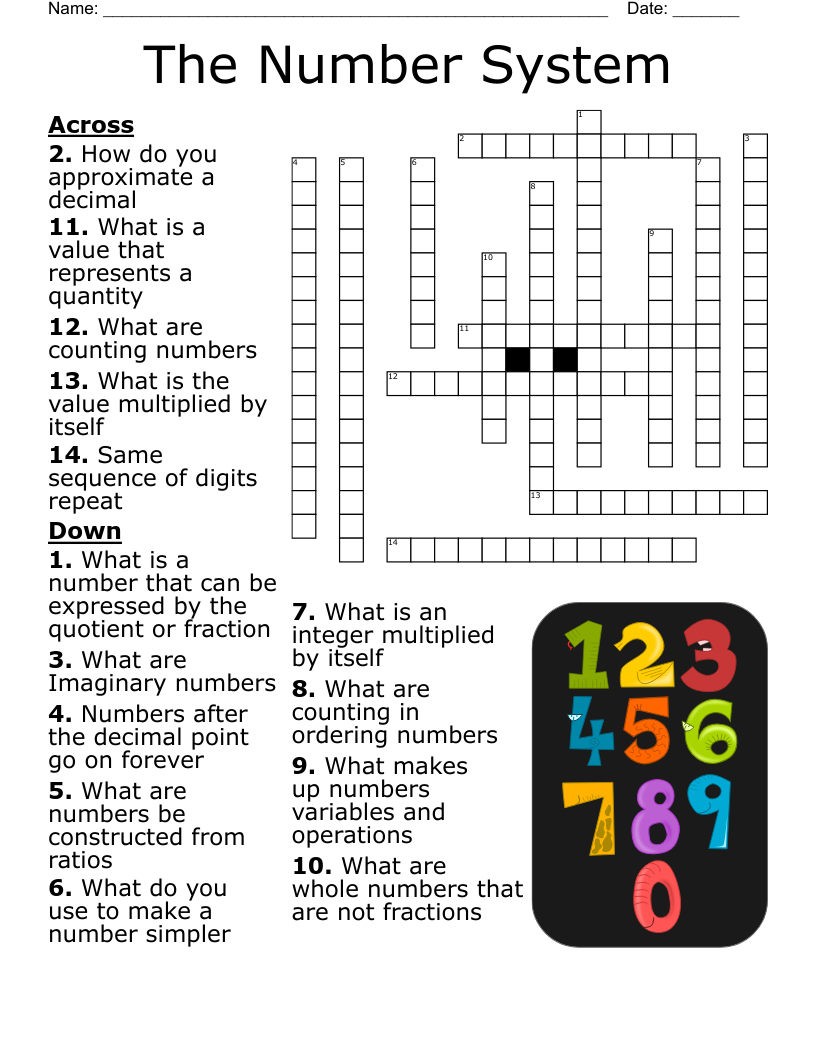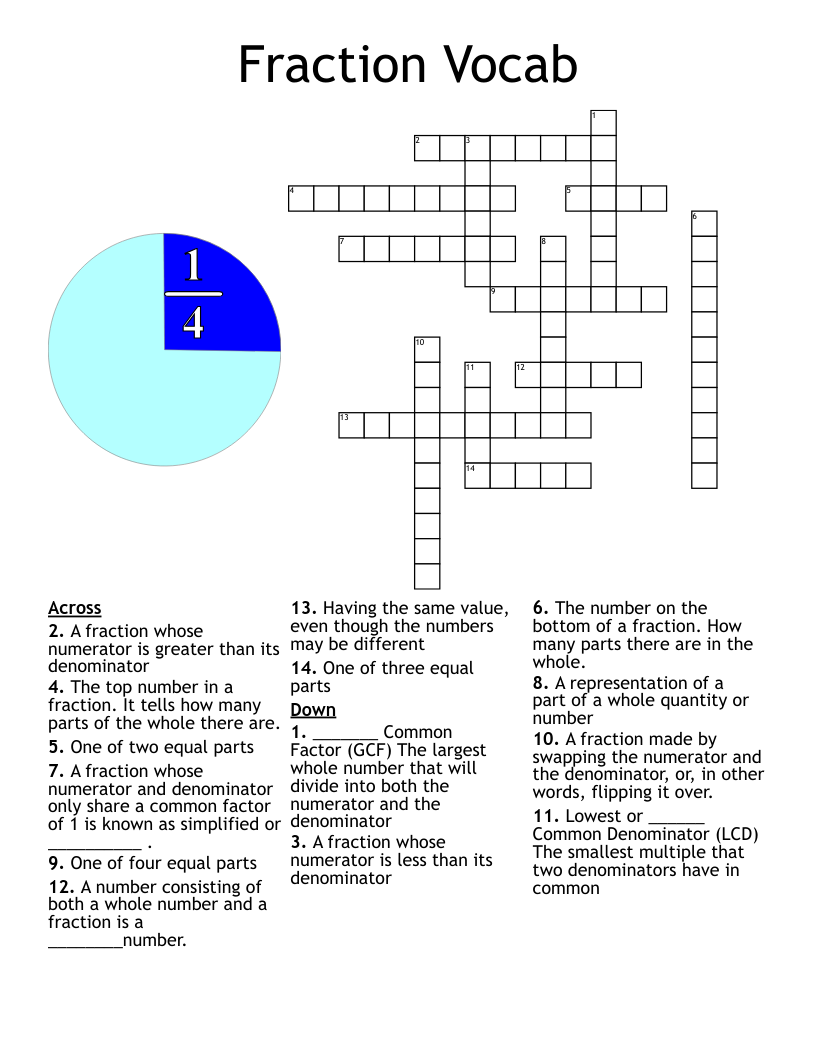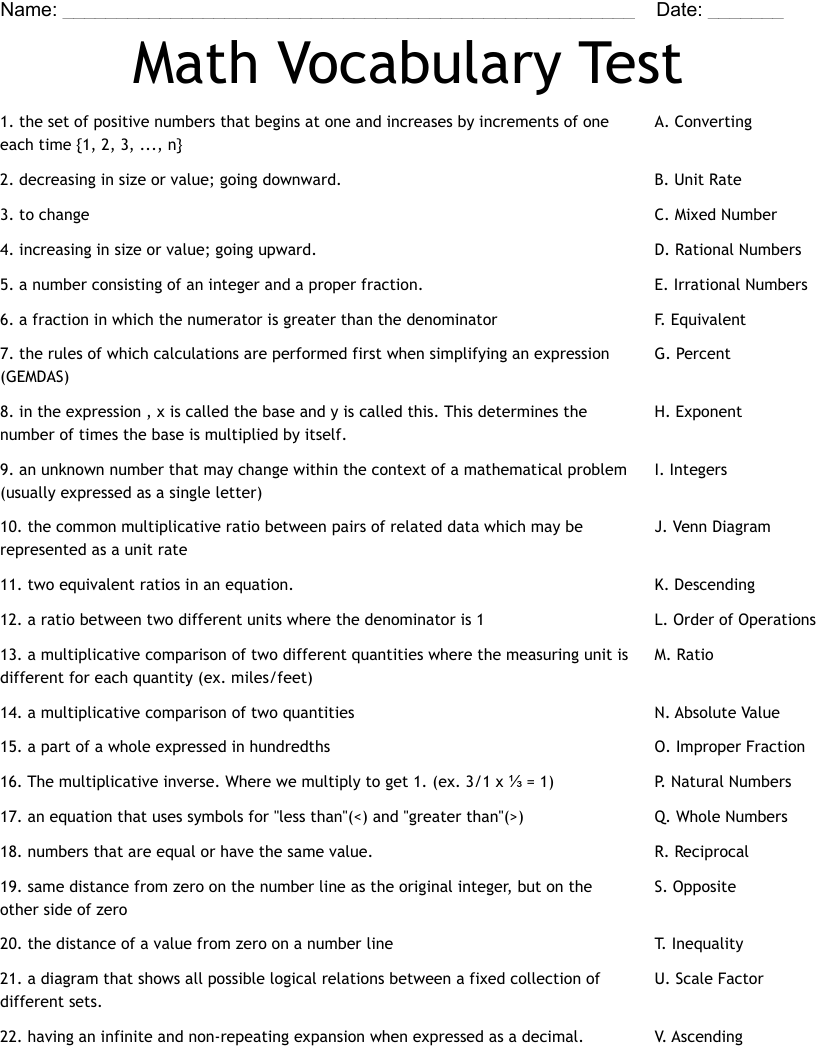
Math Vocabulary Test Worksheet
This printable matching worksheet on the topic of Arithmetic & Numbers has 25 questions and answers to match. This matching worksheet is also available to download as a Microsoft Word document or a PDF.
Description
the set of positive numbers that begins at one and increases by increments of one each time {1, 2, 3, ..., n}
decreasing in size or value; going downward.
to change
increasing in size or value; going upward.
a number consisting of an integer and a proper fraction.
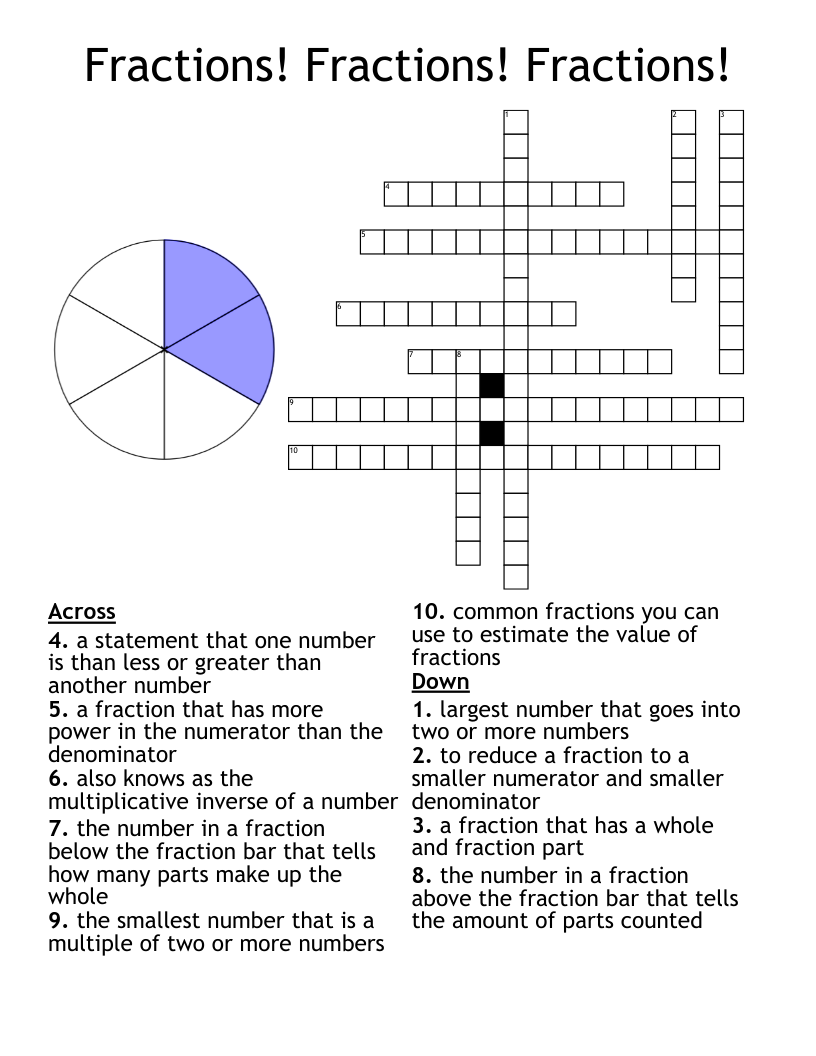
a fraction in which the numerator is greater than the denominator
the rules of which calculations are performed first when simplifying an expression (GEMDAS)
in the expression , x is called the base and y is called this. This determines the number of times the base is multiplied by itself.
an unknown number that may change within the context of a mathematical problem (usually expressed as a single letter)
the common multiplicative ratio between pairs of related data which may be represented as a unit rate
two equivalent ratios in an equation.
a ratio between two different units where the denominator is 1
a multiplicative comparison of two different quantities where the measuring unit is different for each quantity (ex. miles/feet)
a multiplicative comparison of two quantities
a part of a whole expressed in hundredths
The multiplicative inverse. Where we multiply to get 1. (ex. 3/1 x ⅓ = 1)
an equation that uses symbols for "less than"(<) and "greater than"(>)
numbers that are equal or have the same value.
same distance from zero on the number line as the original integer, but on the other side of zero
the distance of a value from zero on a number line
a diagram that shows all possible logical relations between a fixed collection of different sets.
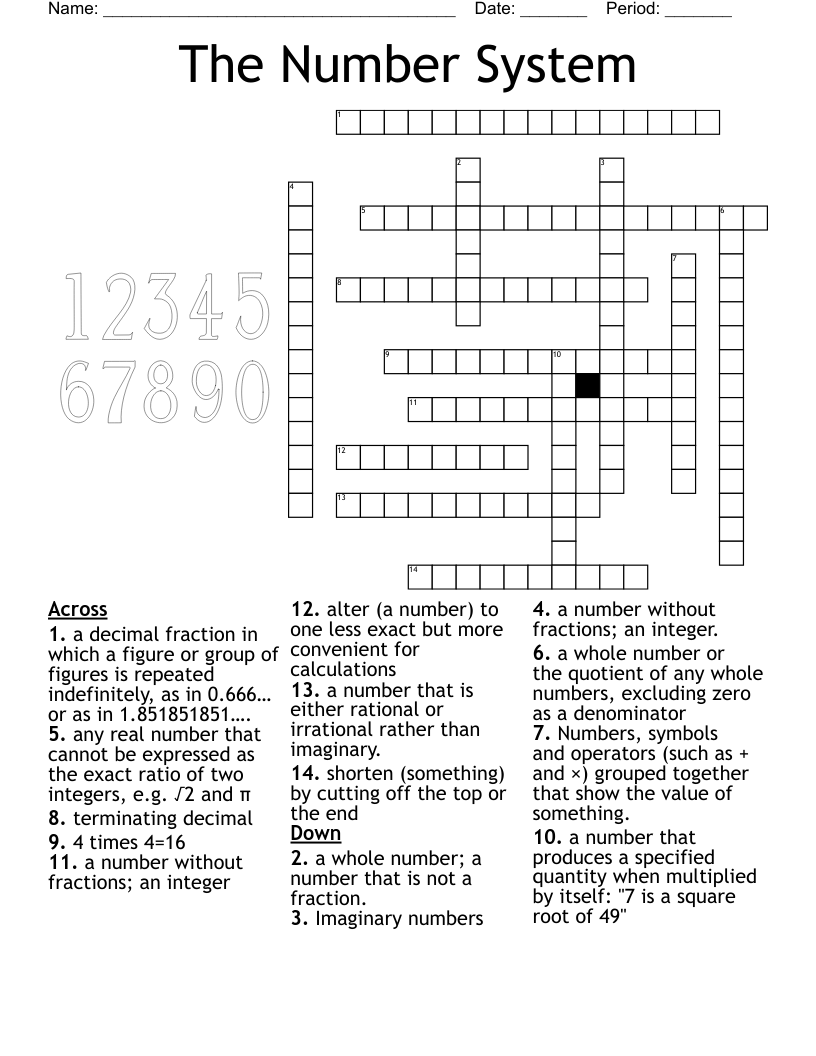
having an infinite and non-repeating expansion when expressed as a decimal.
the set of counting (natural) numbers, their opposites, zero, and numbers that can be expressed as a fraction or decimal.
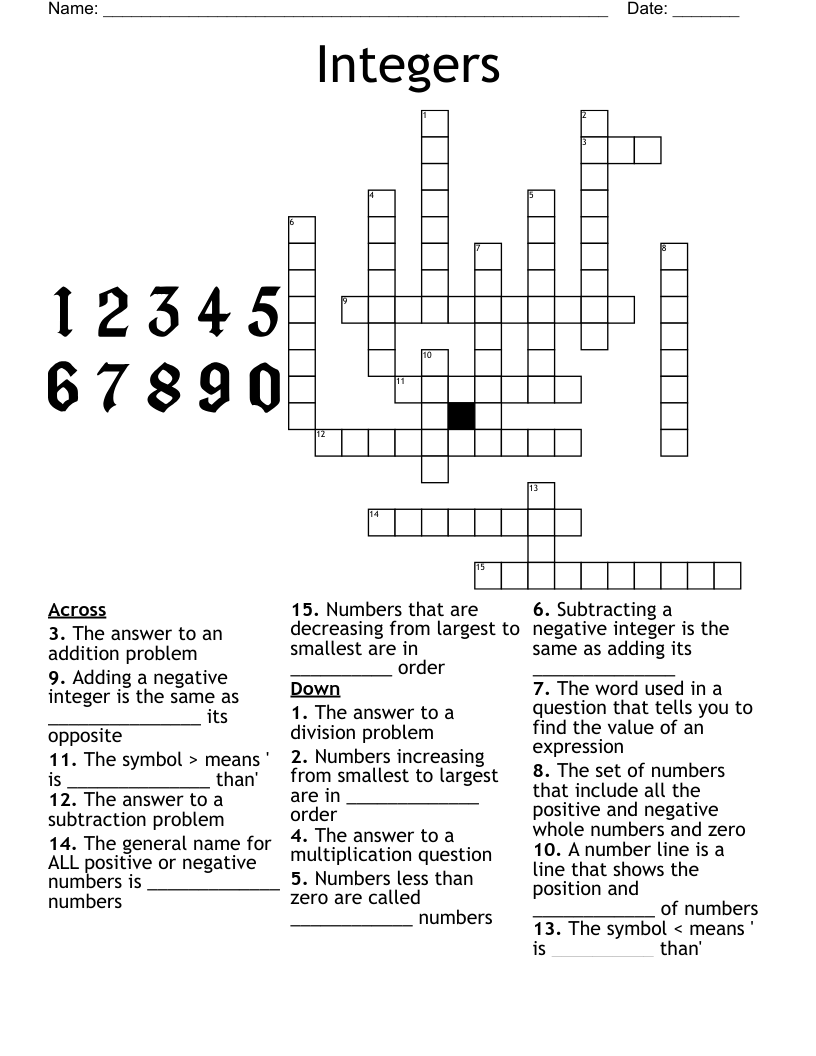
the set of counting (natural) numbers, their opposites, and zero {–n, …, –3, –2, –1, 0, 1, 2, 3, ..., n}
the set of counting (natural) numbers and zero {0, 1, 2, 3, ..., n}