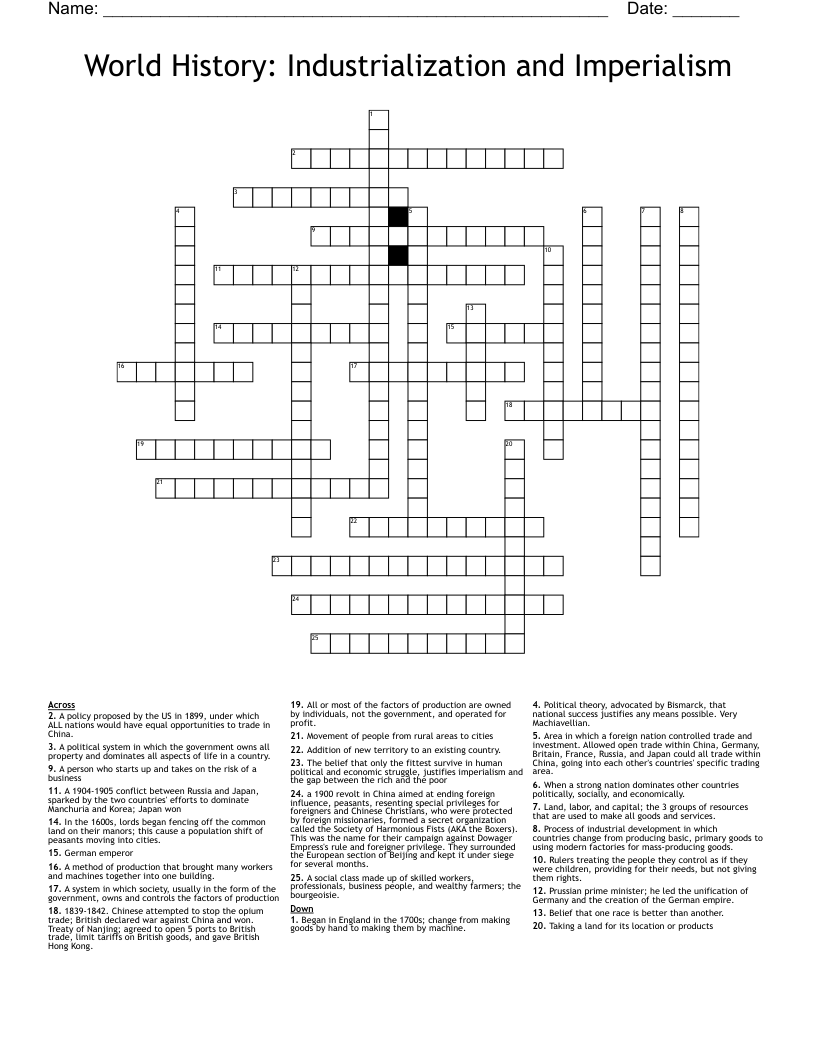
World History: Industrialization and Imperialism Crossword
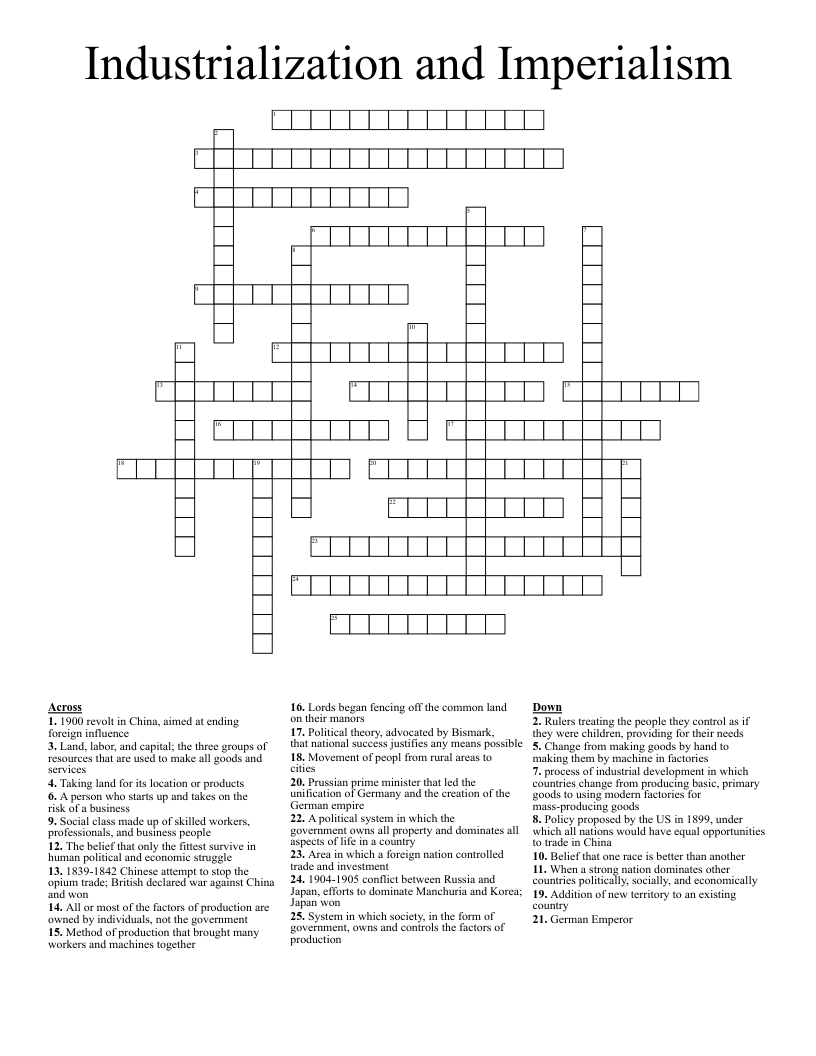
This printable crossword puzzle on the topic of World History (General) has 25 clues. Answers range from 6 to 20 letters long. This crossword is also available to download as a Microsoft Word document or a PDF.
Description
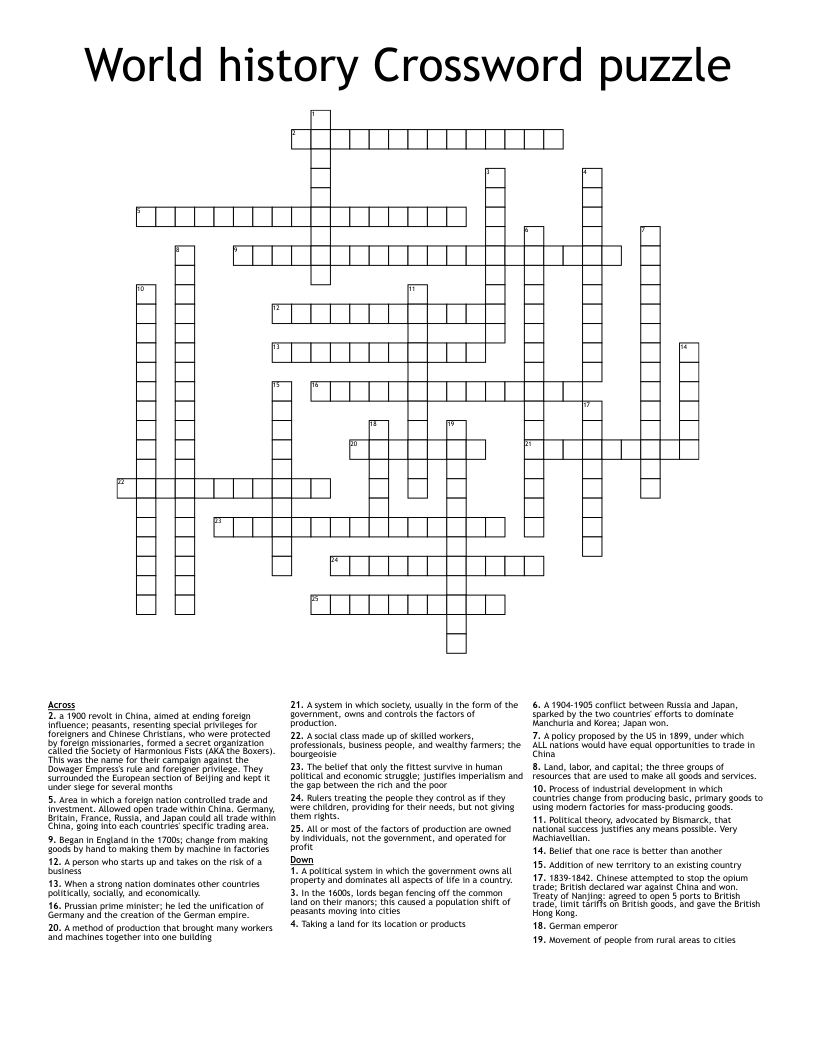
Land, labor, and capital; the 3 groups of resources that are used to make all goods and services.
Process of industrial development in which countries change from producing basic, primary goods to using modern factories for mass-producing goods.
A social class made up of skilled workers, professionals, business people, and wealthy farmers; the bourgeoisie.
Addition of new territory to an existing country.
A policy proposed by the US in 1899, under which ALL nations would have equal opportunities to trade in China.
1839-1842. Chinese attempted to stop the opium trade; British declared war against China and won. Treaty of Nanjing; agreed to open 5 ports to British trade, limit tariffs on British goods, and gave British Hong Kong.
Prussian prime minister; he led the unification of Germany and the creation of the German empire.
Began in England in the 1700s; change from making goods by hand to making them by machine.
A method of production that brought many workers and machines together into one building.
In the 1600s, lords began fencing off the common land on their manors; this cause a population shift of peasants moving into cities.
Movement of people from rural areas to cities
A person who starts up and takes on the risk of a business
A system in which society, usually in the form of the government, owns and controls the factors of production
All or most of the factors of production are owned by individuals, not the government, and operated for profit.
A political system in which the government owns all property and dominates all aspects of life in a country.
Rulers treating the people they control as if they were children, providing for their needs, but not giving them rights.
When a strong nation dominates other countries politically, socially, and economically.
Belief that one race is better than another.
The belief that only the fittest survive in human political and economic struggle, justifies imperialism and the gap between the rich and the poor
Area in which a foreign nation controlled trade and investment. Allowed open trade within China, Germany, Britain, France, Russia, and Japan could all trade within China, going into each other's countries' specific trading area.
Taking a land for its location or products
A 1904-1905 conflict between Russia and Japan, sparked by the two countries' efforts to dominate Manchuria and Korea; Japan won
a 1900 revolt in China aimed at ending foreign influence, peasants, resenting special privileges for foreigners and Chinese Christians, who were protected by foreign missionaries, formed a secret organization called the Society of Harmonious Fists (AKA the Boxers). This was the name for their campaign against Dowager Empress's rule and foreigner privilege. They surrounded the European section of Beijing and kept it under siege for several months.
Political theory, advocated by Bismarck, that national success justifies any means possible. Very Machiavellian.
German emperor