Chapter 3 Worksheet
This printable matching worksheet on the topic of Organic Chemistry & Biochemistry has 26 questions and answers to match. This matching worksheet is also available to download as a Microsoft Word document or a PDF.
Description
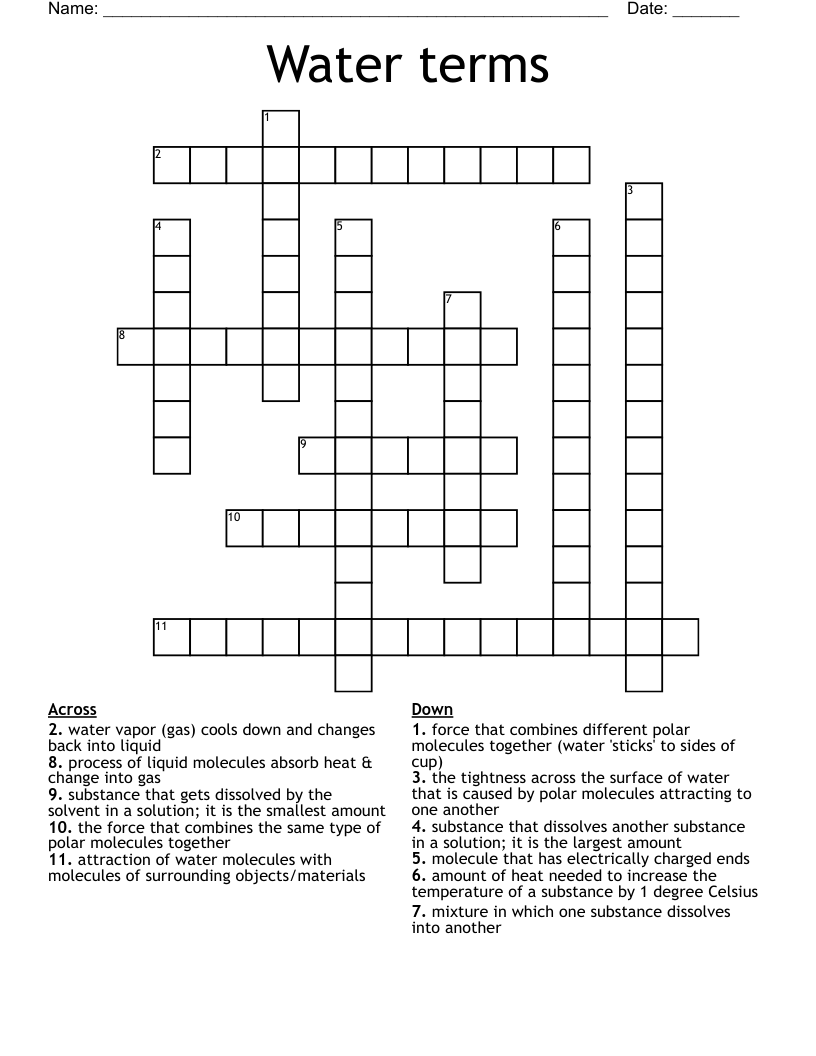
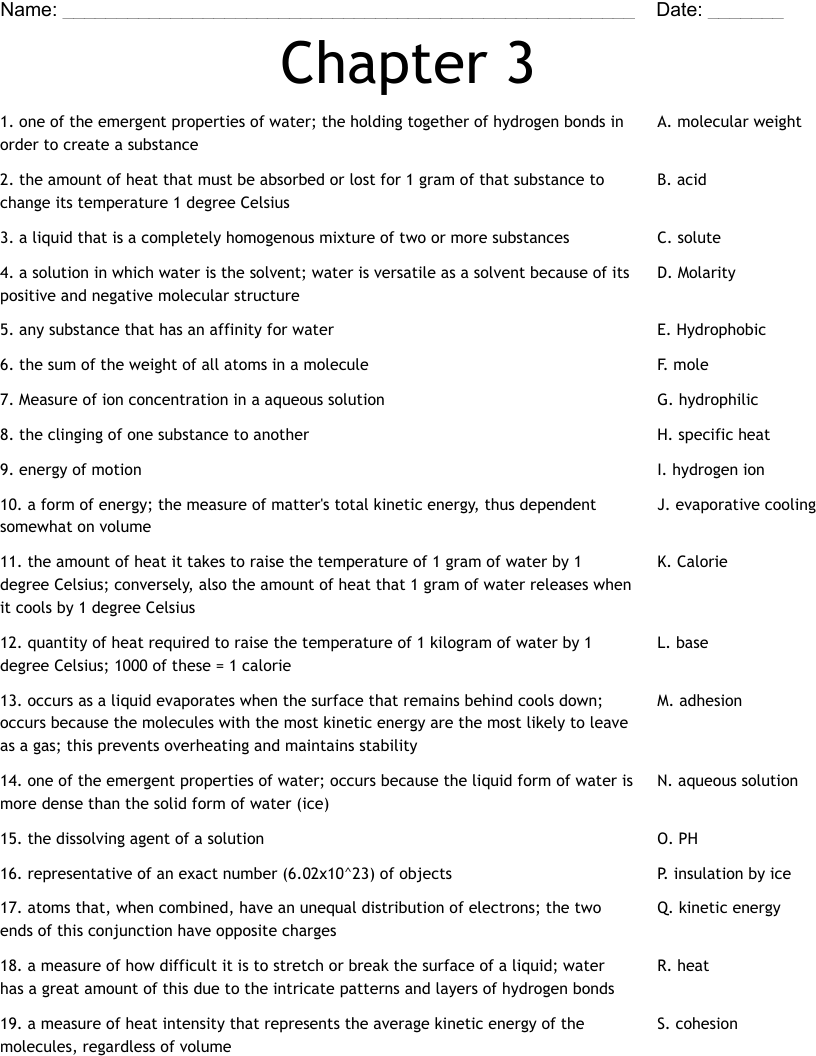
one of the emergent properties of water; the holding together of hydrogen bonds in order to create a substance
the amount of heat that must be absorbed or lost for 1 gram of that substance to change its temperature 1 degree Celsius
a liquid that is a completely homogenous mixture of two or more substances
a solution in which water is the solvent; water is versatile as a solvent because of its positive and negative molecular structure
any substance that has an affinity for water
the sum of the weight of all atoms in a molecule
Measure of ion concentration in a aqueous solution
the clinging of one substance to another
energy of motion
a form of energy; the measure of matter's total kinetic energy, thus dependent somewhat on volume
the amount of heat it takes to raise the temperature of 1 gram of water by 1 degree Celsius; conversely, also the amount of heat that 1 gram of water releases when it cools by 1 degree Celsius
quantity of heat required to raise the temperature of 1 kilogram of water by 1 degree Celsius; 1000 of these = 1 calorie
occurs as a liquid evaporates when the surface that remains behind cools down; occurs because the molecules with the most kinetic energy are the most likely to leave as a gas; this prevents overheating and maintains stability
one of the emergent properties of water; occurs because the liquid form of water is more dense than the solid form of water (ice)
the dissolving agent of a solution
representative of an exact number (6.02x10^23) of objects
atoms that, when combined, have an unequal distribution of electrons; the two ends of this conjunction have opposite charges
a measure of how difficult it is to stretch or break the surface of a liquid; water has a great amount of this due to the intricate patterns and layers of hydrogen bonds
a measure of heat intensity that represents the average kinetic energy of the molecules, regardless of volume
the substance that is dissolved in a solution
any substance that does not have an affinity for water; also, a substance that repels water, perhaps because of its inability to form hydrogen bonds
the number of moles of solute per liter of solution; unit of concentration most often used by biologists for aqueous solutions
a single gained proton of a water molecule with a charge of 1+
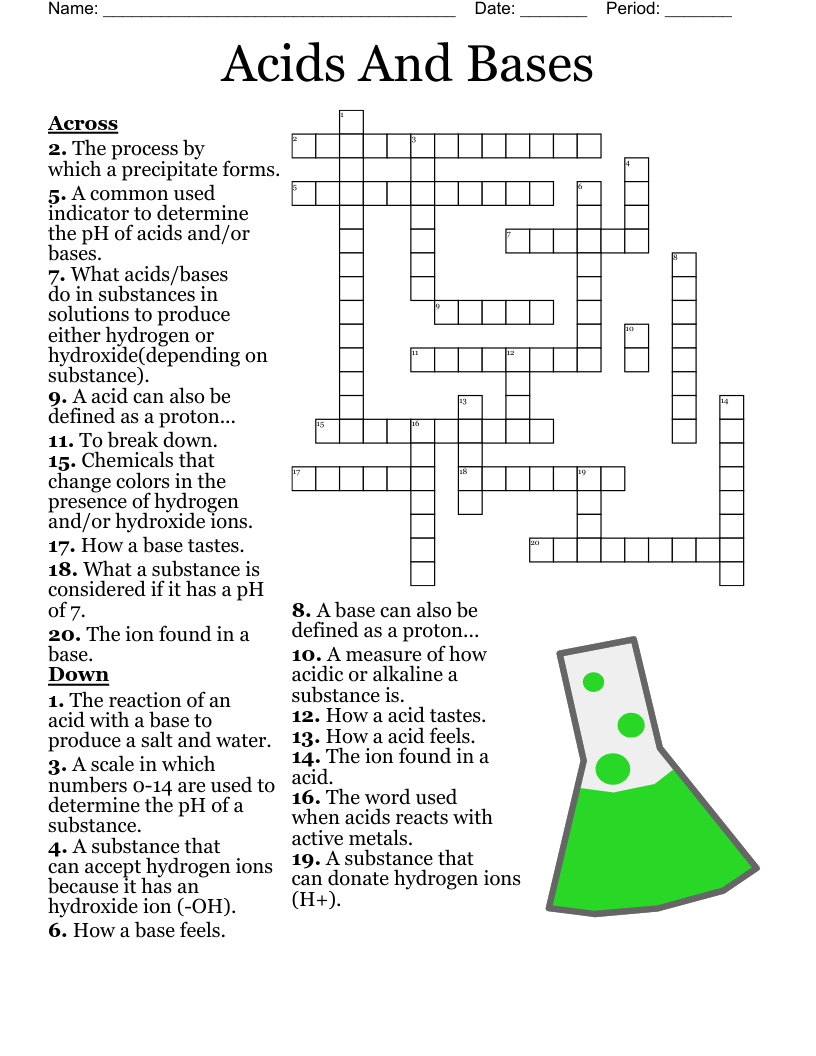
a substance that increases the hydrogen ion concentration of a solution; donates additional H+ to solutions when dissolved in water
a substance that reduces the hydrogen ion concentration of a solution; reduces H+ concentration by accepting H+ ions into itself OR by dissociation to form OH-
substances that minimize changes in the concentrations of H+ and OH- in a solution; these allow for a relatively constant pH in biological fluids by accepting H+ ions; most contain a weak acid and its corresponding base