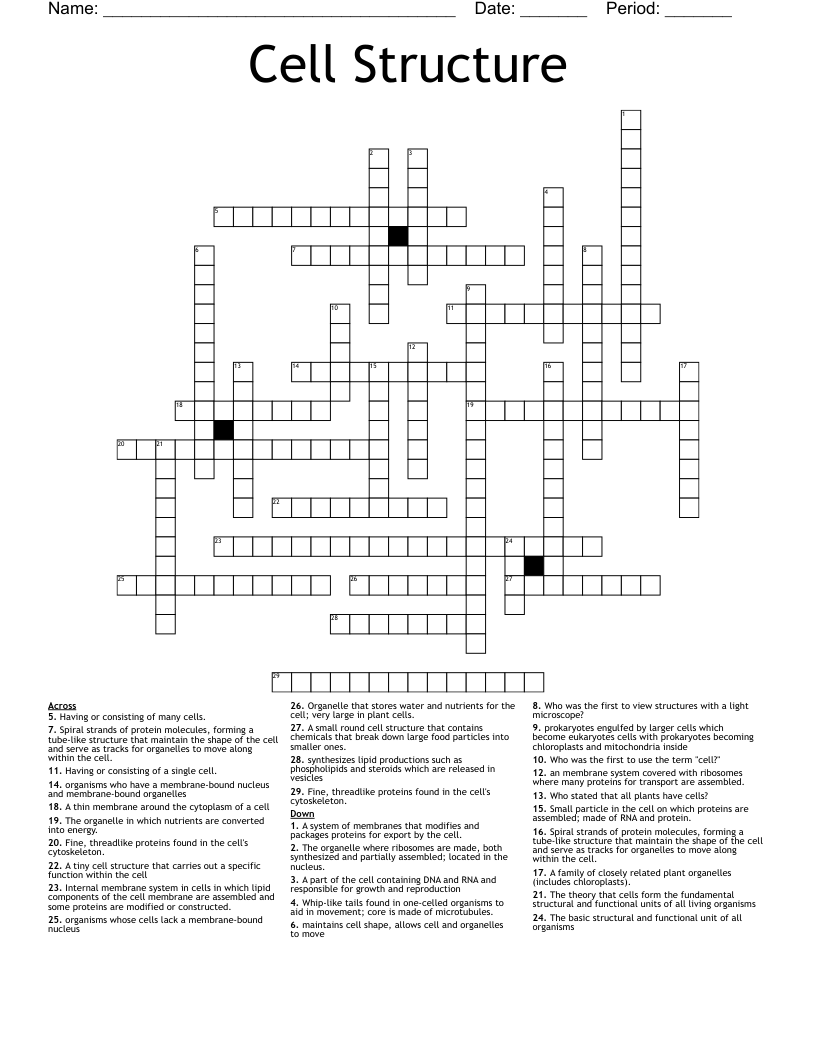
Cell Structure Crossword
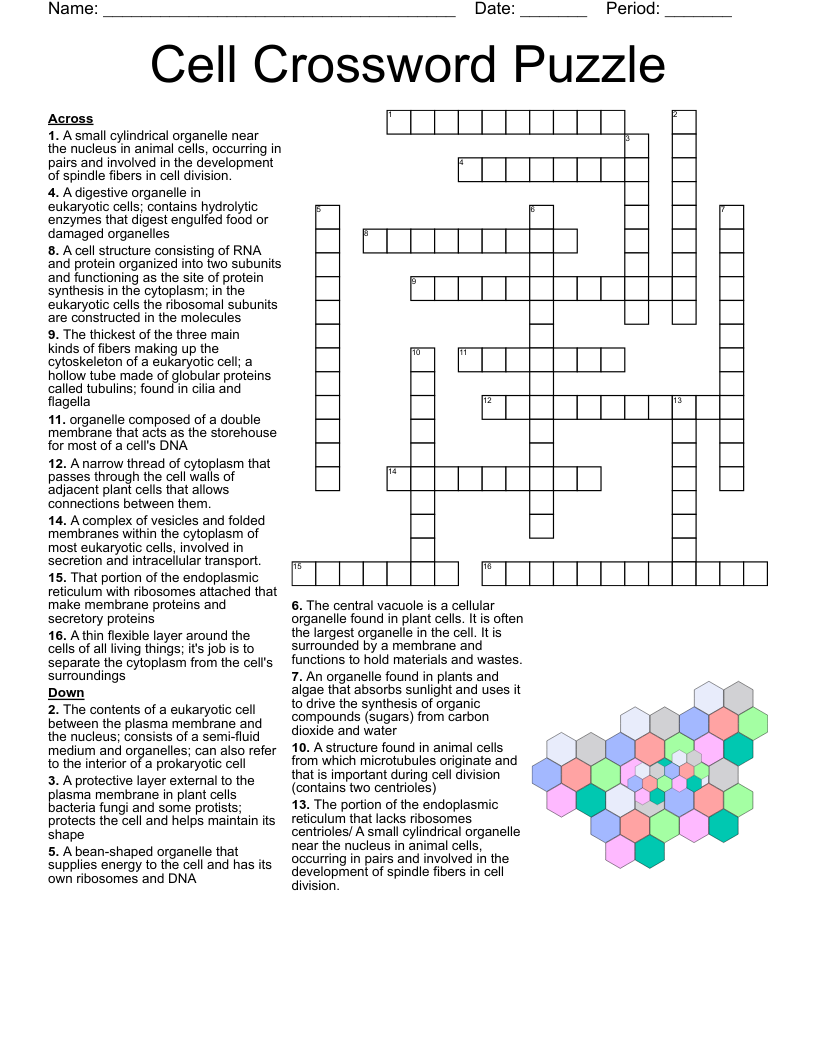
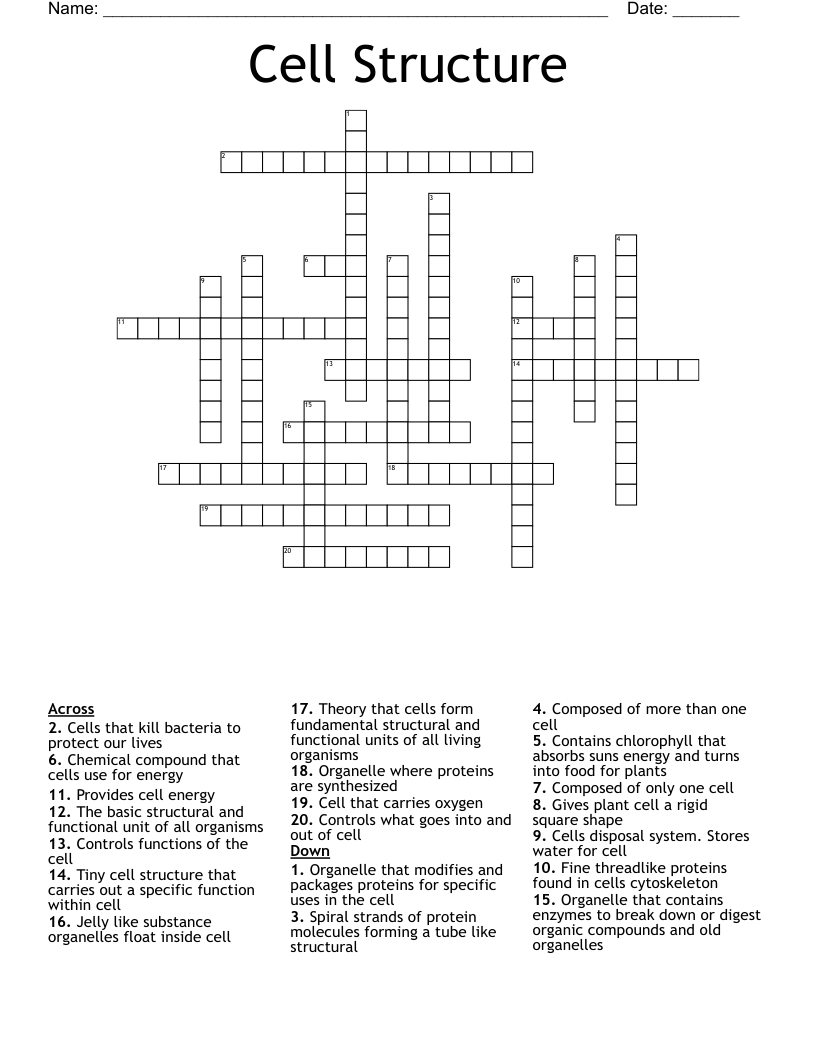
This printable crossword puzzle on the topic of Cell Biology has 29 clues. Answers range from 4 to 20 letters long. This crossword is also available to download as a Microsoft Word document or a PDF.
Description
The basic structural and functional unit of all organisms
The theory that cells form the fundamental structural and functional units of all living organisms
A tiny cell structure that carries out a specific function within the cell
A thin membrane around the cytoplasm of a cell
A part of the cell containing DNA and RNA and responsible for growth and reproduction
Spiral strands of protein molecules, forming a tube-like structure that maintain the shape of the cell and serve as tracks for organelles to move along within the cell.
Fine, threadlike proteins found in the cell's cytoskeleton.
Small particle in the cell on which proteins are assembled; made of RNA and protein.
Having or consisting of many cells.
Having or consisting of a single cell.
Internal membrane system in cells in which lipid components of the cell membrane are assembled and some proteins are modified or constructed.
A system of membranes that modifies and packages proteins for export by the cell.
A small round cell structure that contains chemicals that break down large food particles into smaller ones.
Organelle that stores water and nutrients for the cell; very large in plant cells.
The organelle in which nutrients are converted into energy.
Fine, threadlike proteins found in the cell's cytoskeleton.
Spiral strands of protein molecules, forming a tube-like structure that maintain the shape of the cell and serve as tracks for organelles to move along within the cell.
The organelle where ribosomes are made, both synthesized and partially assembled; located in the nucleus.
A family of closely related plant organelles (includes chloroplasts).
Whip-like tails found in one-celled organisms to aid in movement; core is made of microtubules.
organisms who have a membrane-bound nucleus and membrane-bound organelles
organisms whose cells lack a membrane-bound nucleus
an membrane system covered with ribosomes where many proteins for transport are assembled.
synthesizes lipid productions such as phospholipids and steroids which are released in vesicles
maintains cell shape, allows cell and organelles to move
prokaryotes engulfed by larger cells which become eukaryotes cells with prokaryotes becoming chloroplasts and mitochondria inside
Who was the first to view structures with a light microscope?
Who stated that all plants have cells?
Who was the first to use the term "cell?"